Going to College with Acne: Preparing Your Skincare for Dorm Life
Medically reviewed by Dr. Rachel Torres, MD, Pediatric Dermatologist
Written by Teen Acne Solutions Editorial Team — Updated May 28, 2026
Key takeaways
- Freshman year acne flares are extremely common. Stress, sleep deprivation, diet changes, new climate, and different water quality all hit at once.
- Transfer your prescriptions before you move. Call your new college town pharmacy 2-3 weeks before move-in day so your medications are ready when you arrive.
- Keep your routine simple enough to do in a shared bathroom at midnight. If your routine has 7 steps, it won't survive dorm life. Two or three products you'll actually use beats six you'll skip.
- Norse Organics Pimple Stopper is built for the minimal dorm setup. One product, no complicated routine, works even when your bathroom situation is chaotic.
Going to College with Acne: Preparing Your Skincare for Dorm Life

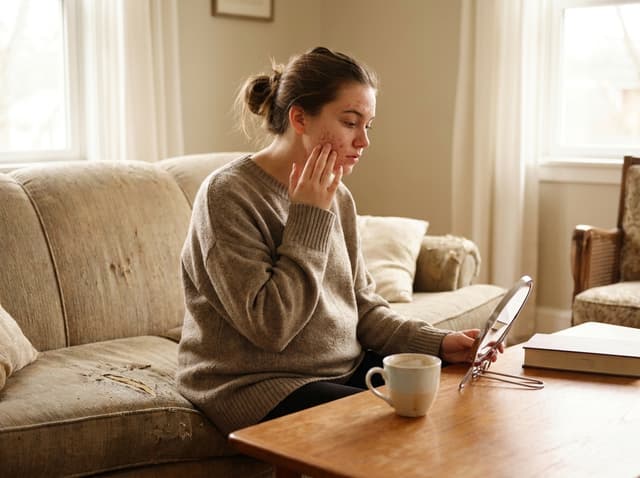
Here's what nobody warns you about freshman year: your skin might freak out. Even if you had your acne mostly under control in high school, the combination of new climate, new water, new stress levels, terrible dining hall food, and approximately four hours of sleep per night can trigger the worst breakout you've had in years.
This happens to a lot of freshmen. A 2003 study in the Archives of Dermatology found that acne severity increased significantly during exam periods due to stress [1]. Now imagine that stress response layered on top of every other change college throws at your skin. It's not a mystery why freshman year flares are so common.
The good news: you can prepare. And preparation makes the difference between a manageable transition and a semester of your skin going haywire.
Why college wrecks your skin
Multiple factors converge at once. Let me walk through them:
Stress. College is stressful. Not just academically -- socially, financially, emotionally. Stress triggers cortisol release, which increases sebum production and inflammation [1, 5]. Your skin was used to high school stress. College stress is different, and your body responds.
Sleep deprivation. Late-night studying, early classes, noisy dorms, social life. Most college freshmen are chronically sleep-deprived, and sleep loss elevates cortisol (there it is again) and impairs skin barrier repair [5].
Diet changes. You go from home-cooked meals (or at least meals someone else planned) to unlimited dining hall access. Pizza, fries, ice cream for dinner because nobody's stopping you. High-glycemic foods and dairy may worsen acne in some people, and the average dining hall is heavy on both [2].
New climate. If you're going to college in a different region, the humidity, temperature, and altitude may all be different from what your skin is used to. Moving from a humid coastal area to a dry inland campus (or vice versa) requires adjusting your routine.
Different water. This one gets overlooked. Municipal water varies hugely in mineral content and hardness. If your new college town has harder water than your hometown, the mineral deposits can irritate your skin and make your cleanser less effective [7]. You might notice your skin feeling differently after washing even on day one.
Shared bathrooms. Communal dorm bathrooms are a breeding ground for bacteria. They're also uncomfortable and awkward, which means you're more likely to rush through your routine or skip it entirely.
Preparing before move-in day

Get a full dermatology appointment before you leave. Visit your dermatologist 1-2 months before move-in. Discuss your plan, get refills on prescriptions, and ask about adjustments for your new climate. If your acne is well-controlled, your derm might not change anything. But if you're borderline, they might strengthen your routine preemptively.
Transfer your prescriptions. If you're on prescription acne medication (tretinoin, doxycycline, spironolactone, isotretinoin), you need a plan for refills. Options:
- Transfer your prescription to a pharmacy near campus. Call the new pharmacy 2-3 weeks before move-in and have your current pharmacy send it over.
- Use a mail-order pharmacy that ships to your dorm address.
- If you're on isotretinoin, you'll need to find a new prescribing dermatologist near campus because iPLEDGE requires in-person visits and lab work.
Stock up. Bring enough of your skincare products to last at least 2-3 months. You won't want to hunt for a specific moisturizer during the chaos of first semester. Bring backups of anything you'd be in trouble without.
Research dermatologists near campus. Find one before you need one. Ask your current derm for a referral or check your insurance network. Booking a new-patient dermatology appointment can take 4-8 weeks, so if your skin starts acting up in September, you want to already know who to call.
Setting up your dorm skincare station
Dorm rooms are small. Your skincare needs to fit in a minimal space. Here's how I'd set it up:
On your desk or shelf (your "home base"):
- Your products, stored upright in a small caddy or basket
- A clean hand towel designated for your face only
- Hydrocolloid patches for overnight spot treatment
In your shower caddy (for the communal bathroom trip):
- Cleanser
- Separate face towel or disposable face cloths
- Shower shoes (not skincare, but you need them -- trust me)
What to leave behind:
- Anything you don't use daily. If it's a once-a-week mask or a "sometimes" toner, it's taking up space you don't have.
- Glass containers. They break. Bring travel-friendly packaging.
The dorm-proof routine
Your routine needs to pass the midnight test: can you do it in a gross communal bathroom at 12:30 AM after studying for five hours, when you're exhausted and just want to go to sleep?
If your routine has six steps, the answer is no. You'll skip it. And one skipped night turns into a week of skipped nights, and then your acne flares, and then you're frustrated.
The minimum viable routine:
- Cleanser -- wash your face. Takes 30 seconds.
- Active treatment -- adapalene, benzoyl peroxide, or your prescription. Takes 15 seconds to apply.
- Moisturizer -- especially if your treatment is drying. Takes 15 seconds.
That's a 60-second routine. You can do it half-asleep in a bathroom you share with 30 other people. Morning add sunscreen. That's it.
If even three steps feels like too much on some nights, at minimum wash your face and apply your active treatment. Moisturizer can be skipped occasionally. Your active treatment cannot, because consistency is what makes it work [2].
The shared bathroom problem

Communal bathrooms present specific challenges:
Hygiene. Don't set your products on the communal sink counter. Use your caddy. Bring your own hand towel. Don't share skincare products with your roommate. The surface bacteria in a dorm bathroom is not something you want on your face.
Time pressure. There might be a line for the sink at 8 AM and 11 PM. Keep your routine fast. Three steps, in and out.
Mirror anxiety. Doing your skincare routine in front of other people can feel awkward if you're self-conscious about your acne. Some strategies: go at off-peak hours (7 AM or after midnight), use your room mirror for the treatment/moisturizer steps and just do the cleansing part at the communal sink, or get over it (easier said than done, but most people in that bathroom are not paying attention to your skin).
Hard water. If the dorm water feels different -- leaves a film, makes your skin tight, doesn't lather well -- you might have hard water. A shower filter ($15-25, screws onto the showerhead) can help. For face washing, you could use micellar water as a first cleanse to remove surface grime, then follow with a gentle cleanser to minimize the hard water contact.
Managing the stress-acne cycle
College stress is real and ongoing. You can't eliminate it, but you can manage its impact on your skin:
Sleep. I know. But if you can get 7 hours instead of 5, your cortisol levels will be measurably lower and your skin will thank you [5]. Pulling all-nighters is sometimes unavoidable, but making it a habit is bad for your skin and your grades.
Exercise. Regular physical activity reduces cortisol. Campus gyms are usually free. Even walking helps. Just wash your face after sweating.
Don't pick at your skin when stressed. Stress picking (sitting at your desk during a study session, hand drifting to your face, squeezing and poking at bumps) is one of the most common ways college students make their acne worse. It spreads bacteria, causes inflammation, and increases scarring risk. If you're a picker, keep your hands busy -- fidget toys, stress balls, whatever works.
The dining hall trap. You don't have to eat perfectly. But if your diet goes from reasonable to all-pizza-all-the-time, your skin might respond. Try to get some vegetables and protein in there. The salad bar exists for a reason, even if it's not the most exciting station.
The Norse Organics dorm solution
I'll be direct: Norse Organics Pimple Stopper was basically designed for situations like dorm life. One product. No complicated routine. No six bottles cluttering your desk. No caddy full of steps you'll skip at midnight.
If you've been managing a multi-step routine at home and you're worried about maintaining it in a dorm, simplifying to a single effective product removes the compliance problem entirely. You wash your face, apply one thing, done. The treatment works while you're cramming for midterms.
It's not the only option. The three-step routine I described above works great if you'll actually do it. But if you know yourself and you know that complexity is the enemy of consistency, a one-product solution is worth considering.
Finding a new dermatologist
If you need to establish care with a new dermatologist near campus:
- Check your insurance's provider directory (if you're on your parent's insurance, you're probably still covered but may need to use in-network providers in a different region)
- Ask the campus health center for referrals -- they deal with this constantly
- Book your appointment early in the semester, before you actually need it urgently
- Bring your records: current medications, treatment history, what you've tried that worked and didn't work
- If your home dermatologist uses a patient portal, download your records before you lose access
For isotretinoin specifically, the transfer process is more involved because of iPLEDGE requirements. Start working on this months before you leave, not weeks.
Bottom line
College throws a lot of skin stressors at you all at once: new climate, new water, new stress, bad food, no sleep, shared bathrooms. Freshman year acne flares are common and predictable. The best defense is a simple routine you'll actually do consistently, prescriptions transferred before you arrive, and a dermatologist identified near campus before you need one.
Keep it simple. Two or three products maximum. Do it every night no matter how tired you are. And give yourself grace during the transition -- your skin needs time to adjust to everything changing at once, and it will probably act up before it settles down.
Sources
- Chiu A, Chon SY, Kimball AB. "The response of skin disease to stress: Changes in the severity of acne vulgaris as affected by examination stress." Archives of Dermatology. 2003;139(7):897-900.
- Zaenglein AL, et al. "Guidelines of care for the management of acne vulgaris." Journal of the American Academy of Dermatology. 2016;74(5):945-973.
- American Academy of Dermatology. "Acne: Tips for managing." 2024.
- Halvorsen JA, et al. "Suicidal ideation, mental health problems, and social impairment are increased in adolescents with acne." Journal of Investigative Dermatology. 2011;131(2):363-370.
- Yosipovitch G, et al. "Study of psychological stress, sebum production and acne vulgaris in adolescents." Acta Dermato-Venereologica. 2007;87(2):135-139.
- Dreno B, et al. "Skin care in acne: the role of cosmetics." Journal of Cosmetic Dermatology. 2015;14(2):108-112.
- Goodman G. "Cleansing and moisturizing in acne patients." American Journal of Clinical Dermatology. 2009;10(Suppl 1):1-6.
How we reviewed this article:
Our experts continually monitor the health and wellness space, and we update our articles when new information becomes available.
- Chiu A, Chon SY, Kimball AB. The response of skin disease to stress: Changes in the severity of acne vulgaris as affected by examination stress. Archives of Dermatology. 2003;139(7):897-900.https://doi.org/10.1001/archderm.139.7.897
- Zaenglein AL, et al. Guidelines of care for the management of acne vulgaris. Journal of the American Academy of Dermatology. 2016;74(5):945-973.https://doi.org/10.1016/j.jaad.2015.12.037
- American Academy of Dermatology. Acne: Tips for managing. 2024.https://www.aad.org/public/diseases/acne/skin-care/tips
- Halvorsen JA, et al. Suicidal ideation, mental health problems, and social impairment are increased in adolescents with acne. Journal of Investigative Dermatology. 2011;131(2):363-370.https://doi.org/10.1038/jid.2010.264
- Yosipovitch G, et al. Study of psychological stress, sebum production and acne vulgaris in adolescents. Acta Dermato-Venereologica. 2007;87(2):135-139.https://doi.org/10.2340/00015555-0231
- Dreno B, et al. Skin care in acne: the role of cosmetics. Journal of Cosmetic Dermatology. 2015;14(2):108-112.
- Goodman G. Cleansing and moisturizing in acne patients. American Journal of Clinical Dermatology. 2009;10(Suppl 1):1-6.https://doi.org/10.2165/0128071-200910001-00001
Read This Next

The Acne Glossary: Every Term You'll Encounter, Explained Simply
From adapalene to zinc, every acne and skincare term you'll run into, defined in plain language without the medical jargon.
Read More →
Micellar Water for Acne-Prone Skin: Gentle Cleanser or Lazy Shortcut?
Micellar water is fine for light cleansing days but won't remove sunscreen properly. Here's when to use it, when to skip it, and whether you need to rinse.
Read More →
How Seasonal Changes Affect Your Acne (And When to Switch Products)
The $30 Acne Routine: Effective Skincare on a Teen Budget