Does Gluten Cause Acne? Separating Fact from TikTok
Medically reviewed by Dr. Sarah Mitchell, MD, Board-Certified Dermatologist
Written by Teen Acne Solutions Team — Updated May 21, 2026
Key takeaways
- Celiac disease can cause skin issues, but not typical acne. Dermatitis herpetiformis is a celiac-related skin condition that looks nothing like acne vulgaris.
- There is essentially no published evidence linking gluten to acne in people who don't have celiac disease or a wheat allergy.
- Going gluten-free often improves skin because you accidentally cut processed high-GI foods, not because gluten itself was the problem. Bread, pasta, cookies, and pizza are high-glycemic regardless of gluten.
- Gluten-free packaged products are not healthier. Many are higher in sugar and lower in fiber than their regular counterparts.
- If you want dietary changes that actually affect acne, focus on reducing added sugar and high-glycemic carbs. That approach has real evidence behind it.
Somewhere along the way, gluten became the villain of the wellness internet. It causes inflammation. It wrecks your gut. It gives you acne. At least that's the narrative. You've probably seen the TikToks claiming someone went gluten-free and their skin completely cleared up.
I've looked at the research on this, and my honest assessment is that gluten is getting blamed for things it almost certainly isn't doing. The story is more interesting than "gluten bad," but it requires looking at what's actually happening when people change their diets.

The celiac-skin connection
Let me start with the one legitimate link between gluten and skin problems, because it exists but looks nothing like what people think.
Celiac disease is an autoimmune condition where the body mounts an immune response to gluten, damaging the lining of the small intestine. About 1% of the population has it, and many don't know.
Celiac disease can cause a skin condition called dermatitis herpetiformis (DH). It presents as intensely itchy blisters, usually on the elbows, knees, buttocks, and back. It does not look like acne. The lesions are symmetrical, clustered, and blistering. If you saw DH and acne side by side, you would not confuse them.
DH responds to a gluten-free diet because it's driven by the same autoimmune mechanism as celiac disease. This is well-documented and uncontroversial. But it's celiac disease causing a specific autoimmune skin reaction, not gluten causing garden-variety pimples.
If you suspect celiac disease (symptoms include digestive issues, fatigue, weight loss, anemia, and DH), get tested. It's a blood test followed by a biopsy. Don't just go gluten-free and assume that's your answer, because going gluten-free before testing can actually make celiac harder to diagnose.
Non-celiac gluten sensitivity and acne
This is where things get murky. Non-celiac gluten sensitivity (NCGS) is a condition where people report symptoms after eating gluten despite not having celiac disease or a wheat allergy. It's controversial among gastroenterologists, and the diagnostic criteria are debated.
A well-known 2013 study by Biesiekierski et al. in Gastroenterology found that when patients with self-reported NCGS were put on a controlled diet and then re-challenged with gluten, there was no difference in symptoms compared to placebo. The study suggested that FODMAPs (fermentable carbs found in wheat and many other foods), not gluten itself, might be driving the symptoms people attribute to gluten.
As for NCGS and acne specifically? I couldn't find a single published study in PubMed directly testing this connection. That's not a gap in my research. It's a gap in the evidence. Nobody has demonstrated that non-celiac gluten sensitivity causes or worsens acne vulgaris.
That doesn't mean it's impossible. But when someone tells you gluten causes acne, they're stating a conclusion that the medical literature has not reached.
Why going gluten-free seems to help
This is the part that trips people up, because some people genuinely do notice their skin improving after going gluten-free. Their experience is real. The explanation just isn't what they think.
When you go gluten-free, you cut out a lot of foods. Bread, pasta, pizza, cookies, cakes, crackers, beer, most fast food buns. Many of these foods share a common trait that has nothing to do with gluten: they're high-glycemic.

White bread has a glycemic index around 75. Pasta is around 50-65 depending on cooking time. Pizza dough, cookies, and pastries are in similar territory. When you eat these foods, your blood sugar rises quickly, triggering insulin and IGF-1 release. Both of those promote sebum production and inflammation.
There's a 2007 randomized controlled trial by Smith et al. that showed a low-glycemic-load diet reduced acne compared to a control group. That study had nothing to do with gluten. It was about glycemic load. But the dietary changes overlap: cutting out white bread, sugary snacks, and processed carbs.
So when someone goes gluten-free and their skin improves, they've very likely stumbled into a lower-glycemic diet. They're eating fewer refined carbs. That's the active ingredient, not the absence of gluten.
You could get the same skin benefit by switching from white bread to whole grain bread (which still contains gluten) and cutting down on sugary snacks. But that's a less dramatic story than "I quit gluten and everything changed."
The Wheat Belly influence
The book Wheat Belly by Dr. William Davis popularized the idea that modern wheat is fundamentally different from ancient wheat and causes all sorts of health problems. It sold millions of copies and influenced how a generation thinks about bread.
The book makes some reasonable points about refined carbohydrates and blood sugar. But it packages those points in a framework that blames wheat and gluten specifically, when the evidence more broadly implicates high-glycemic processed foods of all kinds.
If you replaced all your wheat products with gluten-free products made from rice flour and tapioca starch, you'd be eating foods with similar or even higher glycemic indexes. Gluten-free bread often has a higher GI than regular whole wheat bread. Gluten-free cookies are still cookies.
The acne benefit doesn't come from avoiding gluten. It comes from avoiding the kinds of processed, high-glycemic foods that happen to contain gluten.
What the actual evidence supports
Here's what we know from research that has actually been done:
High-glycemic diets are linked to acne. Multiple studies support this, including the Smith 2007 RCT. The mechanism (insulin, IGF-1, sebum production) is well-understood.
Dairy is linked to acne. Several observational studies have found associations, particularly with skim milk. The mechanism involves hormones naturally present in milk.
Gluten is not linked to acne in people without celiac disease. No controlled studies exist demonstrating this connection.
If you want to make dietary changes for your skin, the evidence says: reduce added sugar, reduce high-glycemic processed foods, and consider reducing dairy (especially skim milk). Whether those foods contain gluten is beside the point.

Save your money on expensive gluten-free alternatives. A bag of gluten-free pasta costs three times as much as regular pasta, has a higher glycemic index, and less fiber. You're paying more for something that's arguably worse for your skin goals.
Bottom line
Unless you have celiac disease (in which case you should be avoiding gluten regardless of skin concerns), cutting gluten is unlikely to help your acne. The reason going gluten-free sometimes improves skin is that you end up eating fewer processed high-glycemic foods, not because gluten itself was causing breakouts. If you want dietary changes that actually have evidence behind them, focus on reducing sugar and refined carbs. That's cheaper, easier, and backed by real research.
How we reviewed this article:
Our experts continually monitor the health and wellness space, and we update our articles when new information becomes available.
- Bonciani D, et al. Dermatitis herpetiformis: from the genetics to the development of skin lesions. Clin Dev Immunol. 2012;2012:239691https://pubmed.ncbi.nlm.nih.gov/22567022/
- Smith RN, et al. A low-glycemic-load diet improves symptoms in acne vulgaris patients: a randomized controlled trial. Am J Clin Nutr. 2007;86(1):107-115https://pubmed.ncbi.nlm.nih.gov/17616769/
- Melnik BC. Linking diet to acne metabolomics, inflammation, and comedogenesis: an update. Clin Cosmet Investig Dermatol. 2015;8:371-388https://pubmed.ncbi.nlm.nih.gov/26203267/
- Biesiekierski JR, et al. No effects of gluten in patients with self-reported non-celiac gluten sensitivity after dietary reduction of fermentable, poorly absorbed, short-chain carbohydrates. Gastroenterology. 2013;145(2):320-328https://pubmed.ncbi.nlm.nih.gov/23648697/
- American Academy of Dermatology. Can the right diet get rid of acne? 2024https://www.aad.org/public/diseases/acne/causes/diet
- Burrows NP, et al. The diet and acne debate. Clin Exp Dermatol. 2023;48(4):344-349https://pubmed.ncbi.nlm.nih.gov/36637270/
- Caproni M, et al. Celiac disease and dermatologic manifestations: many skin clue to unfold gluten-sensitive enteropathy. Gastroenterol Res Pract. 2012;2012:952753https://pubmed.ncbi.nlm.nih.gov/22693492/
Read This Next
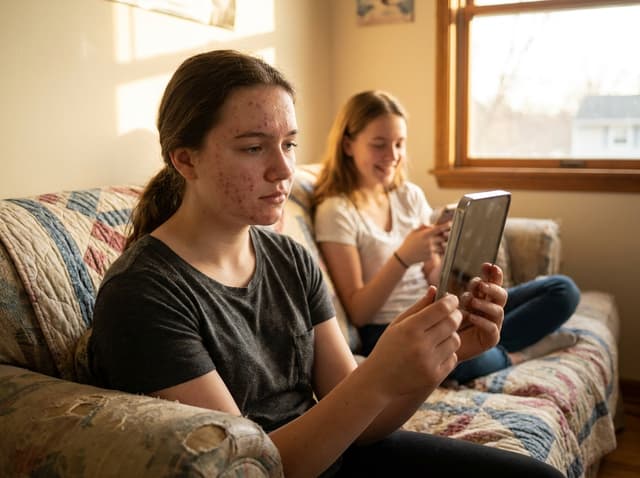
When Your Sibling Has Clear Skin and You Don't: Dealing with Acne Jealousy
Watching your sibling eat the same food, skip skincare, and have perfect skin while you break out constantly is one of the most frustrating parts of having acne.
Read More →
Does Sunlight Help or Hurt Acne? The Complicated Truth
Sun might temporarily mask acne, but it makes things worse long-term. Here's why the vacation skin effect isn't what you think and why UV isn't an acne treatment.
Read More →
Instagram Filters and Acne: How Social Media Distorts Skin Reality
Filters blur texture, erase pores, and create a version of skin that doesn't exist in real life. Here's how that messes with your head when you have acne.
Read More →
Honey for Acne: Does This Kitchen Ingredient Actually Work?
Manuka honey has real antibacterial research behind it. Regular honey, not so much. Here's what works, what doesn't, and whether it's worth the sticky mess.
Read More →
Green Tea and Acne: The Drink (and Ingredient) That Might Help
EGCG in green tea has anti-inflammatory and anti-androgenic properties that could help acne-prone skin. Here's what the research says about drinking it and putting it on your face.
Read More →