Does Screen Time Affect Your Skin? Blue Light, Stress, and Acne
Medically reviewed by Dr. Sarah Mitchell, MD, Board-Certified Dermatologist
Written by Teen Acne Solutions Team — Updated May 9, 2026
Key takeaways
- Blue light from screens has minimal evidence for causing skin damage at real-world exposure levels. Lab studies used intensities far beyond what a phone emits. Don't buy blue-light skincare products based on this fear.
- The real connection between screens and acne is indirect. Screens before bed disrupt sleep, doom-scrolling raises cortisol, and both of those have documented effects on breakouts.
- Touching your face while scrolling transfers oil and bacteria to your skin, and most people don't realize how often they do it.
- Reducing screen time before bed is the single most useful change because it improves sleep quality, which has a direct biological link to acne severity.
Someone has probably told you that staring at your phone is ruining your skin. Maybe you've seen ads for blue-light-blocking serums or screen protectors that claim to save your complexion. The skincare industry jumped on this fast, and now there are entire product lines built around protecting your face from your iPhone.
I want to be honest with you: the blue light thing is mostly marketing. The science behind it is thin. But that doesn't mean screens have nothing to do with your breakouts. The connection is just more complicated and more interesting than a specific wavelength of light.

Blue light and skin: what the research actually says
Blue light (also called high-energy visible light, or HEV light, wavelengths roughly 380-500nm) does interact with skin cells. This is real. Studies have shown that blue light can increase reactive oxygen species in skin cells, affect melanocyte activity, and potentially contribute to hyperpigmentation. In lab dishes. At specific intensities. For extended durations.
The problem is that the intensity used in most of these studies bears almost no resemblance to what you get from a phone screen. A 2018 review in the Journal of Biomedical Physics and Engineering compared the irradiance of smartphone screens to the blue light in sunlight and found that your phone emits a fraction of the blue light you'd get from walking outside for a few minutes. To get the kind of exposure used in many lab studies, you'd need to hold your phone to your face for hundreds of consecutive hours.
That doesn't mean blue light is completely harmless in all contexts. Sunlight contains a LOT of blue light, and extended unprotected sun exposure does affect skin. But that's an argument for sunscreen, not for blue-light phone filters.
When it comes to acne specifically, there's no published clinical evidence that blue light from screens causes or worsens breakouts at real-world exposure levels. None. If you find a skincare brand citing studies to sell blue-light protection, look at the study conditions. They're almost always in vitro (lab dishes, not human faces) and at intensities you'd never encounter from a device.
Interestingly, blue light in controlled doses is actually used as a treatment for acne. Blue light therapy devices (at much higher intensity than any phone) kill C. acnes bacteria because the bacteria produce a compound called porphyrin that absorbs blue light and generates free radicals that damage the bacteria. So the relationship between blue light and acne is genuinely weird. At low levels (your phone), it doesn't seem to matter. At high, targeted levels (medical devices), it actually helps.
The real screen-skin connection is stress
Here's where the conversation gets more honest. Screens probably don't affect your skin through light. They affect your skin through your nervous system.
A 2003 study in the Archives of Dermatology by Chiu, Chon, and Kimball tracked college students through exam periods and found that acne severity worsened consistently during high-stress periods, independent of changes in sleep or diet. Stress increases cortisol, cortisol increases sebum production and inflammation, and more sebum plus more inflammation equals more breakouts. This pathway is well-established in the literature.
Now think about what happens during three hours of doom-scrolling. You see bad news. You see people arguing. You compare yourself to curated highlight reels. You read comments that make you anxious or angry. Your brain is processing all of this as low-grade psychological stress, and your body responds with cortisol accordingly.
A 2007 study in Acta Dermato-Venereologica confirmed in adolescents that psychological stress correlated with increased sebum output. The researchers measured it directly. Higher stress, oilier skin. It's not speculation.
I don't think this means you need to delete all your apps. But I do think it's worth being honest about how you feel after a long scroll session. If you consistently feel worse (more anxious, more down, more agitated), that's affecting your body chemistry whether or not you notice the connection.
Comparison anxiety and filtered selfies
This part is harder to quantify but I think it matters.
Social media is full of flawless skin. Filters smooth out every pore, every bump, every scar. Editing apps let people erase their acne completely. Even "no-filter" posts often involve ring lights and careful angles that minimize skin texture. You're comparing your real face, under bathroom fluorescent lighting, to a curated fiction.

Research published in Clinical Psychological Science in 2018 by Twenge and colleagues found links between new media screen time and increased depressive symptoms in adolescents. Depression and anxiety both have documented connections to acne through the stress-cortisol pathway, and through behavioral changes like disrupted sleep, worse eating habits, and reduced exercise.
There's also a subtler thing I've noticed in how people talk about their skin: spending hours looking at filtered faces can warp your baseline for what "normal skin" looks like. Normal skin has texture. Pores are visible. Mild unevenness is standard. If your reference point is Instagram, your actual face will always feel like it's falling short, and that perception drives anxiety, compulsive mirror-checking, and sometimes skin picking, all of which make acne worse.
I'm not going to tell you to stop using social media because that's not realistic. But I think unfollowing accounts that make you feel bad about your skin is a small thing that can make a real difference. Your feed is not an objective reflection of reality, and adjusting what you see adjusts how you feel.
The face-touching problem
Here's a genuinely practical screen-skin connection that nobody talks about enough.
Watch someone scrolling their phone sometime. Count how many times they touch their face. Resting their chin on their hand. Propping their cheek against their palm. Rubbing their forehead. Picking at their skin absentmindedly while reading something.
On average, people touch their face 16-23 times per hour according to behavioral studies. During phone use, I'd bet that number goes up because your hands are already near your face, and the passive, semi-engaged state of scrolling seems to increase fidgety, unconscious behavior.
Every touch transfers oil, dirt, and bacteria from your fingers to your face. Over the course of an evening of scrolling, that's a lot of contamination. It's not dramatic on its own, but it adds up, especially if you're touching the same areas repeatedly. If your breakouts consistently appear along your cheekbone, jawline, or chin (the areas where your hand naturally rests while holding a phone), this might be a contributing factor.
The fix is simple but annoying: become aware of it. Once you notice the habit, you'll catch yourself doing it constantly. Some people find it helps to hold their phone with both hands or to sit in a position where resting their face on their hand isn't comfortable.
Your phone is dirty
While we're on the subject: your phone screen is not clean. Studies have found that the average smartphone carries more bacteria than a toilet seat, which sounds alarming but is a slightly misleading comparison because toilet seats are actually not that bacteria-rich (they're cleaned regularly and aren't warm, moist environments).
Still, your phone picks up bacteria from every surface it touches, every hand that holds it, every pocket and bag it sits in. When you press that screen against your cheek during a phone call, you're transferring that bacterial load directly to your skin.
This matters more for acne along the cheek and jawline on the side where you hold your phone. If you notice your breakouts are asymmetrical (worse on one side of your face), think about which side you use for phone calls.
Wiping your phone screen with an alcohol wipe once a day takes ten seconds and removes most surface bacteria. It won't transform your skin, but it eliminates one unnecessary source of contamination. Using speakerphone or earbuds for calls also keeps the screen off your face entirely.
Blue light skincare products: save your money
I feel strongly enough about this to give it its own section. The market for blue-light-blocking skincare has grown rapidly, and in my opinion, it's built on anxiety rather than evidence.
Products with iron oxides (certain tinted sunscreens and BB creams) do block visible light including blue light. That's true. But blocking the tiny amount of blue light from your phone screen is solving a problem that, based on current evidence, doesn't meaningfully exist at those exposure levels.
If you're already wearing a broad-spectrum sunscreen with SPF 30+ daily (which you should be for UV protection), you're getting some incidental blue light protection already, especially if it contains zinc oxide or titanium dioxide. There's no reason to pay a premium for a product marketed specifically as "blue light defense."
The money would be better spent on a good retinoid, a basic moisturizer, and sunscreen. Those have actual evidence behind them.
What actually helps
If screens are connected to acne mostly through sleep disruption, stress, face-touching, and phone bacteria, then the useful interventions target those pathways.

Put the phone away 30-60 minutes before bed. This is the big one. A 2015 PNAS study showed that screen use before bed delays sleep onset by about 30 minutes, reduces melatonin secretion, and makes you groggier the next morning. Less sleep means higher cortisol means more breakouts. Getting those 30 extra minutes of sleep back is probably worth more for your skin than any product you could apply to it.
Notice your mood after scrolling. This is individual. Some people scroll for an hour and feel fine. Others spiral into comparison or anxiety within 20 minutes. There's no universal threshold, but if you can identify yours, you can set limits that actually mean something to you rather than following generic advice about "reducing screen time."
Keep your hands away from your face. Pay attention for one evening. Just notice. Once you see the pattern, it's easier to interrupt.
Clean your phone screen regularly. Daily wipe-down with an alcohol wipe. Takes no effort, removes bacteria.
Use earbuds or speakerphone for calls. Keeps the phone off your cheek.
These are small changes. None of them will clear your acne on their own. But they remove aggravating factors that might be undermining the actual treatments (retinoids, benzoyl peroxide, whatever your dermatologist has you on). And the sleep one, honestly, might be the most underrated skin intervention available. I keep coming back to sleep as the thing that affects everything else. If your phone is the reason you're sleeping 6 hours instead of 7.5, your phone is indirectly affecting your acne, just not through blue light.
Bottom line
Blue light from phone and laptop screens has minimal evidence for directly damaging skin or causing acne at real-world exposure levels. The blue-light skincare category is mostly marketing. But screens do affect acne indirectly: by disrupting sleep (which raises cortisol and increases oil production), by creating psychological stress through doom-scrolling and social comparison, and by facilitating face-touching and phone-to-face bacteria transfer. The most useful change is getting the phone out of the bedroom before sleep. Everything else is secondary but worth considering if you're already doing the basics right and still struggling.
How we reviewed this article:
Our experts continually monitor the health and wellness space, and we update our articles when new information becomes available.
- Arjmandi N, et al. Can light emitted from smartphone screens and taking selfies cause premature aging and wrinkles? J Biomed Phys Eng. 2018;8(4):447-452https://pubmed.ncbi.nlm.nih.gov/30568934/
- Spiegel K, Leproult R, Van Cauter E. Impact of sleep debt on metabolic and endocrine function. Lancet. 1999;354(9188):1435-1439https://pubmed.ncbi.nlm.nih.gov/10543671/
- Chang AM, et al. Evening use of light-emitting eReaders negatively affects sleep, circadian timing, and next-morning alertness. Proc Natl Acad Sci. 2015;112(4):1232-1237https://pubmed.ncbi.nlm.nih.gov/25535358/
- Chiu A, Chon SY, Kimball AB. The response of skin disease to stress: changes in the severity of acne vulgaris as affected by examination stress. Arch Dermatol. 2003;139(7):897-900https://pubmed.ncbi.nlm.nih.gov/12873885/
- Yosipovitch G, et al. Study of psychological stress, sebum production and acne vulgaris in adolescents. Acta Derm Venereol. 2007;87(2):135-139https://pubmed.ncbi.nlm.nih.gov/17340019/
- Twenge JM, et al. Increases in depressive symptoms, suicide-related outcomes, and suicide rates among US adolescents after 2010 and links to increased new media screen time. Clin Psychol Sci. 2018;6(1):3-17https://pubmed.ncbi.nlm.nih.gov/32021811/
- Kwon HH, et al. Clinical and histological effect of a low glycaemic load diet in treatment of acne vulgaris in Korean patients. Acta Derm Venereol. 2012;92(3):241-246https://pubmed.ncbi.nlm.nih.gov/22678562/
- Meadows A, Kaur S. Dermatology life quality index scores in skin picking disorder. J Dermatolog Treat. 2020;31(2):172-175
- Bowe WP, Logan AC. Acne vulgaris, probiotics and the gut-brain-skin axis. Gut Pathog. 2011;3(1):1https://pubmed.ncbi.nlm.nih.gov/21281494/
Read This Next
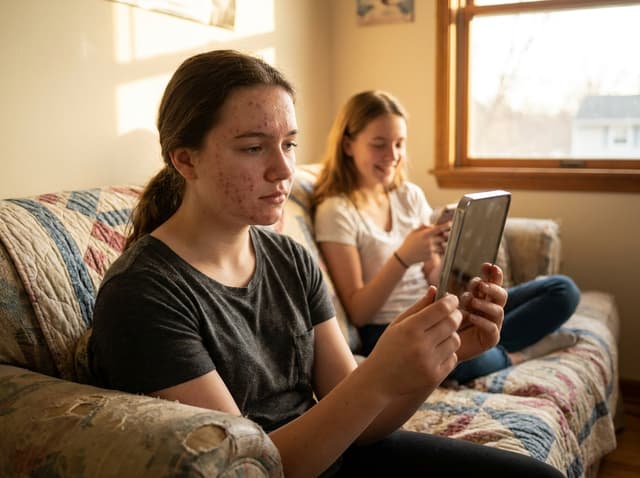
When Your Sibling Has Clear Skin and You Don't: Dealing with Acne Jealousy
Watching your sibling eat the same food, skip skincare, and have perfect skin while you break out constantly is one of the most frustrating parts of having acne.
Read More →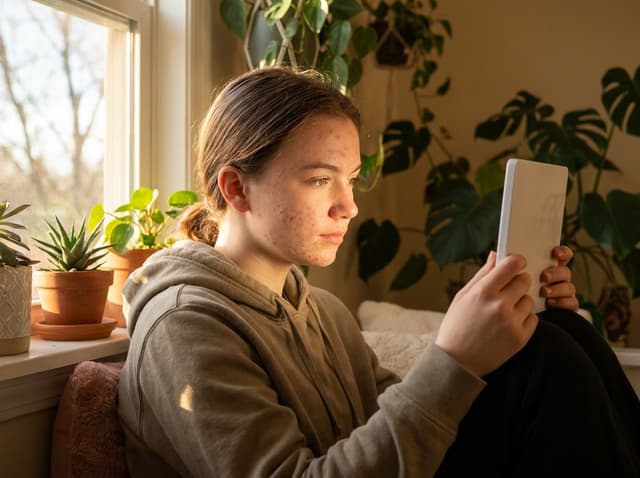
Does Sunlight Help or Hurt Acne? The Complicated Truth
Sun might temporarily mask acne, but it makes things worse long-term. Here's why the vacation skin effect isn't what you think and why UV isn't an acne treatment.
Read More →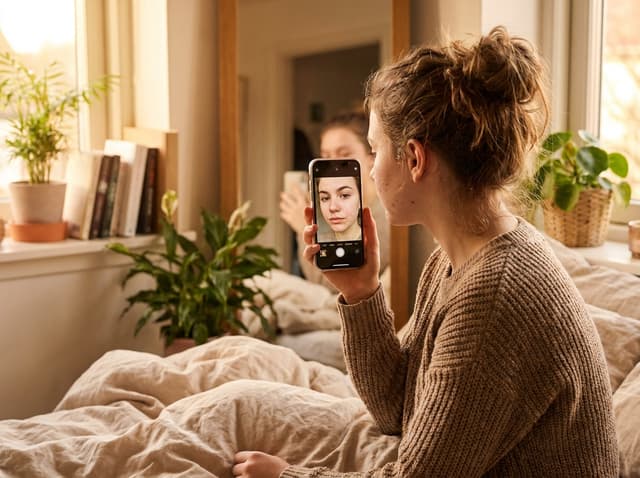
Instagram Filters and Acne: How Social Media Distorts Skin Reality
Filters blur texture, erase pores, and create a version of skin that doesn't exist in real life. Here's how that messes with your head when you have acne.
Read More →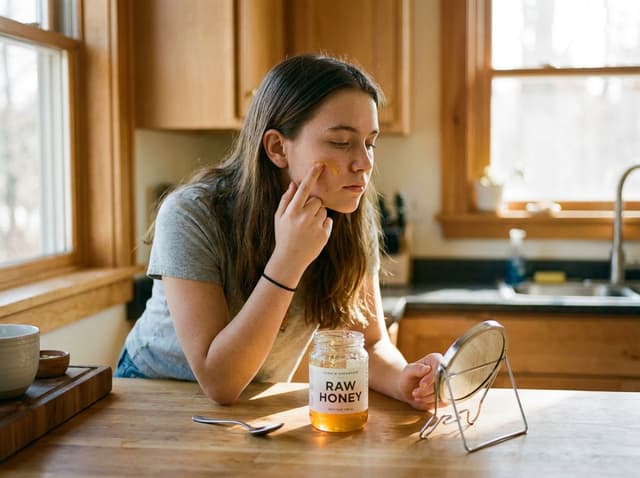
Honey for Acne: Does This Kitchen Ingredient Actually Work?
Manuka honey has real antibacterial research behind it. Regular honey, not so much. Here's what works, what doesn't, and whether it's worth the sticky mess.
Read More →
Green Tea and Acne: The Drink (and Ingredient) That Might Help
EGCG in green tea has anti-inflammatory and anti-androgenic properties that could help acne-prone skin. Here's what the research says about drinking it and putting it on your face.
Read More →