Acne Positivity: Is It Helpful or Does It Miss the Point?
Medically reviewed by Dr. Sarah Mitchell, MD, Board-Certified Dermatologist
Written by Teen Acne Solutions Team — Updated May 11, 2026
Key takeaways
- Acne positivity has helped reduce shame and stigma, giving teenagers permission to exist in public without covering up or hiding.
- Telling someone to 'just accept' painful, scarring acne dismisses a real medical condition that deserves treatment like any other.
- You can pursue clear skin AND practice self-compassion at the same time. These aren't opposing choices.
- The healthiest approach treats acne as a medical issue, not a moral one, while refusing to let breakouts define your self-worth.
I've been going back and forth on the acne positivity movement for a while. On one hand, it's done genuinely good things. On the other hand, there are moments when it feels like it's solving the wrong problem.
Let me explain what I mean.

What acne positivity got right
For decades, acne was treated as something shameful. Skin care commercials showed a "before" face practically grimacing with self-disgust, followed by an "after" face beaming with confidence because the acne was gone. The message was clear: acne makes you ugly, and your life begins when it's over.
That message did real damage. A 2011 study published in the Journal of Investigative Dermatology found that adolescents with acne had significantly higher rates of suicidal ideation compared to those without it. Not slightly higher. Significantly. The psychological burden of acne has been compared to conditions like epilepsy and diabetes in terms of its impact on quality of life.
The acne positivity movement pushed back against this. Starting largely on Instagram around 2018-2019, people began posting unfiltered photos of their skin. Breakouts visible. No concealer. No strategic lighting. Just skin, as it actually looked.
The effect was liberating for a lot of people. Suddenly, someone with acne could scroll through their feed and see other people who looked like them, living their lives, looking attractive, not hiding. The hashtag #acnepositivity has hundreds of thousands of posts. Content creators like Kali Kushner and others built large followings by being transparent about their skin journeys.
Here's what I think this accomplished that was genuinely valuable:
It normalized a condition that affects 85% of teenagers. Acne is one of the most common conditions in dermatology, yet before this movement, it was treated like a rare and embarrassing affliction. Seeing it everywhere on social media matched the reality that it is, in fact, everywhere.
It gave people permission to leave the house. This sounds small, but it's not. Some teenagers with acne avoid social situations, skip school, and refuse to be photographed. The movement communicated something that needed to be said: you don't have to hide.
It separated acne from personal worth. Having breakouts says nothing about your hygiene, your discipline, or your value as a person. The movement reinforced this message at a time when teenagers are extremely vulnerable to internalizing the opposite.
Where it gets complicated
But there's a version of acne positivity that I think goes too far, or at least goes in a direction that isn't helpful for everyone.
It's the version that says treatment isn't necessary. The version that implies wanting clear skin means you've failed at self-acceptance. The version that treats acne as nothing more than a cosmetic difference to be embraced, like freckles or a gap in your teeth.
Acne isn't freckles. For a lot of people, it's painful. Literally. Cystic acne hurts. Nodular acne hurts. Even moderate inflammatory acne involves swelling, tenderness, and discomfort. Beyond the physical pain, untreated acne can cause permanent scarring. Atrophic scars (icepick, boxcar, rolling) form when inflammation destroys collagen in the dermis. Once those scars form, they're extremely difficult and expensive to treat.
When someone with painful, scarring acne is told to "just embrace it," there's an uncomfortable gap between the sentiment and the reality. You wouldn't tell someone with chronic migraines to just accept the headaches. You'd tell them to see a doctor while also reminding them that having migraines doesn't make them weak.

Acne is a medical condition, not a character flaw
I think this is where the conversation needs to land, and where both sides sometimes miss.
Acne vulgaris is classified as a chronic inflammatory skin disease. It involves hormonal dysregulation, bacterial overgrowth, abnormal keratinization, and immune system activity. It has genetic components. It responds to medical treatment.
It's not caused by not washing your face. It's not caused by eating too much chocolate (although diet plays some role). It's not a reflection of your cleanliness, your lifestyle choices, or your character.
But here's the thing: it's also not "just cosmetic" for many people. The American Academy of Dermatology explicitly notes that acne's psychological effects can be severe and that untreated acne can lead to depression and anxiety. A 2006 study comparing the psychological impact of acne to other medical conditions found that acne patients reported levels of social and psychological difficulty comparable to those with asthma, arthritis, and epilepsy.
Treating acne medically isn't vanity. It's health care. And framing treatment-seeking as a failure of self-acceptance creates a false dilemma that nobody benefits from.
You can want clear skin without hating yourself
This is my actual opinion on the matter, and I'll state it plainly: the best approach combines treatment with self-compassion, and pretending you have to pick one is unhelpful.
You can make a dermatologist appointment on Monday and also not cry about your skin on Tuesday. You can start adapalene at night and still post an unfiltered selfie the next morning. You can hate your breakouts without hating yourself.
The two things are not connected unless you connect them.
What I've seen work in practice, both in the research and in real conversations with teenagers dealing with this:
Treat acne like what it is. A medical condition that responds to treatment. See a doctor. Use the products. Follow through with the routine. Do this without shame, the same way you'd take allergy medicine or wear glasses.
Refuse to put your life on hold. Don't skip the party because you're breaking out. Don't avoid photos. Don't cancel the date. Your acne is temporary (even if it doesn't feel that way), and the experiences you miss are gone forever.
Stop comparing your skin to filtered images. This applies whether you're following acne positivity accounts or clear-skin accounts. Everyone's skin looks different in different lighting, and social media is a terrible representation of reality regardless of the poster's intentions.
Talk about it if it helps. Don't if it doesn't. Some people find it cathartic to share their skin journey publicly. Others find that constant focus on their acne, even in a "positive" context, keeps it at the center of their identity when they'd rather it wasn't. Both approaches are valid.

Social media and acne representation
Social media influencers who show their acne have done something that traditional media never did: they've provided representation. When a teenager with acne sees someone they admire also dealing with breakouts, it normalizes the experience in a way that no public health campaign could match.
Creators who document their treatment journeys, showing the purging phase, the slow progress, the setbacks, provide something valuable. They set realistic expectations. They demonstrate that treatment isn't a linear path from bad skin to perfect skin. They show that good days and bad days coexist.
But I want to flag something I think gets overlooked. Social media acne positivity still operates within the social media framework. Posts still get more engagement when the person is conventionally attractive in other ways. The most visible acne positivity influencers tend to be young, slim, and otherwise conforming to beauty standards except for their skin. Representation that only includes one type of person with acne isn't complete representation.
There's also a selection bias in who participates. The people most comfortable posting their acne publicly tend to be people who've already done significant internal work on their self-image. The teenager who can't make eye contact because of their skin isn't posting selfies, and the movement doesn't always reach them. That's not a criticism of the movement itself. It's a limitation worth acknowledging.
The difference between positivity and toxic positivity
Toxic positivity is when positive messaging is used to shut down legitimate negative emotions. In the context of acne, it sounds like:
- "It's just skin, don't let it bother you" (to someone dealing with real depression about their appearance)
- "Acne is beautiful, you don't need to treat it" (to someone with painful cystic acne that's scarring)
- "If you were really confident, you wouldn't care about your skin" (implying that distress is a personal failing)
- "Just stop stressing about it and it'll go away" (factually wrong and dismissive)
Real positivity sounds different:
- "Your acne doesn't define you, and it's also okay to feel frustrated about it"
- "You can treat your acne without feeling ashamed for having it"
- "Breakouts are normal and so is wanting them to go away"
- "You deserve to feel good, and that includes getting medical help for your skin if you want it"
The difference is that real positivity holds space for the full range of emotions someone might feel about their acne. It doesn't demand that you feel a specific way about your skin. It gives you permission to feel whatever you feel and then take action from a place of self-respect rather than self-hatred.
What I wish more people said
If I could distill all of this into the message I think teenagers with acne actually need to hear, it's this:
Your acne is a medical condition. It's not your fault, and it says nothing about who you are. You have every right to seek treatment for it, and doing so is not a sign of insecurity or weakness. At the same time, your worth as a person is completely unrelated to what your skin looks like on any given day. Both of these things are true simultaneously.
You don't owe anyone a positive attitude about your breakouts. You don't have to perform gratitude for your skin. But you also don't have to let your acne become the main character of your life story. It's a chapter, not the whole book. Treat it, be patient with the process, and live your life while it resolves.
Bottom line
The acne positivity movement has done good work in reducing stigma and shame around a condition that affects nearly every teenager at some point. Where it can go wrong is when it drifts into dismissing acne as a medical condition or making people feel guilty for wanting treatment. The healthiest position is the nuanced one: acne is normal, it's not your fault, you deserve to feel good about yourself while dealing with it, and you also deserve effective medical treatment if your skin is causing you pain (physical or emotional). Positivity and treatment aren't opposites. They work best together.
How we reviewed this article:
Our experts continually monitor the health and wellness space, and we update our articles when new information becomes available.
- Halvorsen JA, et al. Suicidal ideation, mental health problems, and social impairment are increased in adolescents with acne: a population-based study. J Invest Dermatol. 2011;131(2):363-370https://pubmed.ncbi.nlm.nih.gov/20844551/
- Yentzer BA, et al. Acne vulgaris in the United States: a descriptive epidemiology. Cutis. 2010;86(2):94-99https://pubmed.ncbi.nlm.nih.gov/20919605/
- Magin P, et al. The psychological and social effects of acne: a comparison with general medical conditions. J Clin Psychol Med Settings. 2006;13:148-159
- Tan JKL, Bhate K. A global perspective on the epidemiology of acne. Br J Dermatol. 2015;172(Suppl 1):3-12https://pubmed.ncbi.nlm.nih.gov/25597339/
- Dalgard FJ, et al. Self-esteem and body satisfaction among late adolescents with acne: results from a population survey. J Am Acad Dermatol. 2008;59(5):746-751https://pubmed.ncbi.nlm.nih.gov/19119094/
- American Academy of Dermatology. Acne Can Affect More Than Your Skin. AAD. 2024https://www.aad.org/public/diseases/acne/acne-emotional-effects
Read This Next
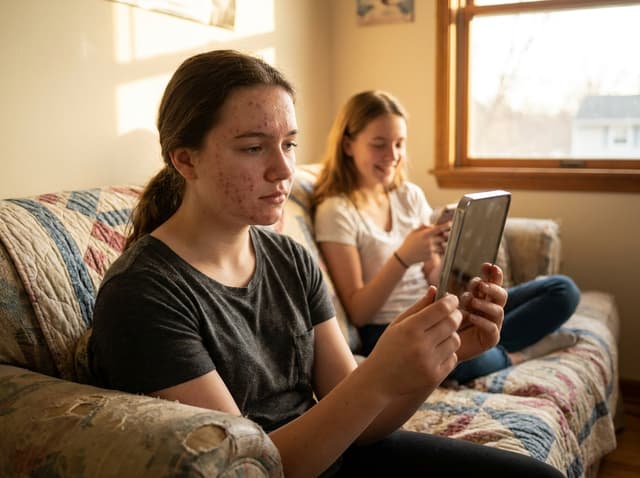
When Your Sibling Has Clear Skin and You Don't: Dealing with Acne Jealousy
Watching your sibling eat the same food, skip skincare, and have perfect skin while you break out constantly is one of the most frustrating parts of having acne.
Read More →
Does Sunlight Help or Hurt Acne? The Complicated Truth
Sun might temporarily mask acne, but it makes things worse long-term. Here's why the vacation skin effect isn't what you think and why UV isn't an acne treatment.
Read More →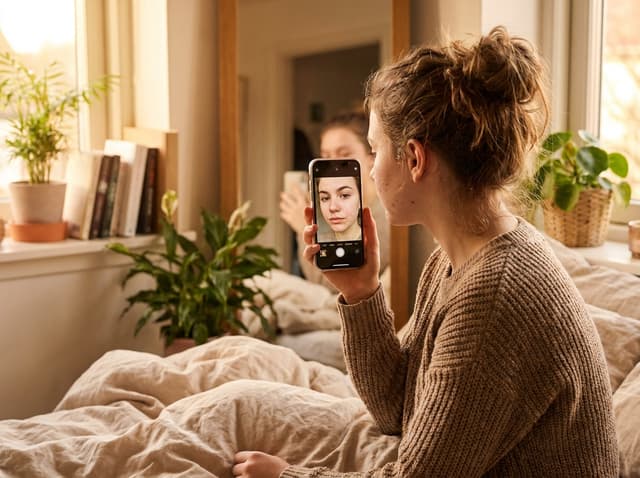
Instagram Filters and Acne: How Social Media Distorts Skin Reality
Filters blur texture, erase pores, and create a version of skin that doesn't exist in real life. Here's how that messes with your head when you have acne.
Read More →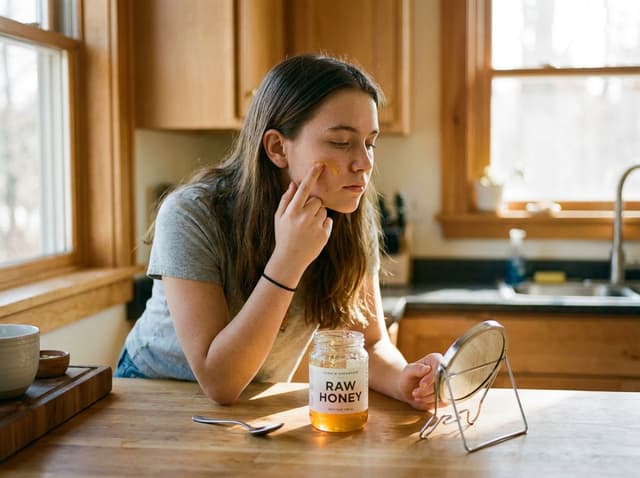
Honey for Acne: Does This Kitchen Ingredient Actually Work?
Manuka honey has real antibacterial research behind it. Regular honey, not so much. Here's what works, what doesn't, and whether it's worth the sticky mess.
Read More →
Green Tea and Acne: The Drink (and Ingredient) That Might Help
EGCG in green tea has anti-inflammatory and anti-androgenic properties that could help acne-prone skin. Here's what the research says about drinking it and putting it on your face.
Read More →