Acne and Self-Care: Building a Routine That's About More Than Just Your Skin
Medically reviewed by Dr. Rachel Torres, MD, Board-Certified Dermatologist
Written by Teen Acne Solutions Team — Updated May 14, 2026
Key takeaways
- Stress directly worsens acne through cortisol-driven increases in oil production. Managing stress isn't just feel-good advice; it's acne management.
- Your skincare routine can double as a calming ritual if you slow down and pay attention instead of rushing through it.
- Sleep deprivation impairs skin barrier function and increases inflammation. Getting enough sleep is one of the most underrated things you can do for your skin.
- Regular exercise reduces stress hormones and improves circulation, but shower promptly after sweating to avoid clogged pores.
- Tracking your skin in a journal can reduce anxiety by giving you a sense of control and helping you spot patterns.
There's something depressing about skincare when your skin won't cooperate. You stand at the sink, apply the cleanser, wait, apply the treatment, wait, apply the moisturizer, and the whole time you're staring at a face that doesn't seem to care about any of it. The routine starts to feel like maintenance on something broken.
I've been there. And I think a lot of teenagers with acne are stuck in that same rut where skincare is just another obligation, right alongside homework and chores. Something they're supposed to do because adults told them to.
But what if the routine itself could actually feel good? Not because it magically clears your skin overnight, but because the act of taking care of yourself, slowly, with intention, does something for your headspace that's separate from what it does for your pores.
Skincare as a ritual, not a chore
There's a difference between rushing through your routine because you have to and doing it because you're choosing to take care of yourself. The products are the same. The steps are the same. The difference is entirely in how you approach it.
When you treat skincare as a chore, you're just going through motions. Splash, rub, rinse, slap something on, done. Your mind is already on the next thing. You might even resent the routine because it reminds you of the problem.
When you treat it as a ritual, you slow down. You feel the water temperature. You notice how the cleanser feels on your skin. You take the 60 seconds to actually let the treatment absorb instead of immediately layering moisturizer on top. These sound like small, silly things. They're not. There's real psychology behind the idea that intentional, repetitive self-care actions can shift your relationship with your body.
I'm not suggesting you light candles and play meditation music every time you wash your face. I'm suggesting you stop treating yourself like a project that needs fixing and start treating yourself like someone worth taking care of. The distinction matters more than it sounds like it should.

Stress and acne: the connection is real
This isn't just wellness-culture hand waving. The connection between stress and acne has been studied repeatedly, and it holds up.
Chiu et al. (2003) published one of the cleaner studies on this. They tracked acne severity in university students across exam periods versus non-exam periods. During exams, acne worsened in the vast majority of participants, and the increase in severity correlated with self-reported stress levels. This wasn't observational guesswork. They controlled for changes in sleep, diet, and skincare habits.
Yosipovitch et al. (2007) went a step further and measured sebum production (oil output) in stressed versus non-stressed adolescents. Stressed teenagers produced more sebum. More oil means more clogged pores, which means more acne. The mechanism is hormonal: stress triggers cortisol release, which stimulates the sebaceous glands.
So when someone tells you to "just relax" about your acne, they're accidentally giving you legitimate skincare advice, even though it's annoying to hear. Stress management isn't a replacement for topical treatment, but ignoring stress while treating acne is like trying to mop a floor while the faucet is still running.
The question is how you actually manage stress as a teenager, when you can't exactly quit school or stop caring about grades and social dynamics. You can't eliminate stress. But you can build small pockets of regulation into your day.
Your evening routine as a wind-down
Most teenagers' evenings go something like this: homework, phone, phone, more phone, panic about tomorrow, attempt to sleep, phone again, eventually pass out.
Your skincare routine can be the dividing line between "the day" and "winding down for the night." Not because the products have calming properties (though some do), but because the physical act of washing your face and going through a sequence of steps can serve as a transition ritual that tells your brain: the active part of the day is over.
This works better if you do it at a consistent time each evening, and if you pair it with putting your phone in another room or at least facedown on a charger. The combination of warm water on your face, a few minutes of not looking at a screen, and a sequence of predictable steps creates a sensory pattern that your nervous system can latch onto.
I know this sounds like something your mom would say. But the research on bedtime routines and sleep quality is consistent, even for adults. Humans respond to ritual. Having a predictable sequence of actions that signals "we're done for the day" genuinely improves the transition from awake-and-wired to ready-for-sleep.
And better sleep means less cortisol, which means less oil production, which means fewer breakouts. It connects.
Five minutes of paying attention
You don't need to become a meditation person. I'm not going to tell you to download an app and commit to 20 minutes of guided breathing. But here's something small that actually works.
While you're applying your skincare products, especially the ones that need a minute to absorb, try paying attention to the physical sensations instead of thinking about everything else. How does the product feel? Is it cool? Does it tingle? What does your skin feel like under your fingertips?
This is a basic mindfulness practice stripped of all the vocabulary that makes mindfulness annoying to teenagers. You're not "being present." You're just noticing what's happening while it's happening, instead of mentally rehearsing tomorrow's problems.
Kabat-Zinn (2003) laid the groundwork for mindfulness-based interventions and the evidence consistently shows that even brief, informal mindfulness practices reduce cortisol and perceived stress. You don't need a meditation cushion. You need five minutes of actually paying attention to what you're doing.
Schut et al. (2016) specifically studied stress management techniques in patients with skin conditions and found that even minimal mindfulness practices improved both psychological well-being and self-reported skin satisfaction. The skin satisfaction part is interesting because sometimes the skin didn't objectively change much; the person's relationship to their skin did.

Journaling your skin journey
I debated whether to include this because it can sound corny. But I've talked to enough teenagers who tried it and found it helpful that I'd feel dishonest leaving it out.
The idea is simple: keep a brief, daily record of your skin. It doesn't need to be detailed. A few notes each day:
- How does your skin look today? (Better, same, worse, or rate 1-10)
- Any new breakouts?
- What products did you use?
- How stressed are you? (1-10)
- How did you sleep?
- Where are you in your menstrual cycle, if that applies?
- Anything else notable? (New food, skipped a product, traveled, sweated a lot)
After a few weeks, patterns start appearing that you'd never notice otherwise. Maybe your skin consistently worsens 2 days after a bad night's sleep. Maybe breakouts cluster around specific cycle days. Maybe certain products seem to precede improvement.
The practical value is real, but there's also a psychological benefit. Journaling gives you a sense of data-driven control over something that usually feels uncontrollable. Instead of "my skin is terrible and nothing works," you can see trends. You can see that things actually did improve over the past month, even if today feels bad. You have evidence, not just feelings.
You can do this in a notes app, a spreadsheet, or a plain notebook. Some people take a photo each day under the same lighting, which creates a more objective visual record. Do whatever you'll actually stick with.

Exercise as skincare
Regular exercise reduces cortisol, improves blood circulation (which helps deliver nutrients to skin cells and remove waste), and improves sleep quality. All of these benefit your skin indirectly but meaningfully.
There's a catch, though. Sweat itself doesn't cause acne, but sitting in sweat-soaked clothing or not washing your face after exercise can. The sweat mixes with oil and dead skin cells, and if it sits on your skin long enough, it can clog pores.
The fix is simple: rinse your face with water (or a gentle cleanser if you have one handy) after exercising, and change out of sweaty clothes within a reasonable timeframe. You don't need to do a full skincare routine at the gym. A quick rinse and a clean shirt are enough.
The type of exercise doesn't matter much from a skin perspective. What matters is that you do something physical regularly enough that your body gets the stress-reducing benefits. Walking counts. Dancing in your room counts. You don't need a gym membership or a training plan. You need to move your body most days.
One thing worth mentioning: some people notice breakouts from wearing helmets, headbands, or tight athletic gear during exercise. This is acne mechanica, caused by friction and pressure rather than sweat itself. If you notice breakouts in areas where gear contacts your skin, try wearing a moisture-wicking layer underneath or cleaning the equipment regularly.
Sleep as skincare
Sleep is probably the most underrated factor in skin health, and it's the one teenagers are most likely to be getting wrong.
Oyetakin-White et al. (2015) studied sleep quality and skin health and found that poor sleepers had compromised skin barrier function, increased transepidermal water loss (dry skin), and slower recovery from UV damage. Their skin was measurably worse than that of good sleepers, independent of other factors.
Besedovsky et al. (2012) demonstrated that sleep deprivation impairs immune function, which matters for acne because your immune system plays a role in controlling the bacterial colonization and inflammation that drive breakouts. When your immune system is suppressed by lack of sleep, your skin has a harder time managing C. acnes bacteria.
Kahan et al. (2009) reviewed the relationship between stress, immunity, and skin, finding that chronic sleep deprivation creates a low-grade inflammatory state that worsens inflammatory skin conditions, acne included.
The recommended 8-10 hours for teenagers isn't arbitrary. And I know that's basically impossible for a lot of teens between homework, activities, social life, and the gravitational pull of phone screens at midnight. But even small improvements help. Going to bed 30 minutes earlier, reducing screen time in the last hour before sleep, keeping your room cool and dark, these are things that actually move the needle.
Your acne products are working while you sleep, by the way. Retinoids, in particular, do their best work overnight. If you're applying tretinoin at 11 PM and then scrolling until 1 AM, you're undermining the treatment by denying your skin the sleep-driven repair window it needs.
Treating your whole self
I want to be careful here because I don't want to turn this into "your acne is your fault because you're stressed and not sleeping enough." That's not what I'm saying.
Acne has genetic, hormonal, and bacterial components that no amount of meditation or journaling will change. You need your topical treatments. You need your dermatologist. Self-care is not a substitute for medical care.
But your body is a connected system. Your stress levels affect your hormones. Your hormones affect your oil production. Your sleep affects your immune function. Your immune function affects your skin's ability to manage bacteria. Your anxiety about your skin increases your stress, which worsens the acne, which increases the anxiety. It's a loop.
Self-care interventions interrupt the loop at multiple points. Better sleep gives your skin more repair time and lowers inflammation. Stress management reduces cortisol-driven oil production. Exercise improves circulation and sleep quality. Paying attention during your skincare routine shifts your relationship with your skin from adversarial to caring.
None of these things will clear severe cystic acne on their own. But they create conditions where your medical treatments work better and where you feel less consumed by the problem. And honestly? Feeling less consumed by the problem is its own kind of improvement that shows up in how you carry yourself, how you talk to people, and how you feel when you look in the mirror.
Bottom line
Your skincare routine is a few minutes each day that can be either a miserable chore or a small act of self-care. The difference is intention. Slow down, pay attention, pair it with other habits that support your skin from the inside out, and stop treating your face like a problem to be solved. You're a whole person, and your skin is one part of a connected system. Take care of the system, and the system takes better care of your skin.
How we reviewed this article:
Our experts continually monitor the health and wellness space, and we update our articles when new information becomes available.
- Chiu A, et al. The response of skin disease to stress: changes in the severity of acne vulgaris as affected by examination stress. Archives of Dermatology. 2003.https://pubmed.ncbi.nlm.nih.gov/12588223/
- Yosipovitch G, et al. Study of psychological stress, sebum production and acne vulgaris in adolescents. Acta Dermato-Venereologica. 2007.https://pubmed.ncbi.nlm.nih.gov/17340019/
- Oyetakin-White P, et al. Does poor sleep quality affect skin ageing? Clinical and Experimental Dermatology. 2015.https://pubmed.ncbi.nlm.nih.gov/25266053/
- Kahan V, et al. Stress, immunity and skin collagen integrity: evidence from animal models and clinical conditions. Brain, Behavior, and Immunity. 2009.https://pubmed.ncbi.nlm.nih.gov/19539012/
- Kabat-Zinn J. Mindfulness-based interventions in context: past, present, and future. Clinical Psychology: Science and Practice. 2003.https://psycnet.apa.org/record/2003-03824-002
- Schut C, et al. Psychophysiological effects of stress management in patients with atopic dermatitis. Acta Dermato-Venereologica. 2016.https://pubmed.ncbi.nlm.nih.gov/26551528/
- Besedovsky L, et al. Sleep and immune function. Pflugers Archiv European Journal of Physiology. 2012.https://pubmed.ncbi.nlm.nih.gov/22048995/
- American Academy of Dermatology. Acne: tips for managing.https://www.aad.org/public/diseases/acne/self-care/tips
Read This Next
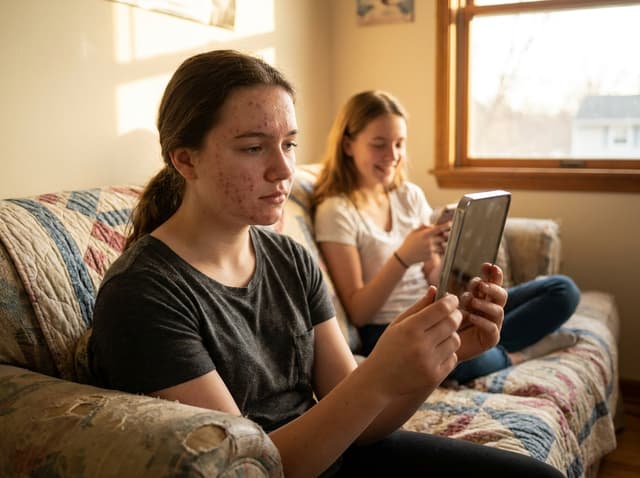
When Your Sibling Has Clear Skin and You Don't: Dealing with Acne Jealousy
Watching your sibling eat the same food, skip skincare, and have perfect skin while you break out constantly is one of the most frustrating parts of having acne.
Read More →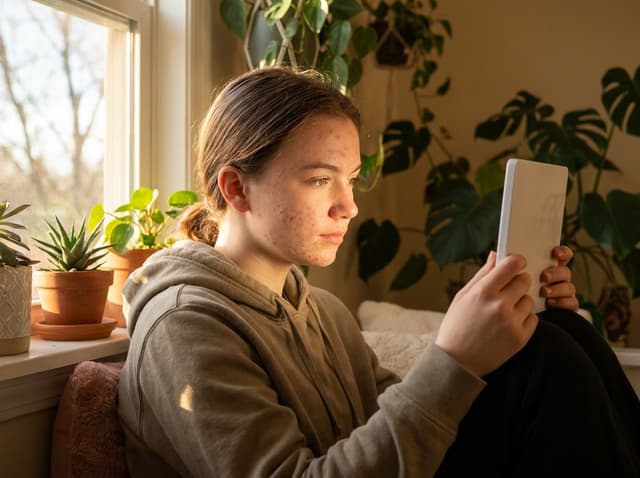
Does Sunlight Help or Hurt Acne? The Complicated Truth
Sun might temporarily mask acne, but it makes things worse long-term. Here's why the vacation skin effect isn't what you think and why UV isn't an acne treatment.
Read More →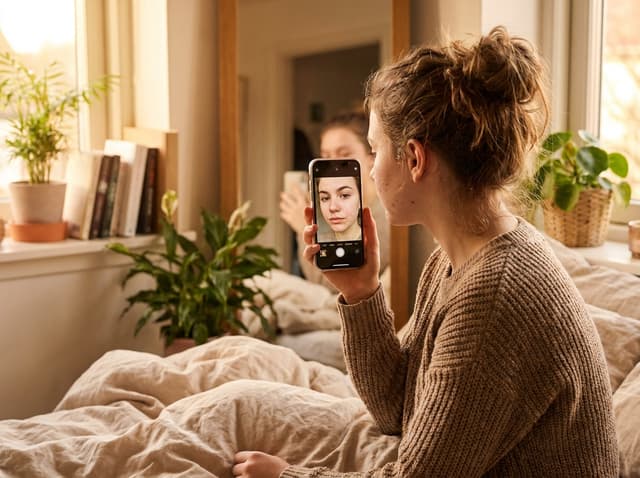
Instagram Filters and Acne: How Social Media Distorts Skin Reality
Filters blur texture, erase pores, and create a version of skin that doesn't exist in real life. Here's how that messes with your head when you have acne.
Read More →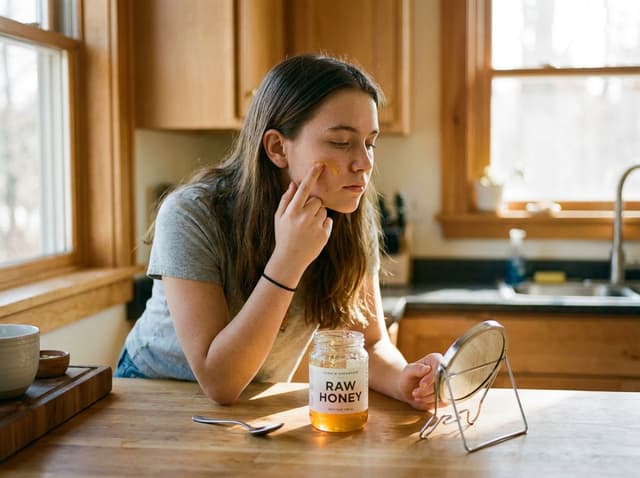
Honey for Acne: Does This Kitchen Ingredient Actually Work?
Manuka honey has real antibacterial research behind it. Regular honey, not so much. Here's what works, what doesn't, and whether it's worth the sticky mess.
Read More →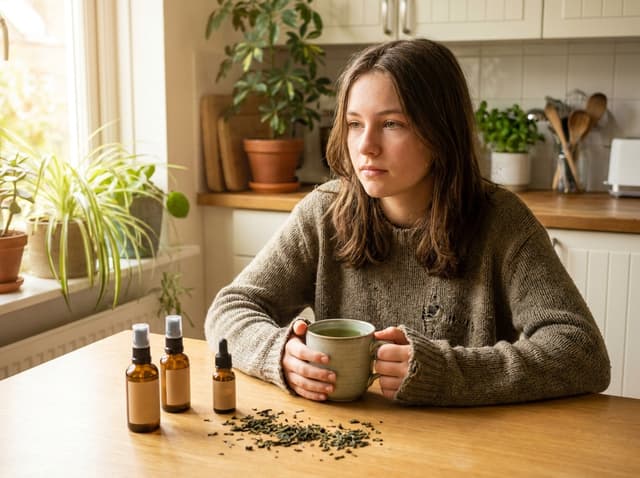
Green Tea and Acne: The Drink (and Ingredient) That Might Help
EGCG in green tea has anti-inflammatory and anti-androgenic properties that could help acne-prone skin. Here's what the research says about drinking it and putting it on your face.
Read More →