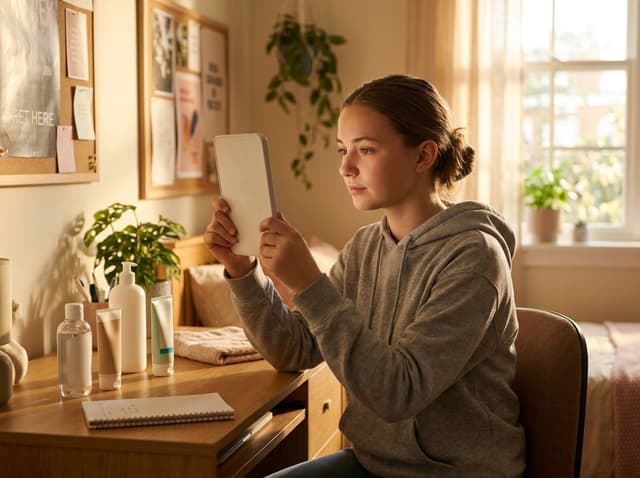
Back-to-School Skincare: Setting Up Your Fall Routine
Medically reviewed by Dr. Rachel Torres, MD, Pediatric Dermatologist
Written by Teen Acne Solutions Editorial Team — Updated May 17, 2026
Key takeaways
- Transition your routine gradually. Don't go from zero actives in summer to a full retinoid + BHA routine overnight. Reintroduce one product at a time over 2-3 weeks.
- Build a locker/backpack kit. A small pouch with blotting papers, a travel moisturizer, and sunscreen means you can do touch-ups between classes.
- Your morning routine needs to take 5 minutes or less. Anything longer and you won't do it consistently on school mornings.
- Fall is the best time to start a retinoid. Less sun exposure and lower UV index make the adjustment period easier.
- Book a dermatologist appointment now. Start of the school year is smart timing. Appointments fill up fast, and you want a plan in place before stress-related breakouts hit.
Back-to-School Skincare: Setting Up Your Fall Routine

Summer is forgiving in some ways. More time in the morning. Fewer deadlines pressing on you. Maybe your skin even cleared up a bit from the sun (before anyone corrects me: UV exposure isn't a treatment, it just temporarily masks inflammation, and your skin will pay the price later). But fall means early alarms, packed schedules, and stress that your skin absolutely notices.
I've seen this pattern play out a lot: teens coast through summer with minimal skincare, hit September, and by October they're dealing with the worst breakouts they've had in months. The combination of routine disruption, stress, weather changes, and abandoned treatments catches up fast.
The good news is that fall is actually an ideal time to get your skincare together. You just need a plan that's realistic about how much time and energy a school schedule leaves you.
Assessing the Damage: What Summer Did to Your Routine
Be honest with yourself about what happened over summer. Most teens fall into one of these categories:
You kept your routine going. Awesome. You're ahead. Skip to the section on fall adjustments.
You did the basics but dropped actives. Common. Maybe you kept washing your face and using moisturizer, but the adapalene or benzoyl peroxide got pushed aside because you were busy, or you got sunburned and your retinoid felt too harsh, or you just forgot for a few weeks and the habit broke. This is fixable.
You stopped everything. Also common. No judgment. Summer chaos, travel, different bathrooms, sleeping at friends' houses. It happens. But your skin has essentially reset, and you'll need to reintroduce things gradually.
You overdid the sun and now your skin is a mess. Sunburns, peeling, post-inflammatory hyperpigmentation getting darker from UV exposure, maybe some new breakouts from heavy sunscreen or sweat. This needs a gentle restart before you add any actives back.
Reintroducing Actives After a Summer Break
This is where people get themselves into trouble. After two months off a retinoid, you can't just jump back to nightly use like nothing happened. Your skin has lost its tolerance, and treating it like it hasn't will give you an unnecessary irritation phase.
Week 1-2: Go back to basics only. Gentle cleanser, moisturizer, sunscreen. Let your skin re-stabilize, especially if you've got any sunburn or peeling lingering from summer.
Week 3-4: Reintroduce your primary active at a reduced frequency. If you were using adapalene nightly before summer, start back at every third night. If benzoyl peroxide was your thing, use it every other day for a couple of weeks. Your skin will adapt faster this time around since it has memory of the product, but it still needs the ramp-up.
Week 5-6: Increase to every other night (for retinoids) or daily (for BP/salicylic acid). Monitor for irritation. If your skin is handling it fine, move to your full pre-summer frequency by week 7-8.
Don't add multiple actives back simultaneously. If you were using both a retinoid and benzoyl peroxide before summer, bring the retinoid back first, let your skin adjust for two weeks, then add the BP back. Stacking everything at once is the fastest way to destroy your moisture barrier and end up looking worse than when you started.

Stocking Up: The Back-to-School Skincare Essentials
Before the school year gets busy, make sure you have enough product to last at least two months. Running out of your cleanser in the middle of midterms and not getting around to buying a new one for two weeks is how routines die.
Here's what you should have on hand:
Gentle cleanser (CeraVe Foaming, La Roche-Posay Toleriane, Vanicream). Buy two. Keep one in the shower and one at the sink. Redundancy prevents laziness.
Moisturizer (CeraVe PM, Neutrogena Hydro Boost, La Roche-Posay Double Repair). You'll probably use more moisturizer in fall and winter than summer as the air gets drier.
Sunscreen (EltaMD UV Clear, La Roche-Posay Anthelios, CeraVe AM with SPF). Yes, you still need sunscreen in fall. The UV index drops but doesn't disappear, and if you're using retinoids, your skin is photosensitive year-round.
Your primary active (adapalene, benzoyl peroxide, prescription if applicable). Check the expiration date. If it's been sitting open all summer, some products may have degraded.
A spot treatment (benzoyl peroxide 2.5% or hydrocolloid patches). For the inevitable individual pimples that show up at the worst possible times.
The Locker and Backpack Kit
Your face doesn't stop being a face just because you're at school for 8 hours. A small kit that lives in your backpack or locker makes a real difference, especially if you have PE, play sports, or just get oily by afternoon.
What to put in a small zippered pouch:
- Oil blotting papers. Takes two seconds, removes midday shine without messing up sunscreen underneath. Clean & Clear or any store brand works.
- A travel-size moisturizer. 1-2 oz tube. For after PE, when you wash your face and need to rehydrate.
- A mini sunscreen. Reapply after lunch if you have outdoor time. Supergoop Unseen Sunscreen or EltaMD UV Clear in the small size travel well.
- A few hydrocolloid patches (like Mighty Patch or CosRX). If a pimple shows up during the school day, slap one on. They're subtle enough that most people won't notice, and they protect the spot from touching and picking.
Don't bring your whole routine to school. That's overkill. The goal is maintenance and damage control, not a full treatment session in the bathroom between periods.
The 5-Minute School Morning Routine
Let me be realistic. At 6:30 AM with 45 minutes before the bus comes, you are not spending 20 minutes on a ten-step skincare routine. You're just not. And anyone who tells you otherwise doesn't remember what school mornings are like.
Your morning routine needs to be fast, automatic, and non-negotiable. Here's what that looks like:
Step 1: Wash your face (60 seconds). Splash with water or use your gentle cleanser. If your skin isn't oily in the morning, water alone is fine.
Step 2: Moisturizer (30 seconds). A quick layer of your regular moisturizer. If it has SPF built in (like CeraVe AM), you can skip step 3.
Step 3: Sunscreen (30 seconds). If your moisturizer doesn't have SPF, apply a separate sunscreen. This step is especially important if you're on a retinoid.
That's it. Three steps. Under three minutes. Active treatments (retinoids, benzoyl peroxide) go in your evening routine when you have more time and aren't about to face UV exposure.
The evening routine gets the extra step: cleanse, apply your active treatment, wait a few minutes, moisturize. Maybe 7-8 minutes total. Still fast.
Consistency beats complexity every time. A simple routine you do every single day will outperform an elaborate routine you do three times a week [5].

Why Fall Is the Best Time to Start a Retinoid
If you've been thinking about starting adapalene or getting a tretinoin prescription, fall is your window. Here's why:
Lower UV exposure. The UV index drops significantly in fall and winter in most of the US. Since retinoids increase photosensitivity, starting one when the sun is less intense means less risk of sunburn and pigmentation issues during the adjustment period.
The 12-week timeline lines up. If you start a retinoid in September, you're hitting the 12-week mark (when retinoids reach full efficacy) right around December [1]. That means by the time holiday photos and winter break come around, your skin should be showing real improvement.
You're establishing a routine anyway. The start of the school year is when you're building habits. Adding a retinoid to a new routine is easier than disrupting an existing one.
Less sweating. Summer heat and sweat can make retinoid irritation worse. Fall's cooler temperatures are kinder to skin that's adjusting to a new active ingredient.
Talk to a dermatologist about getting started. If you can't get an appointment quickly, adapalene (Differin) 0.1% is available over the counter and is the standard starting retinoid for teens [1].
Managing School Stress and Your Skin
This is the part nobody puts on the back of a product label, but it matters. Multiple studies have shown a direct connection between psychological stress and acne severity [2][4]. One study of students during exam periods found a statistically significant increase in acne severity during exams compared to non-exam periods [2].
Stress increases cortisol production, which stimulates sebaceous glands, increases inflammation, and impairs wound healing. Your skin knows when you're stressed, and it reacts accordingly [4][6].
I'm not going to pretend that "manage your stress" is actionable advice for a teenager juggling school, social life, extracurriculars, and possibly a job. But a few things that genuinely help and don't require a lifestyle overhaul:
Sleep. This matters more than any product you'll put on your face. Teens need 8-10 hours, and most are getting 6-7. Even one extra hour per night can reduce cortisol levels and improve skin turnover. Going to bed 30 minutes earlier is a skincare intervention, whether it feels like one or not.
Exercise. Regular physical activity reduces stress hormones and improves circulation to your skin. You don't need to train for a marathon. Walking, shooting hoops, riding a bike. Just move regularly.
Not picking. Stress-picking is a real thing. When you're anxious, your hands find your face. Keep them busy. Fidget toys, a stress ball, whatever. The less you touch your skin, the better it heals [3].
Starting Fresh with a Dermatologist
If you've been battling acne on your own and it's not getting better, the start of the school year is a good time to book a dermatologist appointment. Here's why timing matters:
Derm offices get busy in fall. Everyone has the same idea. Book now, even if the earliest available slot is weeks out.
Your dermatologist can assess where you are, adjust your treatment plan for the school year, and potentially prescribe something stronger if OTC options haven't been enough. They can also help with retinoid selection, combination therapy, and managing the adjustment period alongside your school schedule.
If you've never seen a dermatologist and your acne has been persistent for more than a few months, this is the push to make that appointment. Over-the-counter products work for mild acne, but moderate to severe acne often needs prescription-strength treatments that you can't access on your own.
Norse Organics: A Simple Solution Worth Trying
If you're looking for a streamlined system that takes the guesswork out of building a routine, Norse Organics makes a straightforward acne care line designed for teens. Their products are formulated with natural ingredients and focus on keeping things simple: cleanser, treatment, moisturizer. Three products, no complicated layering, no conflicting ingredients.
What I appreciate about their approach is that it removes the decision fatigue. Instead of standing in a CVS aisle wondering which of 47 cleansers to buy, you get a system that's designed to work together. For teens who want effective skincare without becoming skincare hobbyists, that simplicity has real value.
It's not going to replace prescription treatments for severe acne. Nothing over the counter will. But for mild to moderate breakouts, having a consistent, simple routine matters more than having the "perfect" product, and Norse Organics makes consistency easy.
Putting Your Fall Plan Together
Here's a week-by-week framework for getting your fall routine locked in:
Week 1 (before school starts or first week): Inventory your products. Throw out anything expired. Buy what you need. Set up your bathroom so everything is visible and accessible. Pack your backpack kit.
Week 2: Establish your basic morning and evening routines. Cleanser, moisturizer, sunscreen. No actives yet if you took the summer off.
Week 3-4: Reintroduce your primary active (retinoid or BP) at reduced frequency. Start every other day or every third day.
Week 5-6: Increase active frequency to your target level. Add any secondary products (spot treatments, niacinamide, etc.).
Week 7+: Maintain. Your routine should be on autopilot by now. The habit is established, the products are working, and you're just running the program.
By mid-October, you should have a stable, consistent routine that fits your schedule and is showing early results. By December, you should be seeing meaningful improvement.
Key Takeaways
- Transition your routine gradually. Don't go from zero actives in summer to a full retinoid + BHA routine overnight. Reintroduce one product at a time over 2-3 weeks.
- Build a locker/backpack kit. A small pouch with blotting papers, a travel moisturizer, and sunscreen means you can do touch-ups between classes.
- Your morning routine needs to take 5 minutes or less. Anything longer and you won't do it consistently on school mornings.
- Fall is the best time to start a retinoid. Less sun exposure and lower UV index make the adjustment period easier.
- Book a dermatologist appointment now. Start of the school year is smart timing. Appointments fill up fast, and you want a plan in place before stress-related breakouts hit.
The Bottom Line
The back-to-school transition is an opportunity, not just for your grades but for your skin. You're building habits anyway. You're establishing rhythms. Slotting a 3-5 minute skincare routine into that structure is genuinely one of the easiest times of year to start or restart.
Don't overcomplicate it. Three to four products, morning and evening, done consistently. That's the whole thing. Your skin doesn't care about the 14-step routine you saw on TikTok. It cares about whether you wash your face, treat it, moisturize it, and protect it from the sun. Every single day, even when you're tired, even when you'd rather sleep ten more minutes. That's what actually works.
Sources
- Zaenglein AL, et al. "Guidelines of care for the management of acne vulgaris." Journal of the American Academy of Dermatology. 2016;74(5):945-973.
- Chiu A, et al. "The response of skin disease to stress: changes in the severity of acne vulgaris as affected by examination stress." Archives of Dermatology. 2003;139(7):897-900.
- American Academy of Dermatology. "Acne: Tips for Managing." Updated 2024. https://www.aad.org/public/diseases/acne/skin-care/tips
- Yosipovitch G, et al. "Study of psychological stress, sebum production and acne vulgaris in adolescents." Acta Dermato-Venereologica. 2007;87(2):135-139.
- Baldwin HE. "Tricks for improving compliance with acne therapy." Dermatologic Therapy. 2006;19(4):224-236.
- Dréno B, et al. "Understanding innate immunity and inflammation in acne." Journal of the European Academy of Dermatology and Venereology. 2015;29(Suppl 4):3-11.
How we reviewed this article:
Our experts continually monitor the health and wellness space, and we update our articles when new information becomes available.
- Zaenglein AL, et al. Guidelines of care for the management of acne vulgaris. Journal of the American Academy of Dermatology. 2016;74(5):945-973.https://pubmed.ncbi.nlm.nih.gov/26897386/
- Chiu A, et al. The response of skin disease to stress: changes in the severity of acne vulgaris as affected by examination stress. Archives of Dermatology. 2003;139(7):897-900.https://pubmed.ncbi.nlm.nih.gov/12873885/
- American Academy of Dermatology. Acne: Tips for Managing. Updated 2024.https://www.aad.org/public/diseases/acne/skin-care/tips
- Yosipovitch G, et al. Study of psychological stress, sebum production and acne vulgaris in adolescents. Acta Dermato-Venereologica. 2007;87(2):135-139.https://pubmed.ncbi.nlm.nih.gov/17340019/
- Baldwin HE. Tricks for improving compliance with acne therapy. Dermatologic Therapy. 2006;19(4):224-236.https://pubmed.ncbi.nlm.nih.gov/17004998/
- Dréno B, et al. Understanding innate immunity and inflammation in acne. Journal of the European Academy of Dermatology and Venereology. 2015;29(Suppl 4):3-11.https://pubmed.ncbi.nlm.nih.gov/26059728/
Read This Next

The Acne Glossary: Every Term You'll Encounter, Explained Simply
From adapalene to zinc, every acne and skincare term you'll run into, defined in plain language without the medical jargon.
Read More →
Micellar Water for Acne-Prone Skin: Gentle Cleanser or Lazy Shortcut?
Micellar water is fine for light cleansing days but won't remove sunscreen properly. Here's when to use it, when to skip it, and whether you need to rinse.
Read More →
How Seasonal Changes Affect Your Acne (And When to Switch Products)
Going to College with Acne: Preparing Your Skincare for Dorm Life