The 2-Product Acne Routine for Teens Who Won't Do 5 Steps
Medically reviewed by Dr. Rachel Torres, Board-Certified Dermatologist
Written by Teen Acne Solutions Editorial Team — Updated April 17, 2026
The 2-Product Acne Routine for Teens Who Won't Do 5 Steps
I'm going to be honest with you. The skincare industry doesn't want you reading this post.
They want you buying seven products. A cleanser, a toner, a serum, an essence (what even is an essence?), an eye cream, a moisturizer, and a spot treatment. Maybe throw in a weekly mask and a monthly peel. That'll be $147 and forty-five minutes of your evening, please.
Here's the thing: you're not going to do that. I know it. You know it. Your parents who just bought you all those products know it too, even if they haven't admitted it yet.
And that's fine. Because the dirty secret of skincare is that consistency beats complexity every single time. Two products used every day will outperform seven products used "whenever I remember, which is like twice a week, maybe."
A study in the Journal of the American Academy of Dermatology found that treatment adherence is one of the biggest predictors of acne improvement, and complex regimens have significantly lower adherence rates among adolescents [1]. Translation: the routine you actually stick with is the one that works.
Key Takeaways
- Two products, twice a day, is all you actually need. A cleanser and a treatment moisturizer cover the basics.
- Consistency beats complexity. A simple routine done daily outperforms an elaborate routine done sporadically.
- Multi-tasking products exist for a reason. A moisturizer that also treats acne cuts your steps in half.
- You can always add more later. Starting simple and building up is smarter than starting complicated and giving up.
- It takes about 90 seconds. You spend longer choosing a Netflix show.
Why Teens Don't Do Multi-Step Routines
This isn't laziness. I'm tired of skincare content calling teens lazy for not wanting to stand at the bathroom counter for 20 minutes. There are real reasons multi-step routines fail for most teenagers:
Time. You're waking up at 6:30 AM for school. You're going to bed after homework, sports, and doomscrolling. A 10-step routine at either end of the day is not happening.
Executive function. Your prefrontal cortex is still developing. Literally. The part of your brain responsible for planning, organizing, and following through on multi-step processes isn't fully mature until your mid-20s [2]. This isn't a character flaw. It's neuroscience.
Boredom. After the novelty of a new skincare routine wears off (about 5-9 days in my observation), maintaining motivation for a complex regimen requires discipline that competes with everything else demanding your attention.
Cost. Seven products add up. If you're buying your own stuff with babysitting money or a part-time job, you're going to gravitate toward the cheapest option, which is fewer products.
Confusion. Which products go in what order? Can you mix this acid with that one? Wait 20 minutes between steps? No wonder teens give up.
So instead of pretending you're going to follow a dermatologist's ideal 7-step routine, here's the minimum that actually moves the needle.
The 2-Product Routine
Product 1: A Gentle Cleanser
That's it. A basic, gentle, non-medicated cleanser. Nothing fancy.
Pick one:
- CeraVe Foaming Facial Cleanser (~$15, lasts 2-3 months)
- Vanicream Gentle Facial Cleanser (~$9, lasts 2-3 months)
- La Roche-Posay Toleriane Cleanser (~$15, lasts 2-3 months)
Any of these will work. They all do the same thing: remove dirt, oil, sunscreen, and dead skin cells without stripping your face raw. Don't overthink this choice. Just grab one and go.
Product 2: A Treatment Moisturizer (Your 2-in-1 Workhorse)
This is where the magic happens. Instead of a separate moisturizer AND a separate acne treatment, you use one product that does both.
I recommend the Norse Organics Pimple Stopper Day Balm. It's a 6-in-1 formula, which means it's handling hydration, acne-fighting ingredients, and skin nourishment in a single step. For a two-product routine, this kind of multi-tasker is exactly what you need.
Why a treatment moisturizer instead of, say, just a benzoyl peroxide gel?
Because skipping moisturizer is the number one mistake teens with acne make. Your skin needs hydration regardless of skin type. When you strip it with acne treatments and don't put moisture back, your skin overcompensates by producing more oil, which causes more breakouts [3]. It's a self-defeating cycle.
A combined treatment moisturizer breaks that cycle. You hydrate and treat in the same step, which means you can't accidentally skip one or the other.
The Actual Routine (90 Seconds, Twice a Day)
Morning
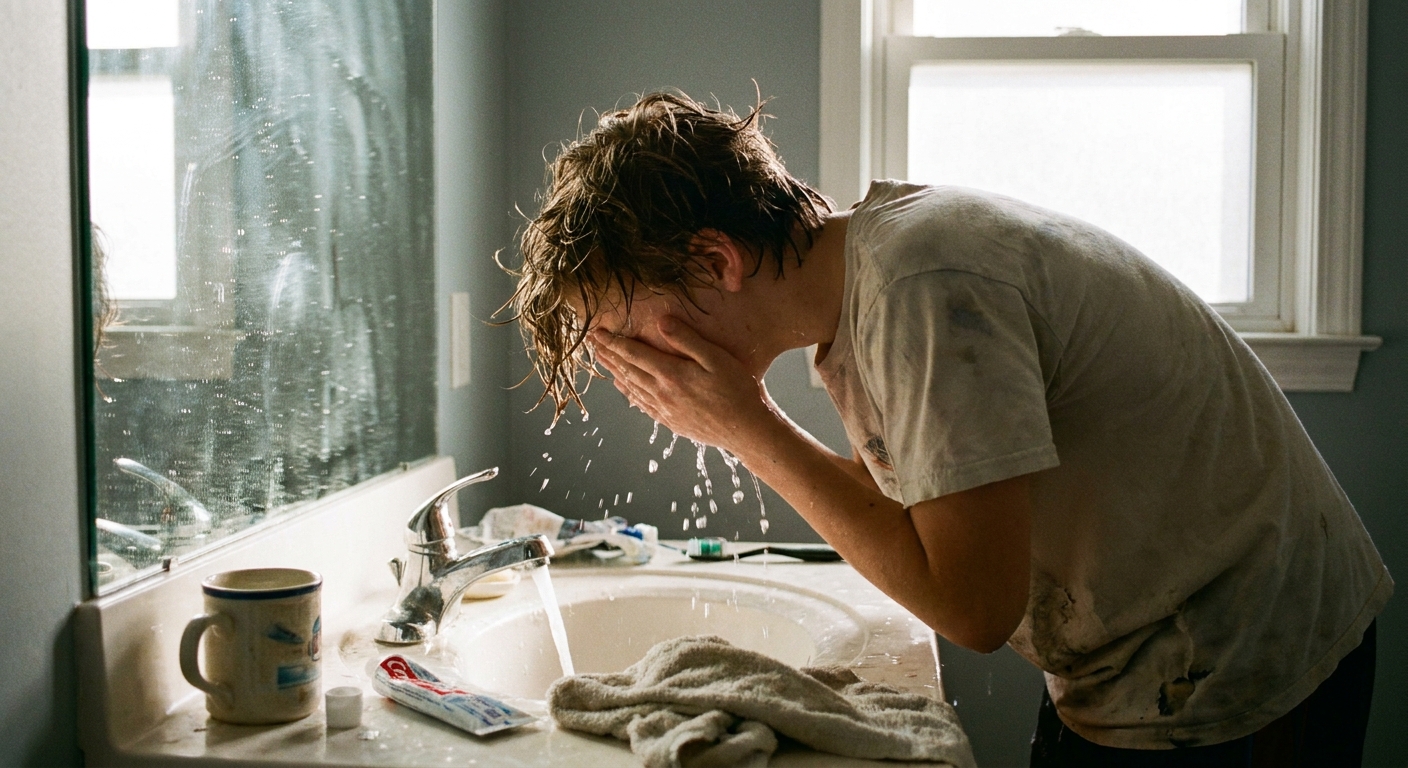
- Wet face with lukewarm water.
- Apply a small amount of cleanser. Massage for 20-30 seconds. Rinse.
- Pat face mostly dry with a clean towel.
- Apply treatment moisturizer (the Norse Organics Pimple Stopper Day Balm or whatever you chose).
- Done. Go eat breakfast.
Total time: about 60-90 seconds.
"But what about sunscreen?" Ideally yes, you should wear sunscreen daily. I'm not going to pretend that a teenager who won't do 5 steps is going to add a third product. If you will, great. SPF 30, non-comedogenic, apply after moisturizer. But if the choice is between a two-product routine you'll actually do and a three-product routine you'll abandon by Thursday, I'll take the two-product version.
Night
Same thing.
- Wet face.
- Cleanser. Massage 30 seconds. Rinse.
- Pat dry.
- Treatment moisturizer.
- Done. Go watch YouTube.
That's the whole routine. Twice a day, every day. No toner. No serum. No essence. No "waiting 15 minutes between steps."
Why This Actually Works
I can hear the skincare enthusiasts typing their objections already. "That's too simple!" "You NEED a toner!" "Where's the retinoid?!"
Here's the evidence:
Cleansing removes the stuff that clogs pores. Excess sebum, dead skin cells, environmental grime, bacteria. That alone reduces breakout frequency. A 2018 review in Dermatologic Therapy confirmed that proper cleansing is the foundation of acne management [4].
Moisturizing maintains barrier function. An intact skin barrier keeps bacteria out and reduces the inflammatory response that turns clogged pores into red, swollen pimples [5]. Skipping moisturizer in the name of "drying out" your acne is counterproductive.
Active ingredients in the treatment moisturizer do the acne-fighting work. Products like the Norse Organics formula contain ingredients that target Cutibacterium acnes bacteria, reduce inflammation, and support skin healing, all while hydrating.
Consistency amplifies everything. The best retinoid in the world won't help if you use it once a week. A simpler product used religiously will outperform a stronger product used sporadically. A study tracking teen adherence to acne treatments found that simpler regimens had roughly 75% adherence rates versus 30-40% for complex ones [1].
Let that sink in. You're getting almost twice the treatment effect just by making the routine easier to follow.
The Math of Consistency
Let's make this concrete.
Scenario A: A 7-product routine that you follow 3 times a week (out of 14 possible applications). That's a 21% adherence rate. Your skin gets some treatment, some of the time, with some days of complete neglect mixed in.
Scenario B: A 2-product routine that you follow every morning and every night, 14 out of 14 times. That's 100% adherence. Your skin gets consistent, uninterrupted treatment.
Scenario B wins. It's not even close.
This is the same principle behind exercise science. Walking for 30 minutes every day produces better health outcomes than running for an hour once a week [6]. Frequency and consistency beat intensity.
"But My Acne Is Really Bad"
Fair point. If you have severe cystic acne, a two-product routine might not be enough. You might need prescription medication, which means a dermatologist visit regardless of how many over-the-counter products you use.
But here's what I'd suggest: start with the two products for 6-8 weeks. If you see improvement, stay the course. If you don't, you can either:
- Add one more product. A benzoyl peroxide wash (2.5%) in the evening, used before your moisturizer. That bumps you to 3 products, which is still very manageable.
- See a dermatologist. They can prescribe adapalene, topical antibiotics, or other treatments. But even with prescriptions, your cleanser and moisturizer foundation stays the same. You're just adding a treatment step, not reinventing your routine.
The two-product routine is a floor, not a ceiling. You can build on it whenever you're ready. But the floor has to be solid first, and showing up every day is what makes it solid.
Things That Help (That Aren't Products)
Since we're keeping this minimal, here are some zero-product habits that make a genuine difference:
Don't touch your face. The average person touches their face 16-23 times per hour [7]. Every touch transfers bacteria and oils from your hands to your skin. This one habit change can noticeably reduce breakouts.
Change your pillowcase. Once a week minimum. Twice is better. You press your face into it for 6-8 hours every night. It absorbs oil, dead skin, drool, and bacteria. Flip it over after two nights to get four nights per case if you only own two.
Drink water. Not because "hydration cures acne" (it doesn't, directly), but because dehydrated skin functions worse overall. You don't need to carry a gallon jug around. Just drink water instead of soda at meals.
Sleep. Sleep deprivation increases cortisol, which increases inflammation, which worsens acne [8]. Getting 8 hours isn't just about energy. Your skin literally repairs itself during sleep.
FAQ
Q: Can I use just one product instead of two? Technically yes, but I wouldn't recommend it. Cleansing is pretty non-negotiable. Sleeping in yesterday's sunscreen, sweat, and oil on your skin is a breakout factory. The moisturizer-treatment combo is also non-negotiable because you need to hydrate AND treat. Two is the real minimum.
Q: How long until I see results? Expect 4-6 weeks for noticeable improvement and 8-12 weeks for significant clearing. Acne treatments work on skin cells that are still forming beneath the surface. What you see today started developing 2-4 weeks ago. Be patient.
Q: What if the treatment moisturizer irritates my skin? Scale back to using it once a day (nighttime only) and use the cleanser alone in the morning. If irritation continues, switch to a gentler moisturizer without actives and see a dermatologist about appropriate treatment options.
Q: Can I use this routine if I have oily skin? Dry skin? Yes to both. Gentle cleanser plus treatment moisturizer works across skin types. If your skin is very dry, you might want a richer moisturizer at night. If very oily, the cleanser-and-light-moisturizer combo still applies, just look for gel-cream textures.
The Real Talk Section
Here's what nobody in skincare marketing will tell you: most teen acne is mild to moderate. It'll probably get better on its own as your hormones stabilize in your late teens or early 20s [9]. That doesn't mean you should ignore it. Untreated acne can cause scarring, both physical and emotional. But it does mean you don't need a PhD in skincare chemistry to manage it.
Wash your face. Moisturize with something that fights acne. Do it every day. That's genuinely 80% of the battle for most people.
The other 20% is for the dermatologist to handle if needed. Not for you to figure out by watching 47 "What I Put on My Face" videos at 2 AM.
Start tonight. It takes 90 seconds. You've already spent longer reading this post.
Bottom Line
The best acne routine is the one you'll actually do. For most teens, that means two products: a gentle cleanser and a treatment moisturizer like the Norse Organics Pimple Stopper Day Balm. Use them morning and night, every day, for at least 6-8 weeks before judging results. You can always add complexity later, but you can't get results from products sitting untouched on your bathroom shelf.
Ninety seconds. Twice a day. That's it.
Sources
- Tan JKL, et al. "A randomized controlled study of adherence to acne therapy." J Am Acad Dermatol. 2009;61(4):673-676. PubMed
- Casey BJ, et al. "The adolescent brain." Dev Rev. 2008;28(1):62-77. PubMed
- Sethi A, et al. "Moisturizers: The slippery road." Indian J Dermatol. 2016;61(3):279-287. PubMed
- Draelos ZD. "The science behind skin care: Cleansers." J Cosmet Dermatol. 2018;17(1):8-14. PubMed
- Del Rosso JQ, Levin J. "The clinical relevance of maintaining the functional integrity of the stratum corneum in both healthy and disease-affected skin." J Clin Aesthet Dermatol. 2011;4(9):22-42. PubMed
- Warburton DER, et al. "Health benefits of physical activity: the evidence." CMAJ. 2006;174(6):801-809. PubMed
- Kwok YLA, et al. "Face touching: A frequent habit that has implications for hand hygiene." Am J Infect Control. 2015;43(2):112-114. PubMed
- Chiu A, et al. "The response of skin disease to stress." Arch Dermatol. 2003;139(7):897-900. PubMed
- Gollnick HP, et al. "Management of acne: a report from a Global Alliance to Improve Outcomes in Acne." J Am Acad Dermatol. 2003;49(1 Suppl):S1-37. PubMed
How we reviewed this article:
Our experts continually monitor the health and wellness space, and we update our articles when new information becomes available.
Read This Next

The Acne Glossary: Every Term You'll Encounter, Explained Simply
From adapalene to zinc, every acne and skincare term you'll run into, defined in plain language without the medical jargon.
Read More →
Micellar Water for Acne-Prone Skin: Gentle Cleanser or Lazy Shortcut?
Micellar water is fine for light cleansing days but won't remove sunscreen properly. Here's when to use it, when to skip it, and whether you need to rinse.
Read More →
How Seasonal Changes Affect Your Acne (And When to Switch Products)
Going to College with Acne: Preparing Your Skincare for Dorm Life