Does Sleep Affect Acne? What Happens to Your Skin While You Sleep
Medically reviewed by Dr. Sarah Mitchell, MD, Board-Certified Dermatologist
Written by Teen Acne Solutions Team — Updated May 1, 2026
Key takeaways
- Skin cell turnover peaks at night. Growth hormone release during deep sleep drives cell repair and collagen production, which is why chronic sleep loss shows up on your face.
- Sleeping under 6 hours raises cortisol levels measurably, and elevated cortisol increases oil production and inflammation, both direct acne triggers.
- Phone screens before bed hurt your skin in two ways: blue light may have minor direct effects, but the bigger issue is that screens delay sleep onset by 30-60 minutes on average.
- Your PM skincare routine matters more than your AM one because skin is more permeable at night and active ingredients like retinoids and niacinamide work better during the repair window.
You probably already know you're supposed to sleep more. Everyone says it. Teachers, parents, that one friend who somehow goes to bed at 9:30 and wakes up looking annoyingly refreshed. Telling a teenager to sleep more is about as useful as telling them to stress less. Sure, great advice. Not exactly actionable.
But here's why I think the sleep-acne connection is worth paying attention to even if you've tuned out every other "get more sleep" lecture: your skin is doing specific, measurable repair work while you're asleep, and when you cut that short, the consequences show up on your face in ways that matter for acne specifically. This isn't vague wellness talk. There's a real biological mechanism at work.
What your skin does while you sleep
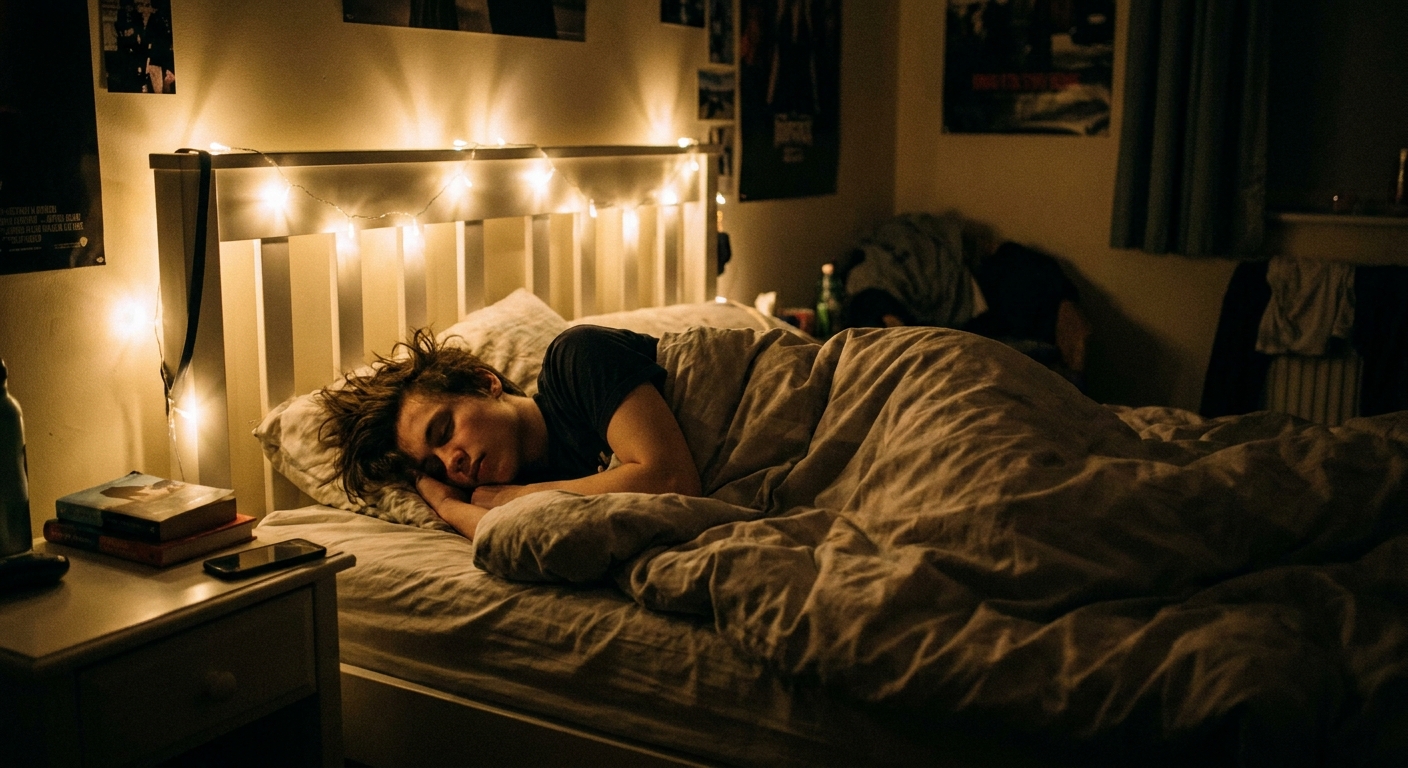
Your skin doesn't just sit there at night. It's actually more active during sleep than during the day, and the type of activity shifts in ways that directly affect acne.
During deep sleep (stages 3 and 4 of non-REM sleep), your pituitary gland releases a surge of growth hormone. This triggers a cascade of repair processes: damaged cells get replaced faster, collagen production increases, and blood flow to the skin picks up, bringing more nutrients and oxygen to the surface.
Research published in the International Journal of Molecular Sciences in 2016 mapped out the skin's circadian rhythm and found that cell division in the epidermis peaks between 11 PM and 4 AM. Skin cell turnover, the process by which old cells shed and new ones replace them, happens roughly 30 times faster during sleep than during the day.
Why does this matter for acne? Because one of the core problems in acne-prone skin is that dead cells don't shed properly. They stick together inside the pore, mixing with sebum and forming a plug. That plug becomes a whitehead. That whitehead can become an inflamed pimple. Anything that disrupts your skin's natural shedding cycle, including not sleeping enough, contributes to this clogging process.
There's also an inflammation angle. During sleep, your body produces anti-inflammatory cytokines and clears out inflammatory mediators that built up during the day. Cut sleep short, and you carry more inflammation into the next day. Given that inflammation is what turns a clogged pore into a red, angry breakout, this matters.
Cortisol, sleep debt, and breakouts
The cortisol connection is probably the most well-documented pathway between sleep and acne.
A frequently cited 1999 study in The Lancet by Spiegel, Leproult, and Van Cauter showed that restricting sleep to 6 hours per night for one week increased evening cortisol levels and slowed the rate at which cortisol cleared from the body. The subjects weren't doing anything stressful during the day. They were just sleeping less. That alone was enough to measurably raise their stress hormone levels.
And cortisol, as we know from acne research, does two things you don't want:
It increases sebum production. Your oil glands have cortisol receptors on them. When cortisol levels go up, those glands produce more oil. A 2007 study in Acta Dermato-Venereologica confirmed this connection in adolescents specifically, finding that higher psychological stress (and by extension, higher cortisol) correlated with increased sebum output.
It ramps up inflammation. Cortisol in chronic excess doesn't just suppress immunity cleanly. It creates a messy immune response where certain inflammatory pathways get amplified while others get suppressed. The net result for skin is more redness, more swelling, and longer healing times for existing breakouts.
So when you sleep 5 hours instead of 8, you're not just tired. You're walking around with higher cortisol, oilier skin, and more inflammation. Any of those alone can trigger breakouts. Together, they're pretty reliable at it.
A 2015 study at University Hospitals Case Medical Center found that self-reported poor sleep quality was associated with increased signs of skin aging and slower barrier recovery. The researchers noted that poor sleepers showed significantly more transepidermal water loss, meaning their skin barrier was compromised. A weakened barrier means more irritation, more sensitivity, and for acne-prone skin, more reactivity to bacteria and products.
The phone-before-bed problem
I debated whether to include this section because it risks sounding preachy, which I'm trying to avoid. But the research is interesting enough that I think it's worth covering, and probably not for the reasons you expect.
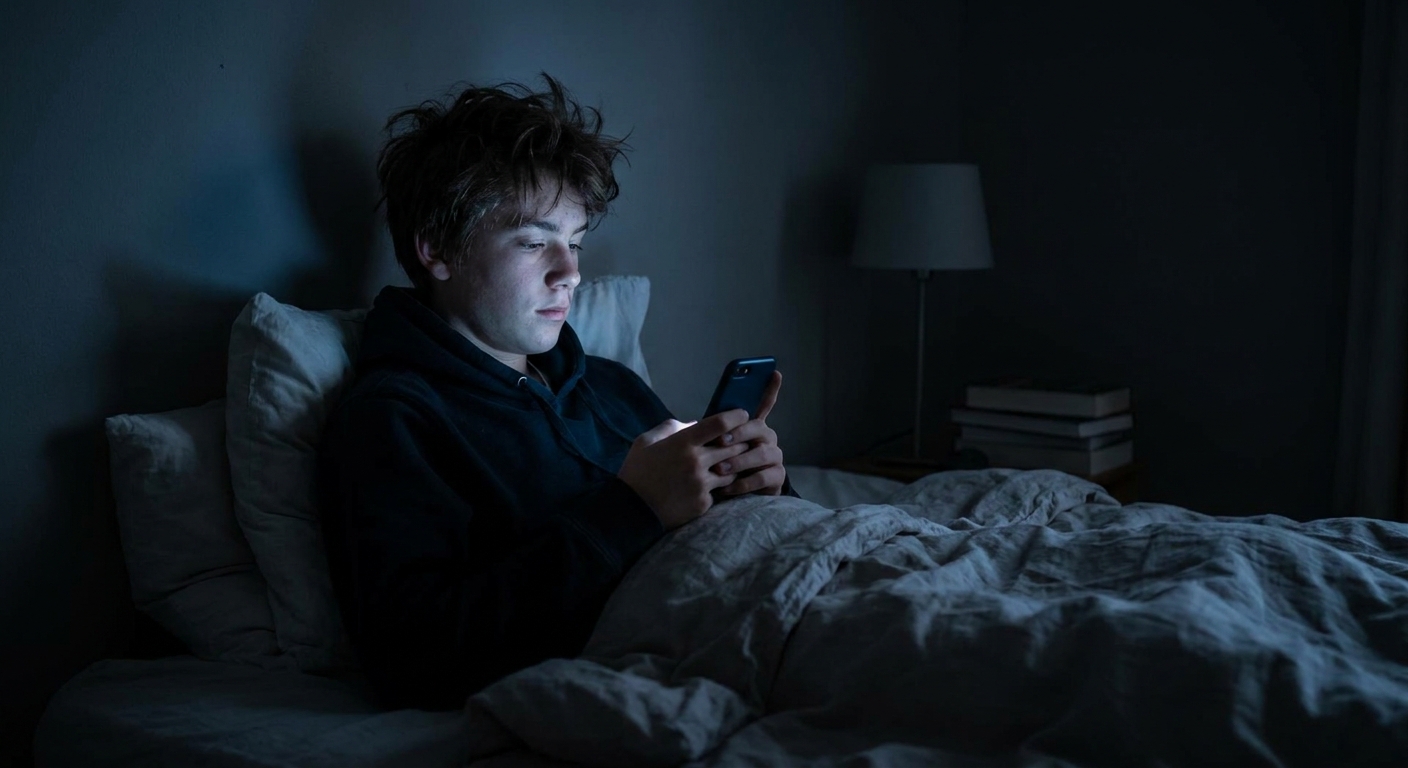
The blue light conversation has gotten overblown. Yes, blue light (wavelengths around 380-500nm) can affect skin cells in lab settings. Some in vitro studies have shown that high-intensity blue light exposure can increase oxidative stress in skin cells and potentially stimulate melanocytes. But the intensity used in those lab studies is way beyond what your phone screen emits. The evidence that your phone's blue light directly damages your skin in real-world conditions is, to be honest, pretty thin.
Where phones genuinely do matter is sleep disruption.
A 2015 study in the Proceedings of the National Academy of Sciences compared people reading on an iPad before bed versus reading a printed book. The iPad group took longer to fall asleep, had reduced melatonin secretion, and felt sleepier the next morning. The effect was real and measurable. And it wasn't huge in isolation, maybe 30 minutes of delayed sleep onset, but over time those 30 minutes add up.
For teens, the problem compounds because it's not just the light. It's the content. Scrolling Instagram, responding to group chats, watching TikToks: these are psychologically activating. Your brain doesn't wind down while you're processing social information and novelty. By the time you put the phone down, you may be tired but your nervous system is still buzzing, and falling asleep takes even longer.
So my honest take: don't worry about buying blue-light blocking skincare or special screen filters for your skin. But do think about what screens are doing to your sleep schedule, because that has a real and documented effect on your acne.
How much sleep teens actually need (vs. how much they get)
The American Academy of Sleep Medicine recommends that teenagers aged 13-18 get 8 to 10 hours of sleep per night. That recommendation is based on a consensus statement published in 2016 and it's pretty uncontroversial among sleep researchers.
The gap between that recommendation and reality is enormous.
National surveys consistently show that most teens average about 6.5 to 7.5 hours on school nights. Some get less. A CDC Youth Risk Behavior Survey found that roughly 73% of high school students sleep less than 8 hours on school nights.
This isn't entirely the teen's fault. Puberty shifts the circadian clock later, a process called delayed sleep phase. Melatonin release, which tells your brain it's time to sleep, shifts about 2 hours later in adolescence compared to childhood. So a teen who can't fall asleep before 11 PM isn't being difficult. Their biology has literally moved their sleep window later. But school start times haven't moved to match, which means the alarm goes off at 6:30 AM whether you fell asleep at 10 PM or midnight.
The result is chronic sleep debt. Not one bad night, but weeks and months of running on less sleep than your body needs. And chronic sleep debt keeps cortisol chronically elevated, which keeps oil production chronically elevated, which keeps your acne chronically active.
I don't have a magic fix for school start times. But understanding that the deck is stacked against teen sleep makes it easier to prioritize the parts you can control.
PM skincare: why nighttime treatments work harder
Your evening skincare routine does more work than your morning one, and that's not marketing talk.
Skin permeability follows a circadian pattern. Research has shown that transepidermal water loss (a measure of how "open" the skin barrier is) peaks in the evening and overnight. This means your skin absorbs topical products more effectively at night.
Additionally, because your skin is in repair mode during sleep, active ingredients applied before bed are working with the biological grain rather than against it.
Some specifics:
Retinoids (tretinoin, adapalene, retinol) are photosensitive and break down in sunlight, which is one reason they're recommended for PM use. But they also work better at night because they support the cell turnover process that naturally accelerates during sleep.
Niacinamide helps regulate sebum production and strengthen the skin barrier. Applying it at night gives it hours of uninterrupted contact time without being diluted by sweat, sunscreen, or makeup.
Benzoyl peroxide used as a leave-on treatment at night has extended contact time with acne bacteria. Some people can't tolerate it during the day because it bleaches fabric and can feel drying under sunscreen.
A reasonable PM routine for acne-prone skin doesn't need to be complicated: gentle cleanser, one active treatment (retinoid or benzoyl peroxide, not both on the same night unless your dermatologist specifically says so), and a non-comedogenic moisturizer. That's it.
Practical sleep habits that won't bore you to death
I'm not going to give you a ten-step sleep hygiene protocol. Most of them are aspirational nonsense for a teenager with homework due at 11 PM. Instead, here are the things that research suggests actually move the needle, in rough order of impact:
Keep your wake time consistent. Even on weekends. This is probably the single most effective thing you can do for sleep quality, and it's also the hardest. Your circadian clock sets itself primarily by when you wake up, not when you go to bed. Sleeping until noon on Saturday and then trying to fall asleep at 10 PM on Sunday is like giving yourself jet lag every week.
Put the phone outside the bedroom. Not face down on the nightstand. Outside. If you use it as an alarm, buy a $10 alarm clock. This one change eliminates both the blue light issue and the "just one more scroll" issue simultaneously.
Make your room dark. Blackout curtains or an eye mask. Light exposure during sleep suppresses melatonin and fragments your sleep cycles. Even the LED on a charging cable can be disruptive for some people.
Cool temperature. Your body drops its core temperature during sleep onset. A room that's too warm interferes with this process. Around 65-68°F (18-20°C) is the range most sleep researchers recommend.
Caffeine cutoff. Caffeine has a half-life of about 5-6 hours. An energy drink at 4 PM still has half its caffeine in your system at 10 PM. I'm not saying don't drink coffee. I'm saying don't drink it after lunch if you want to fall asleep at a reasonable hour.
Don't try to go to bed earlier by force. If you're currently falling asleep at midnight, setting an alarm for "bedtime" at 10 PM will just mean two hours of lying in bed frustrated. Instead, keep your wake time locked and let sleep pressure gradually pull your bedtime earlier over a week or two.
Bottom line
Sleep affects acne through straightforward biological pathways: less sleep means more cortisol, more oil, more inflammation, and less time for your skin to do its nightly repair work. The research on this is solid. Phones before bed matter less for their blue light and more because they steal 30-60 minutes of sleep you weren't going to get back.
You probably can't get 9 hours on a school night. But the gap between 6 hours and 7.5 hours is bigger than it sounds for your skin. Keep your wake time steady, get the phone out of the bedroom, and take your PM skincare routine seriously. Those three things alone are a meaningful difference.
How we reviewed this article:
Our experts continually monitor the health and wellness space, and we update our articles when new information becomes available.
- Spiegel K, Leproult R, Van Cauter E. Impact of sleep debt on metabolic and endocrine function. Lancet. 1999;354(9188):1435-1439https://pubmed.ncbi.nlm.nih.gov/10543671/
- Oyetakin-White P, et al. Does poor sleep quality affect skin ageing? Clin Exp Dermatol. 2015;40(1):17-22https://pubmed.ncbi.nlm.nih.gov/25266053/
- Hisler GC, et al. Sleep and body mass index, acne severity, anxiety, and depressive symptoms in young adults. Sleep. 2020;43(Suppl_1):A422
- Chiu A, Chon SY, Kimball AB. The response of skin disease to stress: changes in the severity of acne vulgaris as affected by examination stress. Arch Dermatol. 2003;139(7):897-900https://pubmed.ncbi.nlm.nih.gov/12873885/
- Leung DYM, Bieber T. Atopic dermatitis. Lancet. 2003;361(9352):151-160https://pubmed.ncbi.nlm.nih.gov/12531593/
- Chang AM, et al. Evening use of light-emitting eReaders negatively affects sleep, circadian timing, and next-morning alertness. Proc Natl Acad Sci. 2015;112(4):1232-1237https://pubmed.ncbi.nlm.nih.gov/25535358/
- Crowley SJ, et al. Sleep, circadian rhythms, and delayed phase in adolescence. Sleep Med. 2007;8(6):602-612https://pubmed.ncbi.nlm.nih.gov/17383934/
- American Academy of Sleep Medicine. Recommended amount of sleep for pediatric populations. J Clin Sleep Med. 2016;12(6):785-786https://pubmed.ncbi.nlm.nih.gov/27250809/
- Yosipovitch G, et al. Study of psychological stress, sebum production and acne vulgaris in adolescents. Acta Derm Venereol. 2007;87(2):135-139https://pubmed.ncbi.nlm.nih.gov/17340019/
- Matsui MS, et al. Biological rhythms in the skin. Int J Mol Sci. 2016;17(6):801https://pubmed.ncbi.nlm.nih.gov/27231894/
Read This Next
When Your Sibling Has Clear Skin and You Don't: Dealing with Acne Jealousy
Watching your sibling eat the same food, skip skincare, and have perfect skin while you break out constantly is one of the most frustrating parts of having acne.
Read More →
Does Sunlight Help or Hurt Acne? The Complicated Truth
Sun might temporarily mask acne, but it makes things worse long-term. Here's why the vacation skin effect isn't what you think and why UV isn't an acne treatment.
Read More →
Instagram Filters and Acne: How Social Media Distorts Skin Reality
Filters blur texture, erase pores, and create a version of skin that doesn't exist in real life. Here's how that messes with your head when you have acne.
Read More →
Honey for Acne: Does This Kitchen Ingredient Actually Work?
Manuka honey has real antibacterial research behind it. Regular honey, not so much. Here's what works, what doesn't, and whether it's worth the sticky mess.
Read More →
Green Tea and Acne: The Drink (and Ingredient) That Might Help
EGCG in green tea has anti-inflammatory and anti-androgenic properties that could help acne-prone skin. Here's what the research says about drinking it and putting it on your face.
Read More →