The Acne Diet: What to Eat (and Avoid) for Clearer Skin
The Acne Diet: What to Eat (and Avoid) for Clearer Skin
I spent most of high school convinced that greasy pizza was causing my breakouts. My mom told me it was chocolate. My friend blamed dairy. Turns out we were all sort of right, sort of wrong, and mostly confused about the mechanism behind it.
The connection between food and acne is real, but it's not as simple as "eat this, not that." The research has gotten a lot more specific in the last decade, and I think it's worth understanding the actual biology before you start cutting entire food groups out of your life.
The glycemic index thing
Here's what actually happens. When you eat foods that spike your blood sugar fast (white bread, sugary cereal, candy, soda), your body dumps insulin to deal with it. That insulin spike triggers a cascade: it raises levels of insulin-like growth factor 1 (IGF-1), which tells your skin to produce more sebum, and it increases androgen activity, which does the same thing. More sebum means more clogged pores. More clogged pores means more acne.
This isn't speculation. A 2007 study published in the American Journal of Clinical Nutrition put young men on a low-glycemic-load diet for 12 weeks. Their acne improved measurably compared to the control group eating a typical high-GI diet. A follow-up analysis found the low-GI group also had lower IGF-1 levels and improved insulin sensitivity (Smith et al., 2007).
The glycemic index (GI) ranks foods by how quickly they raise blood sugar. High-GI foods include white rice, white bread, potatoes, sugary drinks, most breakfast cereals. Low-GI foods are things like whole grains, most vegetables, legumes, nuts. The glycemic load (GL) factors in portion size, which makes it more useful in practice.
You don't need to memorize a chart. The rough rule: if it's processed and sweet or very starchy, it's probably high-GI. If it grew out of the ground and still looks like what it is, it's probably low-GI.
Foods that seem to help
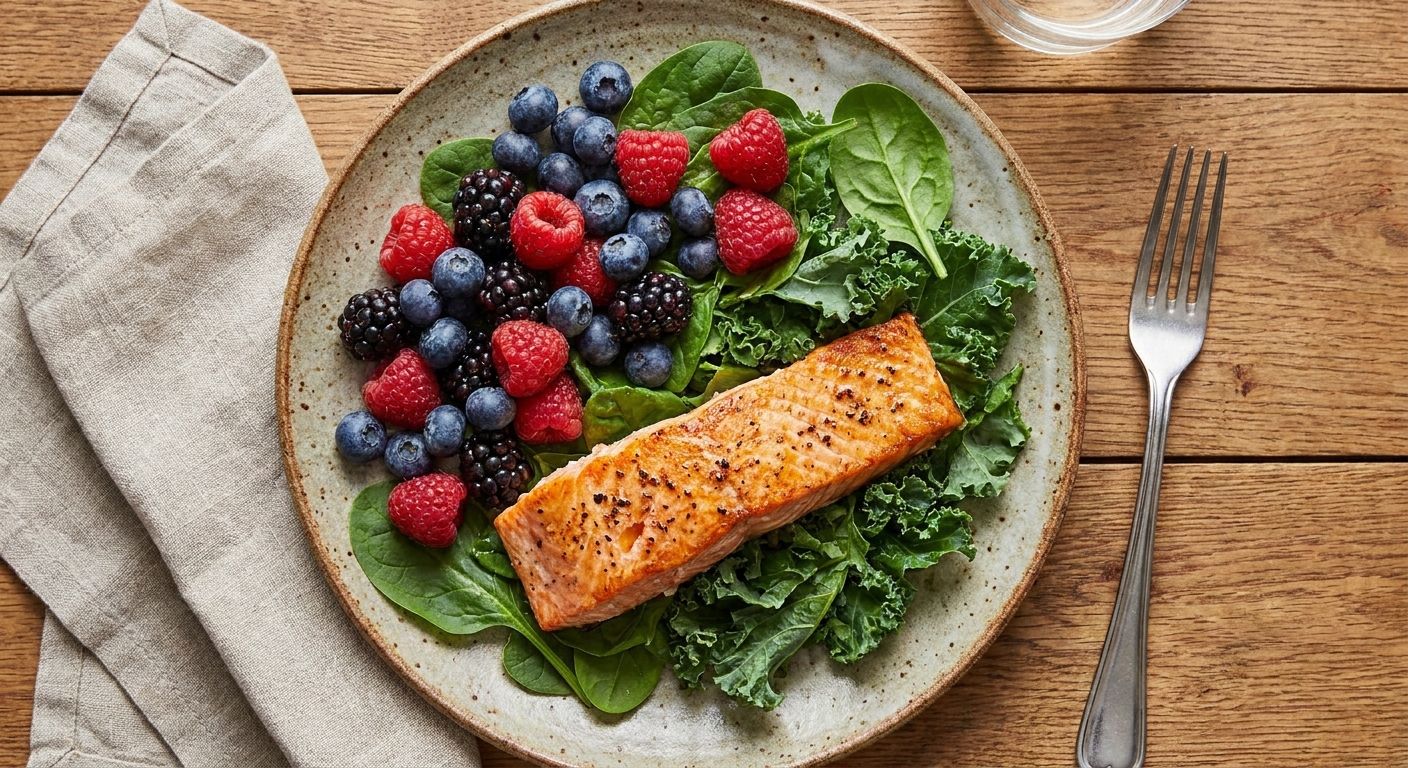
Fatty fish. Salmon, mackerel, sardines. These are loaded with omega-3 fatty acids, which are anti-inflammatory. A 2020 study in the Journal of Cosmetic Dermatology found that omega-3 supplementation reduced inflammatory acne lesions after 10 weeks (Jung et al., 2020). I'd rather eat actual fish than take pills, but fish oil capsules work too if you hate seafood.
Zinc-rich foods. Oysters are the best source, but pumpkin seeds, chickpeas, beef, and cashews all have decent amounts. Zinc has been studied for acne since the 1970s. People with acne tend to have lower zinc levels than people without it (Rostami Mogaddam et al., 2014). A meta-analysis in Dermatologic Therapy found that zinc supplementation improved acne, especially inflammatory acne, though the effect was moderate (Yee et al., 2020).
Berries and colorful produce. Blueberries, strawberries, spinach, bell peppers. These contain antioxidants that reduce oxidative stress, which worsens inflammation. There's no single study that says "eat blueberries, cure acne," but the overall pattern in the research points toward diets high in fruits and vegetables being associated with less acne.
Green tea. Contains epigallocatechin-3-gallate (EGCG), which is an antioxidant that also has anti-androgen properties. A small study found that taking green tea extract for 4 weeks reduced acne lesions in adult women (Lu & Hsu, 2016). Drinking a few cups a day isn't going to transform your skin overnight, but it's a reasonable swap for soda.
Foods that probably make acne worse
Sugar and refined carbs. Already covered this above. The insulin-IGF-1 pathway is the best-studied dietary mechanism in acne. This doesn't mean you can never eat a cookie. It means that if your diet is mostly processed carbs and sugar, your skin is probably paying for it.
Skim milk. This one surprised me. Whole milk doesn't seem to have as strong an association, but skim milk specifically has been linked to acne in multiple large observational studies. A 2019 meta-analysis in Nutrients covering over 70,000 participants found a positive association between dairy intake and acne, with the strongest link for skim milk (Aghasi et al., 2019).
The theory is that skim milk has higher levels of bioavailable hormones and IGF-1 because the fat has been removed but the whey protein concentration is higher. It's not totally settled science, but the signal is consistent enough that it's worth paying attention to.

Whey protein. If you're hitting the gym and chugging whey protein shakes, this could be a factor. Whey is highly insulinotropic, meaning it spikes insulin more than you'd expect from its calorie content. There are case reports and small studies linking whey protein supplementation to acne flares, especially in young men (Simonart, 2012). Switching to a plant-based protein powder is an easy experiment if you suspect this.
Chocolate? The chocolate-acne connection has been debated for decades. A few small studies have found that pure chocolate (not milk chocolate with sugar) might worsen acne, possibly through effects on the immune system's response to acne-causing bacteria. But the studies are tiny and the evidence is weak. I wouldn't lose sleep over it.
Elimination diets beat blanket rules
Here's my honest take: reading a list of "good foods" and "bad foods" and trying to follow it perfectly is a recipe for stress. And stress, ironically, makes acne worse.
What works better is paying attention to your own skin. Everyone's triggers are different. Some people break out from dairy. Some don't. Some people can eat white rice every day with no issues. Some can't.
The practical approach is an elimination diet. Pick one suspect (dairy is a common starting point). Cut it out completely for 3 to 4 weeks. See what happens to your skin. Then reintroduce it and see if anything changes. This takes patience. Acne doesn't clear overnight, and new breakouts take weeks to form, so you need to actually stick with it long enough to see a pattern.
Keep a simple food and skin diary. Nothing elaborate. Just jot down what you ate and what your skin looked like that day. After a month or two, patterns start showing up that you'd never notice otherwise.
The gut-skin axis
This is newer research and I find it genuinely interesting, even though it's still early. Your gut microbiome (the trillions of bacteria living in your intestines) appears to communicate with your skin through immune signaling, metabolites, and neurotransmitters. Researchers call this the gut-skin axis.
A 2021 review in Frontiers in Microbiology found that people with acne tend to have less microbial diversity in their gut compared to people with clear skin (De Pessemier et al., 2021). Some small studies have shown that oral probiotics (particularly Lactobacillus and Bifidobacterium strains) can improve acne, though the evidence is still preliminary.
What does this mean practically? Eating fermented foods (yogurt, kimchi, sauerkraut, kefir) and a variety of fiber-rich plants feeds your gut bacteria. Whether that directly improves your acne is still being studied, but it's not going to hurt, and the general health benefits are well established.
I wouldn't spend money on expensive probiotic supplements marketed for skin health. The marketing is way ahead of the science on that one.

Please don't develop an eating disorder over this
I need to say this directly because I've seen it happen. Teenagers, especially ones who already feel bad about their appearance because of acne, can take dietary advice and run it to an extreme. Orthorexia (an obsession with "clean" eating that becomes its own disorder) is real, and it's particularly common among young people who feel like they need to control something.
If you find yourself:
- Feeling intense guilt or anxiety after eating a "bad" food
- Avoiding social situations because you can't control what food is available
- Spending hours researching which foods are "safe"
- Losing weight you don't need to lose
- Thinking about food rules more than you think about food itself
...then the diet changes have gone too far, and you need to talk to someone about it. A parent, a school counselor, a doctor. Your skin is not worth sacrificing your mental health or your relationship with food.
The goal here is modest shifts, not perfection. Eating a bit more fish and vegetables, drinking water instead of soda most of the time, not living on candy and white bread. That's it. You can still eat pizza with your friends.
Key takeaways
- High-glycemic foods spike insulin, which increases sebum production and can worsen acne. The evidence for this is solid.
- Fatty fish, zinc-rich foods, berries, and green tea have anti-inflammatory or hormone-modulating properties that may help your skin.
- Skim milk and whey protein have the strongest associations with acne among specific foods. Worth experimenting with cutting them out.
- An elimination approach (testing one food at a time) is more useful than following a rigid "acne diet" because triggers vary from person to person.
- Emerging gut-skin axis research suggests that gut health and skin health are connected, though practical recommendations are still evolving.
Bottom line
Diet affects acne. That's no longer controversial. But it's one factor among many, not a cure-all, and definitely not a reason to punish yourself over every meal. Make some reasonable changes, pay attention to what your skin tells you, and remember that food is supposed to be something you enjoy, not a source of constant worry.
Sources
- Aghasi, M., et al. (2019). Dairy intake and acne development: A meta-analysis of observational studies. Nutrients, 11(8), 1949.
- De Pessemier, B., et al. (2021). Gut-skin axis: Current knowledge of the interrelationship between microbial dysbiosis and skin conditions. Frontiers in Microbiology, 12, 572491.
- Jung, J. Y., et al. (2020). Effect of dietary supplementation with omega-3 fatty acid and gamma-linolenic acid on acne vulgaris: A randomised, double-blind, controlled trial. Journal of Cosmetic Dermatology, 19(8), 2015-2022.
- Lu, P. H., & Hsu, C. H. (2016). Does supplementation with green tea extract improve acne in post-adolescent women? A randomized, double-blind, and placebo-controlled clinical trial. Complementary Therapies in Medicine, 25, 159-163.
- Rostami Mogaddam, M., et al. (2014). Correlation between the severity and type of acne lesions with serum zinc levels in patients with acne vulgaris. BioMed Research International, 2014, 474108.
- Simonart, T. (2012). Acne and whey protein supplementation among bodybuilders. Dermatology, 225(3), 256-258.
- Smith, R. N., et al. (2007). A low-glycemic-load diet improves symptoms in acne vulgaris patients: A randomized controlled trial. American Journal of Clinical Nutrition, 86(1), 107-115.
- Yee, B. E., et al. (2020). Serum zinc levels and efficacy of zinc treatment in acne vulgaris: A systematic review and meta-analysis. Dermatologic Therapy, 33(6), e14252.
How we reviewed this article:
Our experts continually monitor the health and wellness space, and we update our articles when new information becomes available.
Read This Next

When Your Sibling Has Clear Skin and You Don't: Dealing with Acne Jealousy
Watching your sibling eat the same food, skip skincare, and have perfect skin while you break out constantly is one of the most frustrating parts of having acne.
Read More →
Does Sunlight Help or Hurt Acne? The Complicated Truth
Sun might temporarily mask acne, but it makes things worse long-term. Here's why the vacation skin effect isn't what you think and why UV isn't an acne treatment.
Read More →
Instagram Filters and Acne: How Social Media Distorts Skin Reality
Filters blur texture, erase pores, and create a version of skin that doesn't exist in real life. Here's how that messes with your head when you have acne.
Read More →
Honey for Acne: Does This Kitchen Ingredient Actually Work?
Manuka honey has real antibacterial research behind it. Regular honey, not so much. Here's what works, what doesn't, and whether it's worth the sticky mess.
Read More →
Green Tea and Acne: The Drink (and Ingredient) That Might Help
EGCG in green tea has anti-inflammatory and anti-androgenic properties that could help acne-prone skin. Here's what the research says about drinking it and putting it on your face.
Read More →