Double Cleansing for Teens: Is It Worth the Extra Step?
Medically reviewed by Dr. Rachel Torres, MD, Pediatric Dermatologist
Written by Teen Acne Solutions Editorial Team — Updated May 3, 2026
Double cleansing picked up massive popularity through Korean skincare culture about a decade ago, and by now it's treated as gospel in most online skincare communities. Two cleansers, every night, no exceptions.
I think that's overkill for most teenagers.
Not because double cleansing doesn't work. It does. The method is sound, and for certain situations it's genuinely the best way to clean your face. But the way it's presented online ignores something obvious: a 15-year-old who spent the day at school and didn't wear sunscreen or makeup doesn't need the same cleansing routine as a 30-year-old who wore full-coverage foundation, SPF 50, and spent 90 minutes on the subway.
Context matters, and nuance has been completely lost in this conversation.
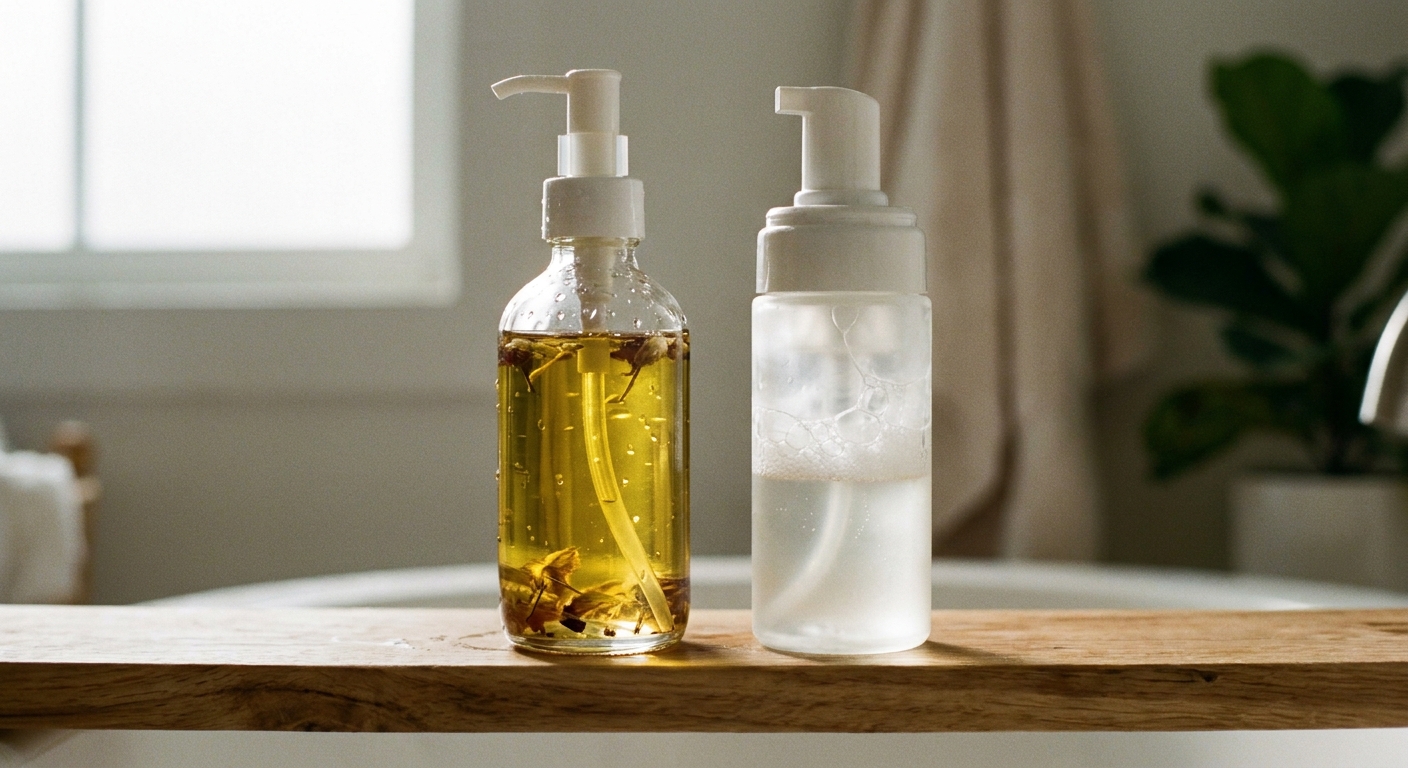
What Double Cleansing Actually Is
The concept is simple. You wash your face twice, using two different types of cleansers:
First cleanse: oil-based. This can be a cleansing oil, a cleansing balm, or a micellar water (though micellar technically works differently). The oil-based step targets oil-soluble debris: sebum, sunscreen, makeup, the general grime that accumulates on skin throughout the day. Oil dissolves oil, which is why this step is more effective at removing these things than a water-based cleanser alone (Mukhopadhyay, 2011).
Second cleanse: water-based. A gel, foam, or cream cleanser. This handles the water-soluble stuff: sweat, residual dirt, any leftover traces from the first cleanser. It also ensures you're starting your treatment step (retinoid, acne medication, whatever you use) on truly clean skin.
The two-step approach came from the observation that neither type of cleanser does a complete job on its own. Oil-based cleansers leave a slight film. Water-based cleansers can't fully break down oil-based products. Together, they cover everything.
That's the theory. In practice, the question is whether your face actually has enough on it to warrant both steps.
When Double Cleansing Makes Sense for Teens
There are specific situations where the two-step method earns its place in a teen's routine:
After Wearing Sunscreen
This is the number one reason I recommend double cleansing to teenagers. If you're wearing sunscreen daily (and you should be, especially if you're using retinoids or other acne treatments that increase sun sensitivity), a single water-based cleanser often leaves sunscreen residue behind.
Mineral sunscreens with zinc oxide are particularly stubborn. They sit on top of the skin and resist water-based removal. Chemical sunscreens absorb into the upper layers and can also leave residue, though they're generally easier to wash off (Gabros et al., 2023).
Leftover sunscreen clogs pores overnight. If you've ever started wearing sunscreen religiously and noticed new breakouts a few weeks later, insufficient removal is likely the cause. An oil-based first cleanse dissolves that sunscreen film, and your regular cleanser finishes the job.
After Wearing Makeup
Concealer, foundation, powder. Even tinted moisturizer and BB cream. These products are formulated to stay on your skin, which means they resist casual washing. An oil-based cleanser breaks down makeup bonds much more effectively than scrubbing harder with a foaming cleanser (which is what most people do instead, and which damages the skin barrier).
Heavy Sweat Days
After sports practice, a long run, or any activity where you sweated heavily for an extended period, your pores have been sitting in a mix of sweat, sebum, and whatever was on your skin beforehand. A double cleanse is appropriate here.
That said, if you shower right after exercise and wash your face with a regular cleanser during that shower, a second oil cleanse beforehand isn't strictly necessary. The timing matters. Sweat that sits on skin for hours is more problematic than sweat that gets washed off within 20 minutes.
When Using Heavy or Occlusive Products
Some acne treatments, particularly thick ointment-based formulations, and some overnight masks or heavy moisturizers leave a residue that a single cleanse won't handle. If you used something thick and occlusive the night before, a morning double cleanse might make sense. But this is situational, not a daily rule.

When Double Cleansing Is Overkill
Here's where I disagree with a lot of what you'll read online.
Most School Mornings
You slept. Your face touched a pillowcase. You didn't apply sunscreen, makeup, or anything else since your PM routine. The only thing on your skin is a thin layer of overnight sebum and maybe some product residue from the night before.
A single gentle cleanser handles this in 30 seconds. Double cleansing a face that has nothing on it just strips the lipid barrier for no reason. Your skin produces oils overnight as part of its natural repair process (Youn et al., 2002). Aggressively removing all of them every morning can trigger a cycle of overproduction. You strip it, it overcompensates, you strip it again, and your skin stays oily all day.
For mornings, I'd actually argue that many teens could get away with just splashing water on their face and applying their morning products. If that feels too minimal, one gentle cleanser. Not two.
Days Where You Stayed Home
No sunscreen, no makeup, minimal sweat. Maybe you played video games or studied all day. Your face doesn't need a 5-step cleansing ritual. One cleanser, done.
If Your Skin Is Irritated or Compromised
When your skin barrier is already struggling, signs being tightness, flaking, stinging when you apply products, more cleansing makes it worse. Even a gentle oil cleanser adds surfactants and friction that a compromised barrier doesn't need. Scale back to one mild, fragrance-free cleanser until your barrier recovers.
This comes up a lot with teens who are adjusting to retinoids. The first 4-6 weeks on adapalene or tretinoin often involve peeling and sensitivity. Double cleansing during this adjustment period can push irritation over the edge.
The PM-Only Approach (What I Actually Recommend)
For most teenagers, here's the framework that makes the most practical sense:
Morning: single cleanse or water only. One gentle cleanser if you feel you need it. Water splash if your skin isn't oily in the AM. Then apply your morning products (treatment, moisturizer, sunscreen).
Evening: double cleanse on applicable nights. If you wore sunscreen, makeup, or sweated heavily, do the two-step. If you didn't, one cleanser is fine.
For most teens, this means double cleansing 3-4 nights per week, not 7. Maybe more in summer when sunscreen use is heavier and sweat is more of a factor. Maybe less in winter when you're indoors more and might skip sunscreen on low-UV days.
This isn't lazy. It's calibrated. Your skin barrier is a living structure that needs its natural lipids to function properly. Every cleanse removes some of those lipids. The goal is removing what doesn't belong (sunscreen, makeup, excess sebum, environmental grime) without stripping what does.
Product Pairings That Work
The first and second cleansers need to play well together. Here are combinations that work for acne-prone teen skin without breaking the bank:
Budget-Friendly Pairing
First cleanse: A basic cleansing oil with mineral oil or jojoba oil as the main ingredient. Look for one without fragrance. Plenty of options under $10 at any drugstore.
Second cleanse: CeraVe Foaming Facial Cleanser or La Roche-Posay Toleriane Purifying Foaming Cleanser. Both contain ceramides or niacinamide that support barrier repair, counteracting any slight stripping from the first cleanse.
For Very Oily Skin
First cleanse: A lightweight cleansing oil or micellar water. If the residue from heavier cleansing oils bothers you, micellar water on a cotton pad works as a lighter first step. It's less effective at dissolving stubborn sunscreen than a true oil cleanser, but it's better tolerated by very oily skin.
Second cleanse: A salicylic acid cleanser (2%). This serves double duty: cleaning and delivering a low-level chemical exfoliant. CeraVe SA Cleanser or Neutrogena Oil-Free Acne Wash are straightforward options. Don't leave SA cleansers on for more than 60 seconds, though. They're meant to be rinsed off.
For Dry or Sensitive Acne-Prone Skin
First cleanse: A cleansing balm. Balms tend to be gentler than liquid cleansing oils because they require less surfactant to emulsify. They also feel more hydrating during the massage step.
Second cleanse: A cream or lotion cleanser rather than a foam. Foaming agents (particularly sodium lauryl sulfate, which some cheaper cleansers still use) can be too stripping for dry skin. Look for sulfate-free formulas.

How to Do Each Step Properly
Small technical details make a bigger difference than people expect.
The First Cleanse (Oil/Balm)
Apply to dry skin. This is the most common mistake I see. If your face is wet, the water creates a barrier between the oil and the sebum/sunscreen sitting in your pores. The oil can't bond properly, and you lose most of the benefit.
Use about a nickel-sized amount. Massage with gentle, circular motions for about 60 seconds. No need to press hard. The oil does the work through chemical affinity, not mechanical force.
After massaging, wet your hands with warm water and massage again for another 15-20 seconds. This emulsifies the oil, turning it milky. Then rinse thoroughly. You should feel a slight slip to your skin but no heavy oily layer.
The Second Cleanse (Water-Based)
Apply to damp skin. Lather gently. This step doesn't need to be long. Thirty seconds is enough. The first cleanse already did the heavy lifting. The second is more of a rinse and refine.
Use lukewarm water, not hot. Hot water feels satisfying but strips protective lipids and can trigger flushing and irritation, especially on acne-prone skin (Ananthapadmanabhan et al., 2004).
Pat dry with a clean towel. Don't rub.
What About Cleansing Tools?
Silicone scrubbing pads, cleansing brushes, muslin cloths. These show up in every double cleansing tutorial, and my opinion is that they're unnecessary for acne-prone teen skin.
Your fingertips provide enough gentle friction. Brushes and pads add mechanical exfoliation that acne-prone skin often can't handle, especially if you're already using chemical exfoliants or retinoids. They also harbor bacteria if not cleaned religiously, which most people aren't great about.
If you like the feeling of a silicone pad during the second cleanse and your skin tolerates it, fine. But it's not adding meaningful cleansing power. It's a texture preference.
The Real Reason Most Teens Over-Cleanse
I want to address something that comes up constantly. A lot of teens wash their face 3 or 4 times a day because their skin feels oily by mid-afternoon. Adding double cleansing to that habit would be a disaster for their skin barrier.
The impulse makes sense. Your face is shiny, it feels gross, you want to wash it. But every time you strip the oil, your sebaceous glands respond by ramping up production. It's a feedback loop, and the solution isn't more washing. It's better oil control during the day (blotting papers, mattifying moisturizer, niacinamide serum) and appropriate cleansing at night (Draelos, 2018).
If you're currently washing your face more than twice a day, I'd focus on cutting that back to twice daily before adding a double cleanse to the evening routine. Get the frequency right first.
Tracking Whether It's Working
Give it three weeks. If double cleansing on applicable nights is working for you, here's what you should notice:
- Sunscreen and makeup come off more easily, with less scrubbing
- Fewer new clogged pores and blackheads
- Skin doesn't feel tight or stripped after washing
- Your treatment products (retinoids, serums) seem to absorb better
If after three weeks you're seeing more breakouts, more oiliness, or more irritation, scale back to single cleansing. Some skin just doesn't need or want the oil step, and that's a perfectly fine outcome.
Key Takeaways
- Double cleansing uses an oil-based cleanser first and a water-based cleanser second. The oil step removes sunscreen, makeup, and excess sebum. The water step handles the rest.
- Most teens benefit from double cleansing 3-4 evenings per week, specifically on days they wore sunscreen, makeup, or sweated heavily. Every night is overkill for most.
- Mornings almost never require a double cleanse. A single gentle cleanser or even just water is enough.
- Apply the oil cleanser to dry skin for it to work properly. This is the most commonly skipped detail.
- If your skin is irritated or adjusting to a new retinoid, cut back to single cleansing until the barrier stabilizes.
The Bottom Line
Double cleansing is a useful tool, not a daily obligation. It excels at removing things that shouldn't be left on your skin overnight: sunscreen, makeup, accumulated grime from a long day. But treating it as a non-negotiable twice-daily ritual leads to over-cleansing, which makes acne worse, not better. Match the method to what's actually on your face. Some nights that's a double cleanse. Some nights it's one quick wash. Both are valid.
Sources
-
Mukhopadhyay, P. (2011). Cleansers and their role in various dermatological disorders. Indian Journal of Dermatology, 56(1), 2-6. https://doi.org/10.4103/0019-5154.77542
-
Gabros, S., et al. (2023). Sunscreens and photoprotection. In StatPearls. StatPearls Publishing. https://www.ncbi.nlm.nih.gov/books/NBK537164/
-
Youn, S. W., et al. (2002). Regional and seasonal variations in facial sebum secretions: a proposal for the definition of combination skin type. Skin Research and Technology, 8(3), 168-174. https://doi.org/10.1034/j.1600-0846.2002.10340.x
-
Ananthapadmanabhan, K. P., et al. (2004). Cleansing without compromise: the impact of cleansers on the skin barrier and the technology of mild cleansing. Dermatologic Therapy, 17(s1), 16-25. https://doi.org/10.1111/j.1396-0296.2004.04S1002.x
-
Draelos, Z. D. (2018). The science behind skin care: Cleansers. Journal of Cosmetic Dermatology, 17(1), 8-14. https://doi.org/10.1111/jocd.12469
-
Isoda, K., et al. (2015). Comparison of the effectiveness of whole and partial face cleansing. Journal of Cosmetic Dermatology, 14(1), 51-56. https://doi.org/10.1111/jocd.12131
-
Blaak, J., & Staib, P. (2018). An updated review on efficacy and benefits of sweet almond, evening primrose and jojoba oils in skin care. Dermatology and Therapy, 2(3), 1-15. https://doi.org/10.1007/s13555-022-00821-w
-
American Academy of Dermatology. (2024). Face Washing 101. https://www.aad.org/public/everyday-care/skin-care-basics/care/face-washing-101
-
Endly, D. C., & Miller, R. A. (2017). Oily Skin: A review of treatment options. The Journal of Clinical and Aesthetic Dermatology, 10(8), 49-55.
How we reviewed this article:
Our experts continually monitor the health and wellness space, and we update our articles when new information becomes available.
Read This Next

The Acne Glossary: Every Term You'll Encounter, Explained Simply
From adapalene to zinc, every acne and skincare term you'll run into, defined in plain language without the medical jargon.
Read More →
Micellar Water for Acne-Prone Skin: Gentle Cleanser or Lazy Shortcut?
Micellar water is fine for light cleansing days but won't remove sunscreen properly. Here's when to use it, when to skip it, and whether you need to rinse.
Read More →
How Seasonal Changes Affect Your Acne (And When to Switch Products)

Going to College with Acne: Preparing Your Skincare for Dorm Life