Topical Retinoids for Acne: Understanding the Purge Period and Side Effects
Medically reviewed by Dr. Sarah Mitchell, MD, Board-Certified Dermatologist
Written by Teen Acne Solutions Team — Updated March 17, 2026
Key takeaways
- The retinoid purge affects 70-80% of users causing increased breakouts, peeling, and redness for 6-12 weeks before improvement begins—a reality that causes many to quit prematurely.
- Skin irritation is near-universal with 60-70% experiencing significant dryness, peeling, burning, and sun sensitivity throughout treatment.
- Maximum benefit requires 6-12 months of consistent use despite discomfort, with 50-70% improvement in those who persist, meaning clear skin is still not guaranteed.
Topical retinoids—tretinoin, adapalene, and tazarotene—represent the most rigorously studied acne medications with the strongest evidence base. They're also among the most poorly tolerated treatments in terms of side effects. As a physician, I find patients are rarely adequately prepared for the initial worsening phase or the prolonged timeline required to see results.
How Retinoids Work
Retinoids are vitamin A derivatives that fundamentally alter skin cell behavior at a genetic level through retinoic acid receptors. The mechanisms include:
Normalized keratinization: Prevents abnormal skin cell buildup in follicles
Comedolytic effect: Unclogs existing comedones and prevents new formation
Anti-inflammatory: Reduces inflammatory mediators
Increased cell turnover: Accelerates skin renewal (also causes side effects)
Clinical significance: Unlike benzoyl peroxide or salicylic acid which work superficially, retinoids change how skin functions. This creates both superior efficacy and more pronounced side effects.
Efficacy: What the Clinical Trials Show
At 12-16 weeks:
- 50-70% reduction in total lesion count (comedonal and inflammatory)
- Best results for comedonal acne and mild-to-moderate inflammatory acne
- Comparable to oral antibiotics without resistance concerns
At 6-12 months:
- Maximum benefit achieved
- 60-80% of persistent users achieve "clear" or "almost clear" status
- Maintenance therapy required indefinitely (acne returns if stopped)
Important context: "Clear or almost clear" in clinical trials means 1-10 small pimples, not perfect skin. The 20-40% who don't achieve this level still see improvement but retain visible acne.
The Retinoid Purge Explained
This is the aspect dermatologists underexplain, leading to treatment abandonment. The "purge" is well-documented in dermatological literature but not adequately emphasized in patient counseling.
What happens: Retinoids accelerate skin cell turnover and bring underlying microcomedones (invisible pre-pimples) to the surface rapidly. This creates a temporary but significant increase in visible breakouts.
Timeline and severity:
- Begins: Week 1-2 of treatment
- Peaks: Week 4-8
- Duration: 6-12 weeks for most patients
- Severity: Can double the number of visible pimples at peak
Clinical data: Studies show 70-80% of retinoid users experience worsening during weeks 2-8. Those who persist through this period have better long-term outcomes than those who quit.
Medical perspective: The purge is actually therapeutic—it's clearing out microcomedones that would have become pimples eventually. But psychologically and socially, it's extremely difficult for teenagers to tolerate looking worse for 2-3 months.
Side Effects and Their Management
Universal Skin Irritation (60-70% of users)
The most common side effects result from increased cell turnover:
Dryness and peeling: Often severe, visible flaking socially embarrassing
Redness: Persistent facial flushing throughout treatment
Burning/stinging: Especially with other skincare products
Increased sensitivity: To wind, cold, friction
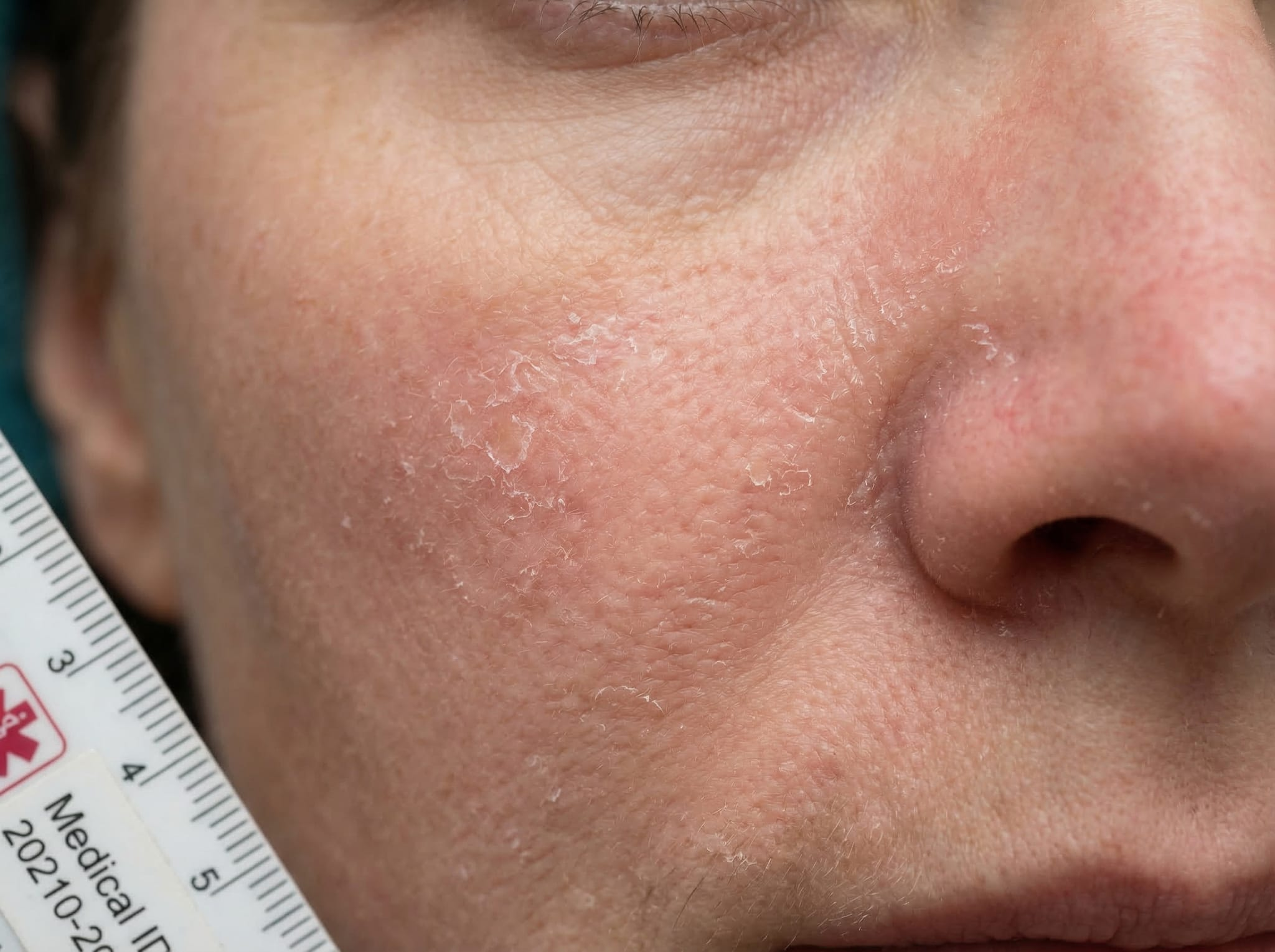
Duration: These effects persist throughout treatment for most users. They don't fully resolve with continued use—you adapt and manage them, but they remain.
Mitigation strategies:
- Start with lowest concentration (0.025% tretinoin or 0.1% adapalene)
- Apply only 2-3 times weekly initially
- Wait 20-30 minutes after washing before applying
- Use heavy, bland moisturizer
- Expect 3-6 months to build tolerance
Photosensitivity (Nearly universal)
Retinoids thin the stratum corneum (outermost skin layer) and increase UV vulnerability:
Increased sunburn risk: Burns occur 50-70% faster than baseline
Photoaging acceleration: Sun damage accumulates more rapidly
Hyperpigmentation risk: Sun exposure causes dark spots on retinoid-treated skin
Required precautions:
- Broad-spectrum SPF 50+ daily (even cloudy days, winter)
- Reapplication every 2 hours outdoors
- Avoid midday sun exposure when possible
- Physical barriers (hats) strongly recommended
Medical reality: Teenagers often don't comply with strict sun protection. This leads to photodamage that can be worse than the original acne. Non-compliance with sun protection is a valid reason not to use retinoids.
Additional Side Effects
Eye irritation: Product migration causes dry eyes, redness
Eczema flares: In predisposed individuals
Temporary hyperpigmentation: In darker skin tones
Skin barrier damage: If overused or combined with other actives
Who Should Avoid Retinoids
Based on clinical experience and published evidence:
Absolute contraindications:
- Pregnancy or planning to become pregnant (teratogenic risk)
- Breastfeeding
- Eczema or rosacea (will worsen significantly)
Relative contraindications:
- Very sensitive skin history
- Inability to comply with sun protection
- Jobs/activities with high sun exposure
- Darker skin tones (higher hyperpigmentation risk)
- Current use of other exfoliants (additive irritation)
Seasonal consideration: Many dermatologists recommend starting retinoids in fall/winter when sun exposure is naturally lower. Starting in summer increases side effect severity.
Prescription vs. OTC Retinoids
Prescription options:
- Tretinoin (Retin-A): Most studied, most effective, most irritating
- Tazarotene (Tazorac): Strongest, highest side effects
- Trifarotene (Aklief): Newest, targets specific receptors
Over-the-counter:
- Adapalene 0.1% (Differin): Recently available OTC, better tolerated than tretinoin
- Retinol products: Far weaker, minimal evidence for acne
Clinical comparison: OTC adapalene 0.1% shows 80-90% of tretinoin's efficacy with 30-40% less irritation. For many patients, particularly those with sensitive skin, it's the better choice despite being less powerful.
Realistic Timeline
Understanding the prolonged timeline prevents premature discontinuation:
Weeks 1-4: Purging begins, irritation peaks, no improvement visible
Weeks 6-12: Purging subsides, irritation continues, early improvement may begin
Weeks 12-24: Gradual improvement continues
Months 6-12: Maximum benefit achieved
Medical perspective: Retinoids require the longest timeline of any acne treatment. Patients need mental preparation for looking worse for 2-3 months before seeing benefit.
Combination Therapy Considerations
Retinoids are often prescribed with other treatments:
Safe combinations:
- Benzoyl peroxide (apply at opposite times: retinoid night, BP morning)
- Oral antibiotics (common for inflammatory acne)
- Azelaic acid (morning use while retinoid used at night)
Dangerous combinations:
- Other exfoliants (salicylic acid, glycolic acid): Severe barrier damage
- Vitamin C: Can inactivate tretinoin
- Physical exfoliants: Will cause severe irritation
Bottom Line
Topical retinoids represent the gold standard in acne treatment with 50-70% improvement in clinical trials, but this efficacy comes at the cost of near-universal side effects. Approximately 70-80% of users experience the "retinoid purge"—a 6-12 week period where acne worsens significantly before improvement begins. Skin irritation including dryness, peeling, redness, and burning affects 60-70% of users throughout treatment, not just initially. Photosensitivity is near-universal, requiring strict daily sun protection that many teenagers struggle to maintain. Maximum benefit takes 6-12 months of consistent use, meaning patients must tolerate months of side effects before seeing results. Those with very sensitive skin, inability to comply with sun protection, or darker skin tones at risk for hyperpigmentation should discuss whether retinoids are appropriate. For patients who can tolerate the side effects and timeline, retinoids offer superior long-term outcomes compared to benzoyl peroxide or salicylic acid. Start with the lowest strength (0.025% tretinoin or 0.1% adapalene), use 2-3 times weekly initially, expect 3 difficult months, and commit to 6-12 months before evaluating full results. Set realistic expectations: Even with success, "clear" skin typically means 1-10 small pimples, not perfection.
How we reviewed this article:
Our experts continually monitor the health and wellness space, and we update our articles when new information becomes available.
- Leyden J, et al. Why Topical Retinoids Are Mainstay of Therapy for Acne. Dermatol Ther. 2017https://pubmed.ncbi.nlm.nih.gov/28905542/
- Mukherjee S, et al. Retinoids in the treatment of skin aging. Clin Interv Aging. 2006
Read This Next
At-Home Dermatology Tools: Gua Sha, Jade Rollers, and Acne Devices
Most at-home skin tools are luxury items, not acne treatments. Here's an honest look at what works, what's harmless, and what can actually make things worse.
Read More →
Vitamin C Serum and Acne: Brightening Without Breaking Out

Ceramides and Acne: Why Your Skin Barrier Is the Foundation

Probiotics for Acne: What the Science Actually Says (So Far)
The gut-skin axis is real and the early research on probiotics for acne is interesting. But 'interesting' and 'worth spending $30/month on' aren't the same thing. Here's what we know and what we don't.
Read More →
Hormonal IUDs and Acne: Why Some Birth Control Makes Skin Worse
Levonorgestrel IUDs like Mirena and Kyleena can trigger or worsen acne because of their androgenic progestin. Here's why it happens, what to do about it, and how other birth control options compare.
Read More →