Benzoyl Peroxide: The Complete Guide for Teens
Benzoyl peroxide: the complete guide for teens
If I had to pick one acne ingredient, benzoyl peroxide would be it. Not because it's gentle (it's not), not because it's glamorous (definitely not), but because it does something no other over the counter acne treatment can do: it kills acne-causing bacteria in a way they can't develop resistance to. That matters more than most people realize.

How benzoyl peroxide actually works
Most acne treatments either exfoliate dead skin or reduce oil. Benzoyl peroxide does something different. When it contacts your skin, it breaks down into benzoic acid and oxygen. That oxygen floods the pore environment, and Cutibacterium acnes (the bacteria living in your pores that contribute to acne) are anaerobic, meaning they can't survive in oxygen-rich conditions.
So benzoyl peroxide essentially suffocates the bacteria. It oxidizes the bacterial cell membranes and proteins, destroying them on contact (Sagransky et al., 2009).
This mechanism is also why bacteria can't develop resistance to it. Antibiotics (topical or oral) target specific bacterial processes. Bacteria mutate, find workarounds, and become resistant. That's a real problem with long term antibiotic use for acne. The bacteria can't "learn" to survive oxidation the way they can learn to survive a targeted antibiotic. A 1999 study in the British Journal of Dermatology showed that benzoyl peroxide eliminated antibiotic-resistant strains of C. acnes just as effectively as non-resistant strains (Eady et al., 1999).
This is why dermatologists recommend adding benzoyl peroxide to any acne regimen that includes antibiotics, whether topical (clindamycin) or oral (doxycycline). It prevents resistance from developing and makes the antibiotics more effective for longer (Leyden et al., 2001).
The strength question: 2.5% vs 5% vs 10%
This is where most people go wrong. They assume more is better, grab the 10% wash, and wonder why their face looks like it's been sunburned.
Here's what the research actually says: 2.5% benzoyl peroxide is nearly as effective as 10%, with dramatically fewer side effects. A double-blind study published in the International Journal of Dermatology compared 2.5%, 5%, and 10% benzoyl peroxide gels. All three strengths produced similar reductions in acne lesions after 12 weeks. The only meaningful difference was that higher concentrations caused more dryness, redness, and peeling (Mills et al., 1986).
I'll say that again because it really matters. 2.5% worked about as well as 10%. The extra strength mostly just caused extra irritation.
Why? Because the bactericidal effect doesn't scale linearly with concentration. Once you have enough benzoyl peroxide in the pore to generate sufficient oxygen, more doesn't help much. You're already killing the bacteria. Going higher just irritates the surrounding skin.
My recommendation for teens: start with 2.5%. If you're tolerating it well after a month and want slightly more punch, move to 5%. There's almost never a reason for a teenager to use 10% on their face.
The one exception is body acne, where skin is thicker and less sensitive. A 5% or even 10% wash used on the back or chest is reasonable.
Wash vs leave-on vs contact therapy
There are three ways to use benzoyl peroxide, and the method matters as much as the strength.
Leave-on treatment. You apply a thin layer to your skin and leave it on all day or overnight. This gives the longest contact time and is the most effective delivery method. Products like Neutrogena On-The-Spot (2.5%) or prescription-strength gels fall into this category. The downside is maximum irritation and maximum bleaching risk.
Wash (cleanser). You apply the wash to your face, leave it on for 30 to 60 seconds, and rinse it off. Less effective than leave-on because the contact time is so short. Studies show BP washes still reduce C. acnes populations, but not as much as leave-on formulations (Fakhouri et al., 2009). The upside is less irritation.
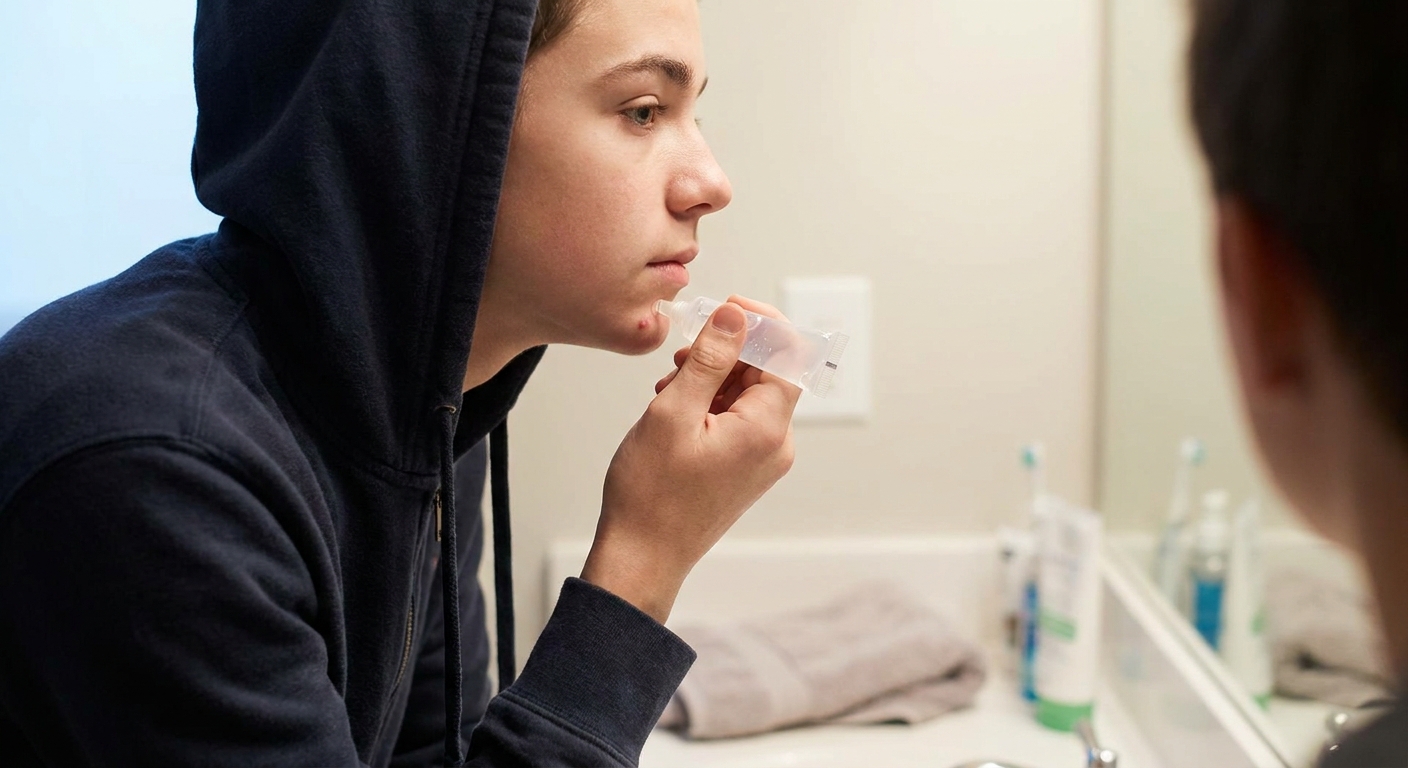
Short contact therapy. This is the method I think more teens should know about. You apply a leave-on benzoyl peroxide product (gel or cream, not a wash), leave it on for 5 to 10 minutes, and then rinse it off. You get more effective penetration than a wash because the product sits on dry skin longer, but less irritation and bleaching than a full leave-on application.
A 2008 study found that short contact therapy with 5% benzoyl peroxide produced similar acne reduction to standard leave-on application while significantly reducing skin irritation (Bucks et al., 2008). Patients in the short contact group reported less dryness and peeling, and they were more likely to stick with treatment long term.
If you're new to benzoyl peroxide, short contact therapy is a great starting point. Apply a 2.5% or 5% gel to clean, dry skin. Wait 5 to 10 minutes. Rinse. Moisturize. Do this once daily. After a few weeks, if your skin handles it well, you can extend the time or switch to leave-on if you want.
The bleaching problem
I need to be honest about this: benzoyl peroxide will bleach your stuff. Towels, pillowcases, shirts, jeans if you lean your chin on your hand. It's an oxidizer. That's how it kills bacteria, and it's also how it removes color from fabric.
There is no way to prevent this entirely. If benzoyl peroxide touches fabric, the fabric will eventually bleach. But you can manage it.
Use white towels and pillowcases. Buy a set of cheap white ones specifically for your acne routine. You can't bleach what's already white.
Apply BP before putting on your shirt. Give it time to absorb. Wait at least 10 minutes (or use contact therapy and rinse it off) before your face touches anything colored.
Wash your hands after applying. Seriously. BP on your fingers will transfer to everything you touch for the next hour.
Old t-shirts for sleeping. If you use a leave-on BP product at night, wear an old shirt you don't care about. It will get bleach spots on the collar.
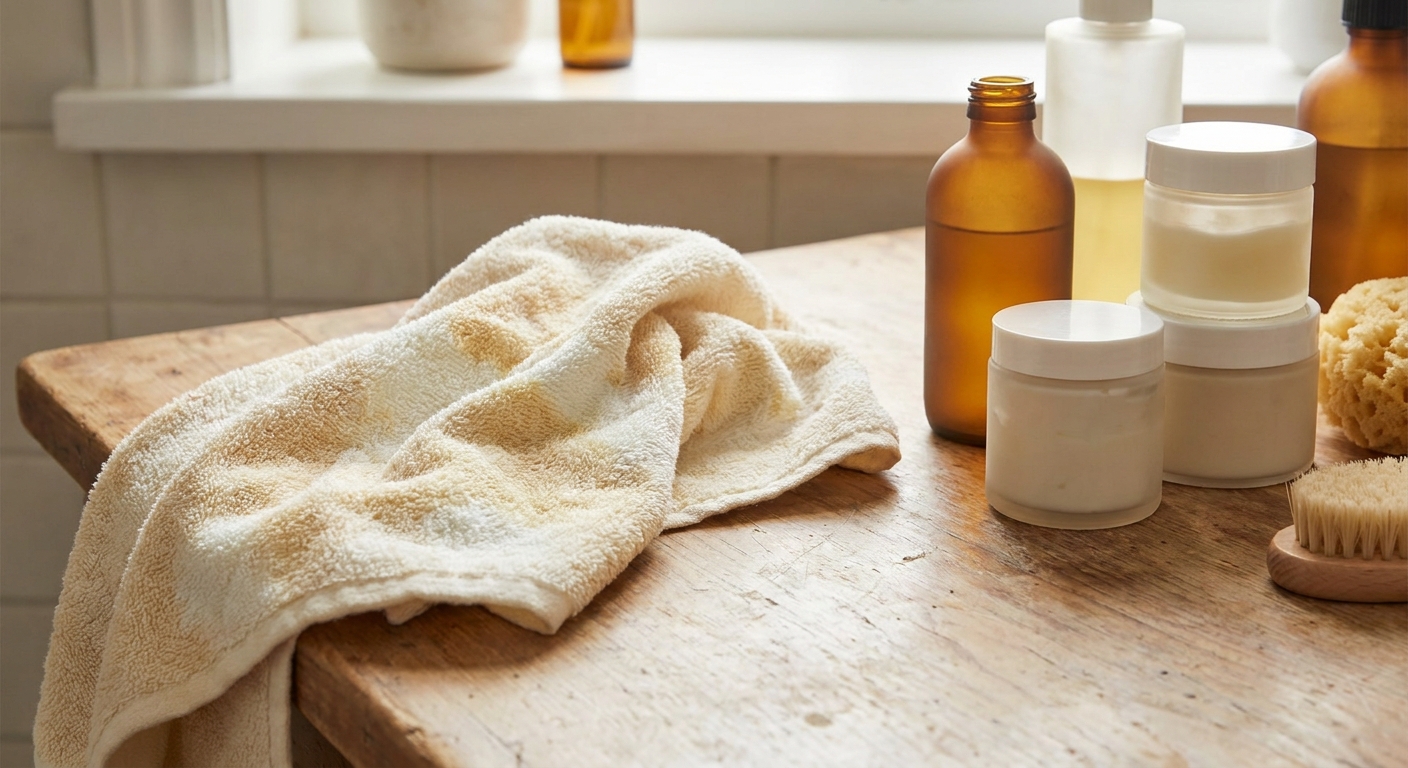
I realize this sounds annoying. It is annoying. But the tradeoff is an acne treatment that genuinely works and that bacteria can't outsmart. A few bleached pillowcases are a small price.
Pairing with moisturizer
Benzoyl peroxide dries your skin out. This isn't optional, it's inevitable. You need a good moisturizer. Not using one is the second most common mistake after choosing a concentration that's too high.
Apply BP first (on clean skin), wait a few minutes for it to absorb, then apply a fragrance-free moisturizer. CeraVe Moisturizing Cream, Vanicream Moisturizing Cream, or Cetaphil Moisturizing Lotion all work. The ceramides and hyaluronic acid in these products help repair the moisture barrier that BP is disrupting.
If you use the contact therapy method, apply moisturizer after you rinse off the BP.
Some people worry that moisturizer over BP reduces the treatment's effectiveness. It doesn't. A 2012 study in the Journal of Drugs in Dermatology found that moisturizer applied after benzoyl peroxide did not reduce its antibacterial activity (Draelos, 2012). The BP has already penetrated the pore by the time you apply the moisturizer.
Why bacteria can't develop resistance
I touched on this earlier, but it deserves its own section because it changes how you think about acne treatment.
Antibiotic resistance in acne is a genuine problem. The AAD has been warning about it for years. Topical clindamycin and erythromycin were once first-line treatments for acne. Now, resistance rates exceed 50% in many populations (Walsh et al., 2016). Oral antibiotics like doxycycline still work, but dermatologists recommend limiting courses to 3 to 4 months to slow resistance.
Benzoyl peroxide operates through a completely different mechanism. It doesn't target a specific enzyme or metabolic pathway that bacteria can mutate around. It floods the pore with reactive oxygen species that destroy cell membranes and proteins indiscriminately. There's no single mutation that makes a bacterium "benzoyl peroxide resistant" because the attack isn't specific enough for a targeted defense to evolve.
This is why the AAD recommends including benzoyl peroxide in nearly every acne treatment regimen. It protects the effectiveness of antibiotics when used together, and it remains effective on its own regardless of how long you use it (Zaenglein et al., 2016).
You could use benzoyl peroxide for years and it would still work. Try saying that about most antibiotics.
Common mistakes
Using too high a concentration. Already covered this, but it's worth repeating. Start at 2.5%. You can always go up.
Applying too much. A thin layer is all you need. More product means more irritation without more benefit.
Skipping moisturizer. Dried-out skin produces more oil. More oil means more breakouts. The BP is creating a dryness problem; you need to solve it.
Mixing with the wrong products. Don't use benzoyl peroxide and a retinoid at the exact same time. BP can oxidize and deactivate certain retinoids (particularly tretinoin). If you use both, apply them at different times of day: BP in the morning, retinoid at night. Adapalene is an exception since it's stable alongside BP, and Epiduo (adapalene + BP) is a prescription combination that uses both together.
Quitting too early. BP takes 4 to 6 weeks to show noticeable results. The bacteria die quickly, but clearing existing acne lesions takes time. Stick with it.
Key takeaways
- Benzoyl peroxide kills acne bacteria through oxidation, and bacteria cannot develop resistance to it. This makes it different from every antibiotic treatment.
- 2.5% is nearly as effective as 10% with far less irritation. Start low.
- Short contact therapy (apply for 5 to 10 minutes, then rinse) gives you most of the benefits with less dryness and bleaching.
- It will bleach fabrics. Use white towels and old pillowcases. There's no workaround.
- Always pair it with a fragrance-free moisturizer. Skipping moisturizer makes acne worse over time.
Bottom line
Benzoyl peroxide is effective, cheap, available everywhere, and the one acne treatment that bacteria literally cannot outsmart. It's not perfect. It's drying, it bleaches things, and 10% will make your face peel. But at 2.5% with short contact therapy and a good moisturizer, most teens can use it comfortably. Combined with a gentle cleanser and sunscreen, it's one of the strongest foundations for an acne routine you can build without a prescription.
If you're only going to buy one acne treatment product, make it a 2.5% benzoyl peroxide gel. You'll get more out of it than most of the expensive "acne systems" sold at Sephora.
Sources
- Sagransky, M., et al. (2009). Benzoyl peroxide: a review of its current use in the treatment of acne vulgaris. Expert Opinion on Pharmacotherapy, 10(15), 2555-2562.
- Eady, E.A., et al. (1999). Is antibiotic resistance in cutaneous propionibacteria clinically relevant? British Journal of Dermatology, 140(3), 431-436.
- Leyden, J.J., et al. (2001). Comparison of the efficacy and safety of a combination topical gel formulation of benzoyl peroxide and clindamycin with benzoyl peroxide, clindamycin and vehicle gel. American Journal of Clinical Dermatology, 2(1), 33-39.
- Mills, O.H., et al. (1986). Comparing 2.5%, 5%, and 10% benzoyl peroxide on inflammatory acne vulgaris. International Journal of Dermatology, 25(10), 664-667.
- Fakhouri, T., et al. (2009). Topical benzoyl peroxide in acne treatment: systemic absorption and clinical relevance. Journal of Clinical and Aesthetic Dermatology, 2(11), 26-30.
- Bucks, D., et al. (2008). Short contact benzoyl peroxide: efficacy and tolerability. Journal of Drugs in Dermatology, 7(5), 442-447.
- Draelos, Z.D. (2012). The effect of moisturizer on benzoyl peroxide treatment. Journal of Drugs in Dermatology, 11(3), 358-361.
- Walsh, T.R., et al. (2016). Antibiotic resistance in acne. The Lancet Infectious Diseases, 16(3), e23-e32.
- Zaenglein, A.L., et al. (2016). Guidelines of care for the management of acne vulgaris. Journal of the American Academy of Dermatology, 74(5), 945-973.
How we reviewed this article:
Our experts continually monitor the health and wellness space, and we update our articles when new information becomes available.
Read This Next
At-Home Dermatology Tools: Gua Sha, Jade Rollers, and Acne Devices
Most at-home skin tools are luxury items, not acne treatments. Here's an honest look at what works, what's harmless, and what can actually make things worse.
Read More →
Vitamin C Serum and Acne: Brightening Without Breaking Out
Ceramides and Acne: Why Your Skin Barrier Is the Foundation
Probiotics for Acne: What the Science Actually Says (So Far)
The gut-skin axis is real and the early research on probiotics for acne is interesting. But 'interesting' and 'worth spending $30/month on' aren't the same thing. Here's what we know and what we don't.
Read More →
Hormonal IUDs and Acne: Why Some Birth Control Makes Skin Worse
Levonorgestrel IUDs like Mirena and Kyleena can trigger or worsen acne because of their androgenic progestin. Here's why it happens, what to do about it, and how other birth control options compare.
Read More →