25 Questions to Ask Your Dermatologist About Acne
Medically reviewed by Dr. Rachel Torres, MD, Pediatric Dermatologist
Written by Teen Acne Solutions Editorial Team — Updated May 27, 2026
Key takeaways
- Write your questions down before the appointment. Derm visits are short and it's easy to freeze up or forget what you wanted to ask. A phone note or printed list fixes this.
- Always ask about timelines and plan B. Knowing when to expect results and what happens if the first treatment doesn't work reduces anxiety and keeps you from quitting too early.
- Don't leave without understanding your routine. Product order, frequency, amount -- get specific so you're not guessing at home.
- Parents: ask your own questions too. You're often the one buying the products, enforcing the routine, and noticing changes. Your observations matter.
25 Questions to Ask Your Dermatologist About Acne

Dermatology appointments are short. You wait 30 minutes in the lobby, sit in the exam room for another 15, and then your dermatologist walks in and you have maybe 10-15 minutes of their actual attention. In that window, you're supposed to describe your skin history, listen to a treatment plan, absorb information about multiple products, and ask any questions you have.
Most people leave having asked zero questions. You nod along, take a prescription printout, and then sit in the car thinking of everything you should have said. I've done it. You've probably done it too.
The fix is stupid simple: write your questions down beforehand. Pull out your phone or a piece of paper when the derm walks in, and just ask them. They won't think it's weird. They'll probably appreciate it, because it means they can give you better care in less time.
Here are 25 questions worth asking, organized by when they're most useful.
Questions about your diagnosis
These are best for first visits or when you're seeing a new dermatologist.

1. What type of acne do I have? There's a difference between comedonal acne (blackheads and whiteheads), inflammatory acne (red papules and pustules), and cystic/nodular acne (deep, painful lumps). Your type determines your treatment [1].
2. What's causing my acne -- is it hormonal, bacterial, or something else? This helps you understand whether your treatment is targeting oil production, bacteria, inflammation, or some combination.
3. Is this actually acne, or could it be something else? Fungal folliculitis, perioral dermatitis, and rosacea can all look like acne but require completely different treatments. It's worth confirming the diagnosis, especially if standard acne treatments haven't worked [2].
4. How severe would you rate my acne? Mild, moderate, or severe. This gives you context for the treatment plan and helps calibrate your expectations.
5. Is my acne likely to scar? Some types of acne scar more than others. If scarring is a risk, more aggressive treatment earlier may be justified [1].
Questions about your treatment plan
6. What products or medications are you recommending, and what does each one do? Don't leave without understanding every item on your plan. If they prescribe three things, know what each one targets.
7. How long before I should expect to see improvement? Most acne treatments take 6-12 weeks to show results [7]. Knowing this upfront prevents you from quitting at week 3 because "it's not working."
8. Will my skin get worse before it gets better? Retinoids and some other treatments cause an initial purge where breakouts temporarily increase. If you don't know this is coming, you'll panic and stop the treatment right when it's about to start working [5].
9. What are the side effects I should watch for? Dryness, irritation, sun sensitivity, peeling -- these are manageable if you know they're coming. Some side effects (like severe headaches on isotretinoin) need immediate attention [3].
10. What if this treatment doesn't work? What's plan B? This is one of the most useful questions you can ask. It takes the pressure off the first treatment and gives you a roadmap if you need to adjust course.
11. Should I use all these products at the same time, or introduce them one at a time? Starting multiple actives simultaneously makes it impossible to identify which one is causing irritation if something goes wrong. Many derms will suggest staggering, but ask if they don't mention it [5].
12. How much product should I use, and where exactly should I apply it? A pea-sized amount of tretinoin means something specific. Ask for specifics rather than guessing at home.
13. Is there a generic version of this prescription that's cheaper? Adapalene went over-the-counter as Differin. Many prescriptions have generics. Your derm knows which ones work just as well [6].
Questions about your daily routine
14. What cleanser should I use? Not all cleansers are compatible with prescription acne treatments. Your derm can recommend one that won't interfere with your medications or strip your skin [4].
15. Do I need to change my moisturizer? Some moisturizers contain ingredients that clog pores. Others are too heavy or too light for your current treatment. Get a specific recommendation.
16. What sunscreen should I use? Many acne treatments increase sun sensitivity. You need sunscreen, but the wrong one will clog your pores and make things worse. Ask for a specific recommendation [7].
17. What order should I apply my products in? This matters more than you think. Applying moisturizer before a prescription retinoid changes the retinoid's absorption. Your derm should walk you through the correct order.
18. Should I do anything differently in the morning vs. evening? Some products are photosensitizing and need to be used at night. Others can be split between AM and PM routines.
Questions about lifestyle and triggers
19. Should I change my diet? The honest answer from current research is that dairy and high-glycemic foods may worsen acne in some people, but the evidence isn't strong enough for blanket dietary recommendations [1]. Your derm's personal opinion on this is useful.
20. Could my acne be related to stress, sleep, or exercise habits? These questions help your derm understand the full picture and may reveal contributing factors you haven't considered.
21. Are any of my current products or makeup causing problems? Bring your current skincare and makeup products (or a photo of them) to your appointment. Your derm can identify potential pore-cloggers [4].
22. Does my acne suggest any underlying hormonal issues that should be tested? Persistent chin and jawline acne in girls, combined with irregular periods or other symptoms, could indicate PCOS or other hormonal conditions worth investigating [1].
Questions about follow-up

23. When should I schedule a follow-up? Typically 8-12 weeks after starting a new treatment [7]. Get this on the calendar before you leave, because booking dermatology appointments last-minute is often impossible.
24. What changes should make me call before my follow-up? Severe irritation, allergic reactions, unexpected side effects, significant worsening. Know when to reach out vs. when to wait it out.
25. At what point would you consider isotretinoin (Accutane)? If your acne is moderate or severe, it's worth understanding when your derm would escalate to isotretinoin, what the process involves, and whether you're a candidate. Even if it's not appropriate right now, understanding the full range of options is empowering [3].
Tips for getting the most out of your appointment
Bring a current photo of your worst breakout day. Your skin might look decent on appointment day because acne fluctuates. Having photos of bad days shows your derm what they might not see in person.
Take photos of your current products. Instead of trying to remember every product name, snap a photo of your bathroom counter. Your derm can quickly scan for problem ingredients.
Take notes during the appointment. Or ask the derm to write things down for you. Treatment plans with multiple products and specific instructions are hard to remember verbally. Some dermatologists will give you a printed summary, but many won't unless you ask.
If you don't understand something, say so. Doctors sometimes slip into medical jargon without realizing it. "Apply the retinoid" means nothing if you don't know which of your three products is the retinoid. Ask them to clarify.
Parents: you can ask questions too. If you're the parent in the room, your observations about your teen's skin are useful. You might notice patterns (like breakouts worsening during exams or after certain foods) that your teen hasn't connected. And since you're probably the one buying the products and monitoring compliance, you need to understand the plan too.
A note about appointment anxiety
A lot of teens feel anxious about dermatology appointments. The idea of a doctor examining your skin up close, diagnosing your acne, and telling you what you need to do differently can feel judgmental even when it isn't.
Dermatologists see acne all day, every day. They are not judging your skin. They're problem-solving. Your acne is their job, not a character flaw they're evaluating. The more information you give them (honest answers about product use, skincare habits, and what you've already tried), the better they can help.
Bottom line
A 15-minute dermatology appointment with no questions asked is a wasted opportunity. Writing down even five or six questions from this list and bringing them to your next visit will give you a clearer treatment plan, realistic expectations, and a backup strategy if the first approach doesn't work. You're paying for the appointment. Get your money's worth.
Sources
- Zaenglein AL, et al. "Guidelines of care for the management of acne vulgaris." Journal of the American Academy of Dermatology. 2016;74(5):945-973.
- American Academy of Dermatology. "How dermatologists diagnose acne." 2024.
- Tan J, et al. "A treatment for severe nodular acne." Dermatologic Therapy. 2008;21(2):90-95.
- Goodman G. "Cleansing and moisturizing in acne patients." American Journal of Clinical Dermatology. 2009;10(Suppl 1):1-6.
- Thiboutot D, et al. "Practical management of acne for clinicians." Dermatology and Therapy. 2018;8(1):1-16.
- Kraft J, Freiman A. "Management of acne." Canadian Medical Association Journal. 2011;183(7):E430-E435.
- American Academy of Dermatology. "Acne treatment: what to expect." 2024.
How we reviewed this article:
Our experts continually monitor the health and wellness space, and we update our articles when new information becomes available.
- Zaenglein AL, et al. Guidelines of care for the management of acne vulgaris. Journal of the American Academy of Dermatology. 2016;74(5):945-973.https://doi.org/10.1016/j.jaad.2015.12.037
- American Academy of Dermatology. How dermatologists diagnose acne. 2024.https://www.aad.org/public/diseases/acne/derm-treat/diagnosis
- Tan J, et al. A treatment for severe nodular acne. Dermatologic Therapy. 2008;21(2):90-95.
- Goodman G. Cleansing and moisturizing in acne patients. American Journal of Clinical Dermatology. 2009;10(Suppl 1):1-6.https://doi.org/10.2165/0128071-200910001-00001
- Thiboutot D, et al. Practical management of acne for clinicians. Dermatology and Therapy. 2018;8(1):1-16.https://doi.org/10.1007/s13555-017-0209-7
- Kraft J, Freiman A. Management of acne. Canadian Medical Association Journal. 2011;183(7):E430-E435.https://doi.org/10.1503/cmaj.090374
- American Academy of Dermatology. Acne treatment: what to expect. 2024.https://www.aad.org/public/diseases/acne/derm-treat/expect
Read This Next

When to Get a Second Opinion from Another Dermatologist
If your teen's acne treatment isn't working and your dermatologist isn't budging, it might be time to find someone new. Here's how to know and what to do about it.
Read More →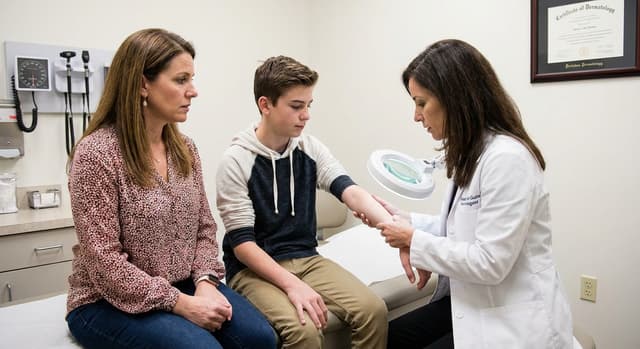
Accutane for Teens: Everything Parents and Teens Need to Know
Accutane (isotretinoin) clears severe acne in about 85% of patients, but the process involves monthly blood tests, strict pregnancy prevention, and several months of very dry everything. Here's what the experience actually looks like.
Read More →
How to Help Your Teenager with Acne: A Complete Guide for Parents
Watching your teen struggle with acne is harder than most people realize. Here's a dermatologist-reviewed guide for parents who want to help — without overstepping, minimizing, or making things worse.
Read More →
How to Talk to Your Teenager About Acne Without Making It Worse
Bringing up acne with your teen is a minefield. Say the wrong thing and they shut down. Say nothing and they suffer alone. Here's how to start the conversation the right way.
Read More →
When to Take Your Teenager to a Dermatologist for Acne: A Parent's Decision Guide
Most parents wait too long. Here's how to know when your teen's acne has crossed the line from 'normal teenager stuff' to 'needs professional help' — and what to expect at the first appointment.
Read More →