How to Talk to Your Teenager About Acne Without Making It Worse
Medically reviewed by Dr. Rachel Torres, MD, Pediatric Dermatologist
Written by Teen Acne Solutions Editorial Team — Updated March 16, 2026
Key takeaways
- Teens interpret ANY comment about their skin as confirmation that their acne is noticeable and bad
- The best conversations happen side-by-side (in the car, walking), not face-to-face at the dinner table
- Ask permission before offering help — 'Would it be helpful if I...' works better than just doing it
- Never comment on their skin in front of other people — not even family
- If they don't want to talk about it, respect that — but leave the door open
You can see it. They can see it. And you both know the other one can see it.
But nobody is saying anything.
Maybe you have tried to bring it up before and it went badly. Maybe your teenager snapped at you, slammed a door, or gave you that withering look that said stop talking immediately. Maybe you mentioned it casually at dinner and watched their face crumble. Maybe you bought them a face wash and they acted like you handed them a personal insult wrapped in cellophane.
Or maybe you have not said anything at all, because you do not know how to start the conversation about your teen's acne without making things worse. You watch them spend longer in the bathroom, avoid mirrors in public, tilt their face away in photos. You know they are hurting. And it kills you to stay quiet. But the alternative — saying the wrong thing — feels even more dangerous.
Here is the truth: talking to your teen about acne is one of the most emotionally loaded conversations you will have as a parent. It sits right at the intersection of their appearance, their identity, their social life, and their relationship with you. There is almost no way to get it perfectly right.
But there are ways to get it much less wrong. And that is what this guide is for.
Why Acne Conversations Go Wrong
Before you say a single word to your teenager about their skin, it helps to understand why this particular topic is so uniquely difficult. It is not just about acne. It is about everything acne represents during adolescence.
Acne is visible, and that changes everything
Most health issues a teenager faces are private. A stomachache, a headache, anxiety — these are invisible. The teen controls who knows and who does not. Acne strips that control away completely. It is right there on their face, the part of their body they cannot hide, the first thing anyone sees.
Research consistently shows that visible skin conditions carry a unique psychological burden. A landmark study in the British Journal of Dermatology found that acne patients reported levels of social, psychological, and emotional problems comparable to those reported by patients with chronic conditions like asthma, epilepsy, and diabetes. Not because acne is medically equivalent to those conditions, but because the visibility of it creates a relentless kind of self-consciousness that most other health issues do not.
When you bring up your teen's acne, you are not just bringing up a skin condition. You are confirming their worst fear: other people can see it too.
The teen brain is not overreacting — it is developing
If your teenager responds to a gentle comment about their skin with what seems like a wildly disproportionate emotional reaction, it is important to understand that this is neurological, not dramatic.
The adolescent brain is undergoing massive remodeling. The prefrontal cortex — responsible for rational thinking, perspective-taking, and emotional regulation — is not fully developed until the mid-twenties. But the amygdala, the brain's emotional alarm system, is already running at full power. This means teenagers are processing emotional input with the intensity of an adult but without the built-in braking system that helps adults put things in perspective.
Research from developmental psychologist Laurence Steinberg and others has shown that adolescents are not simply "being dramatic" when they react strongly to perceived criticism. Their brains are genuinely wired to experience social threats — and a parent commenting on their appearance absolutely registers as a social threat — with heightened intensity.
So when you say "your skin is looking a little rough lately" and your teen hears "you look terrible and everyone can tell," that is not a failure of listening. That is a developing brain doing exactly what developing brains do.
Identity and autonomy are at stake
Adolescence is fundamentally about separating from parents and establishing an independent identity. When you comment on your teen's acne — even lovingly, even helpfully — you are doing two things that run directly against this developmental process:
- You are asserting authority over their body. Their body is supposed to be becoming theirs. Your observations about it feel like surveillance.
- You are reminding them they are still dependent. They cannot drive themselves to a dermatologist. They cannot buy their own products. They need you, and that need conflicts with their drive for independence.
This is why the same teenager who will happily ask a friend for skincare advice will shut down completely when you offer the exact same suggestion. It is not about the information. It is about who it is coming from.
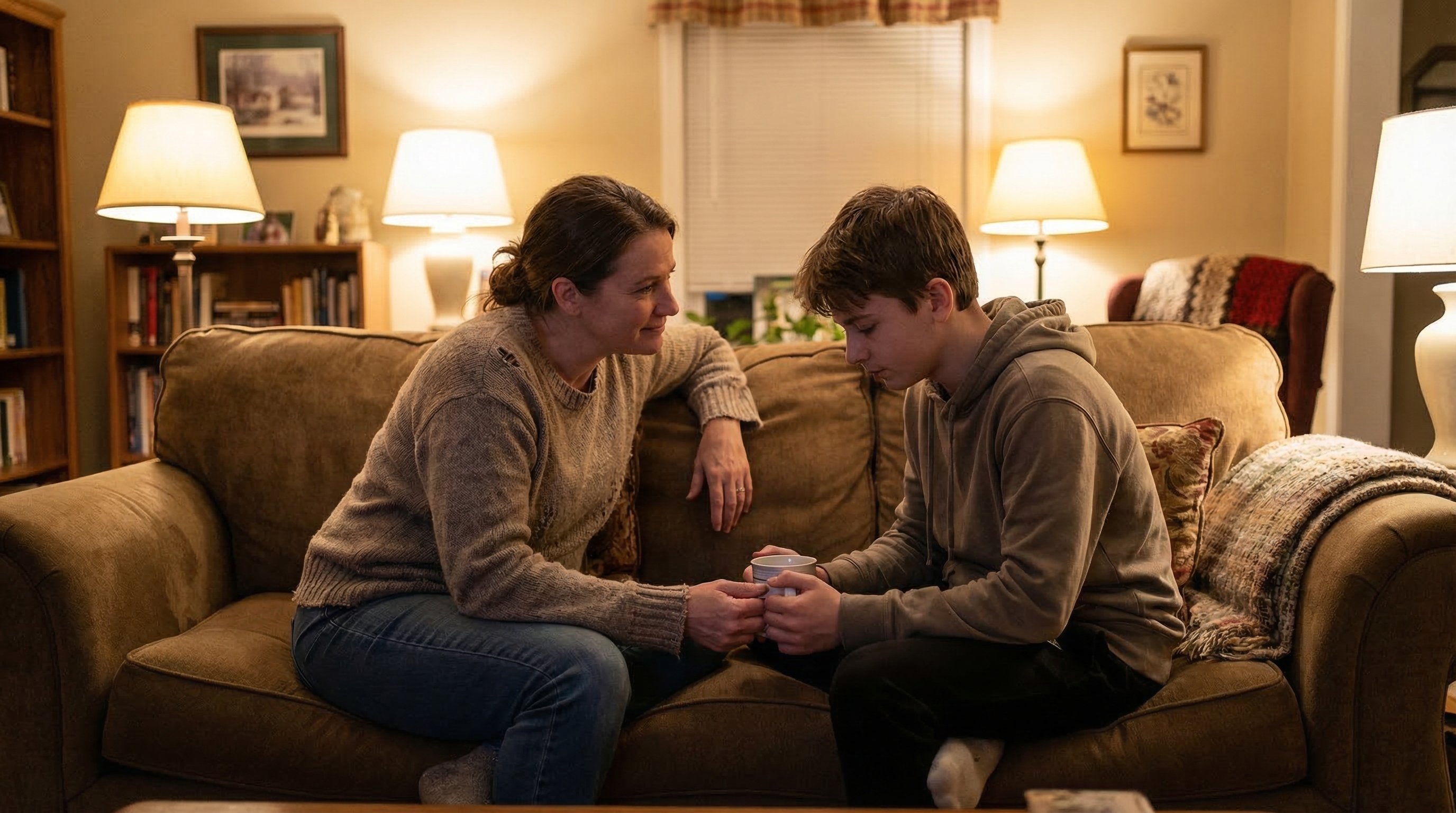
Things Parents Say That Backfire
You have probably already said at least one of these. Most parents have. Understanding why they backfire is more important than feeling guilty about having said them.
"Have you been washing your face?"
Why it hurts: This implies the acne is caused by poor hygiene. It is not. Acne is driven by hormones, genetics, and the overproduction of sebum — none of which are solved by washing more. Your teen almost certainly is washing their face. Many teens with acne are actually over-washing, stripping their skin in a desperate attempt to scrub the problem away. This question tells them you think they are dirty.
"It's not that bad."
Why it hurts: You mean this to be reassuring. Your teen hears it as dismissal. They have spent twenty minutes staring at their face in the bathroom mirror. They have catalogued every pimple. They know exactly how bad it is to them. When you say "it's not that bad," you are telling them their feelings about their own face are wrong. You are also implicitly confirming that it is bad — just not that bad. Not exactly the comfort you were going for.
"I had acne too, and I turned out fine."
Why it hurts: Your intention is to normalize their experience. But to a teenager, this lands as you making their problem about yourself. They are not thinking about how you turned out. They are thinking about the party this weekend, the person they like in third period, and the photo someone posted of them where the light hit their skin at the worst possible angle. Your acne history from the 1990s is not relevant to their crisis right now.
"Don't pick at it!"
Why it hurts: They know. They absolutely know. Picking is not a knowledge problem — it is a compulsion driven by anxiety, a desire for control, and the impossible hope that they can manually fix what is happening to their skin. Telling them not to pick is like telling someone with a mosquito bite not to scratch. Technically correct, practically useless, and it adds shame to the mix.
"Let me see."
Why it hurts: You want to assess the situation. Your teen experiences this as a spotlight being trained on the thing they most want to hide. Leaning in to examine their face communicates intense scrutiny, even if your intent is clinical. This is especially damaging in front of siblings or other family members.
"You should try..."
Why it hurts (when unsolicited): Launching into product recommendations or treatment suggestions before your teen has asked for help communicates that you have been studying their face, that you find it problematic enough to research solutions for, and that you think you know better than they do about their own skin. Even if all of those things are partially true, leading with advice skips over the part where you acknowledge how they feel.

When and Where to Have the Talk
The setting of this conversation matters almost as much as the words you use. Get the environment wrong and even the best script in the world will not land.
Side-by-side beats face-to-face
Research on parent-adolescent communication consistently shows that teenagers are more receptive to difficult conversations when they happen in parallel, not in direct confrontation. This means:
- In the car. You are both facing forward. There is no eye contact pressure. There is a natural time limit (the length of the drive). The car is one of the single best places to have a hard conversation with a teenager.
- On a walk. Same principle. Side by side, moving forward, with the option to look at the scenery instead of each other.
- While doing something together. Cooking, folding laundry, shopping. Activity creates a buffer that makes emotional topics feel less intense.
What does not work: sitting them down at the kitchen table for a formal "we need to talk" moment. That framing activates every defensive instinct your teenager has. They will be braced for a lecture before you finish your first sentence.
Choose a private, low-stakes moment
Never bring up your teen's acne:
- In front of siblings, friends, or extended family
- At a meal (meals should feel safe and pressure-free)
- When they are getting ready to go somewhere (they are already self-conscious)
- Right after they have been looking in the mirror
- When either of you is stressed, tired, or already in conflict
The best moments are the mundane ones. A quiet evening. A car ride to practice. A lazy weekend morning. You want the emotional temperature of the room to be as low as possible before you raise it.
Keep it short
This does not need to be a forty-five-minute heart-to-heart. In fact, it should not be. The first conversation about acne should be brief — a door opened, not a room entered. You are planting a seed, not harvesting a crop. Say your piece in two or three sentences, gauge their response, and be willing to stop there.
Scripts That Actually Work
Here are specific phrases you can use, along with why they work. Adapt them to your voice and your relationship with your teen. The exact words matter less than the underlying approach: ask permission, validate feelings, and offer agency.
Opening the conversation
Script 1: The permission-based opener
"Hey, I want to ask you something, and it's totally fine if you don't want to talk about it. I've noticed you seem a little stressed about your skin lately. Is that something you'd want help with, or would you rather handle it on your own?"
Why it works: It gives them an out immediately. It names what you have observed (stress, not acne itself) and puts the decision in their hands.
Script 2: The normalizing approach
"I was reading that something like 85% of teenagers deal with acne at some point. I just want you to know that if your skin is ever bugging you, I'm happy to help you figure out options. No pressure."
Why it works: It uses a statistic to depersonalize the topic. It positions you as a resource, not an authority. "No pressure" is doing heavy lifting in that last sentence.
Script 3: The indirect check-in
"One of your friend's moms was telling me her daughter just started seeing a dermatologist. It made me think — if you ever wanted to see someone about your skin, just let me know and I'll set it up."
Why it works: It normalizes the idea of professional help by referencing a peer. It puts the initiative with your teen. It is low-pressure and requires no immediate response.
When they bring it up
Script 4: Validation first, always
"That sounds really frustrating. I'm sorry you're dealing with that."
Why it works: It is simple. It does not fix anything. That is the point. Before your teen wants solutions, they want to know that you understand this is hard. Start here every single time.
Script 5: Asking before advising
"Do you want me to just listen right now, or would it be helpful if I looked into some options?"
Why it works: It explicitly separates emotional support from problem-solving. Many parents (especially those who are natural fixers) jump straight to solutions. This question honors the fact that sometimes your teen just needs to vent.
Offering practical help
Script 6: Agency-centered help
"Would it be helpful if I set up a dermatologist appointment? You'd be the one talking to the doctor — I can wait outside if you want."
Why it works: It offers concrete help while making clear that your teen will be in control of the actual interaction. Offering to wait outside signals that you respect their privacy and autonomy.
Script 7: The resource drop
"I came across this and thought of you. No pressure to look at it."
Why it works: Sometimes the best thing you can do is leave information where they can find it — a link texted casually, a product left on their bathroom counter without fanfare. This lets them engage on their own terms, without the pressure of your watching eyes.

If Your Teen Won't Talk About It
You brought it up gently. You used the right setting. You asked permission. And they shut you down anyway.
This is normal. This is okay. This does not mean you failed.
Respect the no
When your teenager says "I don't want to talk about it," believe them. Do not push. Do not circle back to it ten minutes later from a different angle. Do not bring it up again the next day. Pressing a teenager to discuss something they have explicitly declined to discuss will damage their trust in you and make future conversations harder.
Leave the door open
After respecting their boundary, you can say one more thing:
Script 8: The open door
"That's completely fine. If you ever change your mind, I'm here. No judgment."
Then stop. That sentence does more work than an hour of persuasion. It tells them the door is open, it will stay open, and walking through it will not cost them anything.
Provide resources silently
Even if your teen will not talk to you about their acne, you can still help indirectly:
- Stock the bathroom with gentle, fragrance-free cleansers and moisturizers. Do not make a production of it. Just let the products appear.
- Do not comment on whether they are using the products. Do not ask if they liked the cleanser. Do not check the bottle level.
- Leave information accessible. A browser tab left open "by accident." A casual mention that your insurance covers dermatology visits. A text with a link and nothing else.
- Talk to their pediatrician at their next checkup. Let the doctor bring it up. Sometimes a teen who will not listen to a parent will engage with a medical professional, because the dynamic is different.
Watch for warning signs
There is a line between normal teenage self-consciousness and something more serious. Acne is associated with significantly higher rates of depression, anxiety, and social withdrawal in adolescents. A 2011 study in the Journal of Investigative Dermatology found that adolescents with acne had increased rates of suicidal ideation compared to their peers without acne.
If your teen is:
- Withdrawing from friends or activities they used to enjoy
- Refusing to leave the house
- Spending excessive time covering or examining their skin
- Expressing hopelessness or worthlessness connected to their appearance
- Showing signs of depression or anxiety that go beyond normal teen moodiness
These are signals to involve a professional, regardless of whether your teen has agreed to discuss their acne with you. Frame it as mental health support, not skin support: "I've noticed you seem really down lately. I'd like you to talk to someone — not about your skin, about how you're feeling."
When They Come to You
One day, it might happen. Your teenager comes to you. Maybe they are crying. Maybe they are furious. Maybe they stand in the doorway and say, in the smallest voice, "Mom, can we do something about my skin?"
This is a gift. Handle it carefully.
Step one: Just listen
Do not immediately spring into action. Do not pull up dermatologist reviews on your phone. Do not start listing products. Do not say "I've been waiting for you to bring this up."
Just listen. Let them talk. Let them cry if they need to. Let them tell you about the kid at school who said something, or the photo they hated, or the morning they did not want to get out of bed because their skin was so bad. Your job in this moment is to be a safe place to land.
Script 9: The landing pad
"I hear you. That sounds really hard. I'm glad you told me."
Step two: Validate without minimizing
Resist every urge to say "it's not that bad" or "everyone goes through this." Instead:
"Your feelings about this make complete sense. Acne is really tough, especially when it feels like you can't control it."
Step three: Ask what they want
"What would feel most helpful to you right now? We can look into seeing a dermatologist, or try some different products, or I can just be here to listen. Whatever you want."
Script 10: The agency check
"This is your skin and your call. I'll support whatever you decide. What feels right to you?"
This matters more than you might think. After feeling out of control of their own face for weeks or months, being handed the reins on what happens next is deeply restorative for a teenager.
Step four: Follow through quietly
If they decide they want to see a dermatologist, make the appointment promptly. Do not let it become a thing you discuss repeatedly. Do not give them updates on the scheduling process unless they ask. Just get it done and tell them when and where.
If they want to try products, take them shopping and let them choose. Offer guidance if they ask for it. Do not steer them toward what you think is best unless they specifically want your opinion.

The Ongoing Conversation
Acne is not a one-conversation issue. It is a months-long or years-long reality for many teenagers. The way you handle the ongoing dialogue matters as much as the initial conversation.
Check in without nagging
There is a razor-thin line between supportive check-ins and nagging, and your teenager is the one who decides which side you are on. Some guidelines:
- Check in infrequently. Once every few weeks is enough. Not every day. Not every time you look at their face.
- Keep it casual. "How's the skin stuff going?" is better than "Is the medication working? Are you using it every night? Did you call the dermatologist back?"
- Accept short answers. "Fine" is a complete response. Do not press for details.
- Let them lead. If they want to talk about it more, they will. If they give you a one-word answer, take it and move on.
Celebrate without commenting on appearance
When their skin starts to improve — and if they are getting treatment, it likely will — resist the urge to say "your skin looks so much better!" This might seem like a compliment, but it carries an implicit message: I've been monitoring your face, and I noticed when it looked worse, too.
Instead, comment on their energy or mood: "You seem really happy lately." Let them connect the dots if they want to.
Know the difference between support and control
This is the hardest part of parenting a teenager through acne, and honestly, through anything. Support means:
- Making resources available
- Showing up when asked
- Respecting their decisions about their own body
- Managing your own anxiety about their skin privately
Control looks like:
- Monitoring their skincare routine
- Asking if they took their medication
- Commenting on their skin unprompted
- Making dermatologist appointments without their input
- Researching treatments and presenting them unsolicited
The line between these two can feel impossibly thin. When in doubt, ask yourself: Am I doing this because my teen asked for it, or because my own worry is driving me?
If the answer is your worry, find another outlet for it. Talk to your partner, a friend, or your own therapist. Your teenager does not need to carry the weight of your anxiety about their face on top of their own.
A Note for the Mom Who Already Said the Wrong Thing
If you are reading this and cringing because you have already said "have you been washing your face?" or "it's not that bad" or all five of the things on the backfire list — take a breath.
You are not a bad parent. You are a parent who loves their kid and did not have a roadmap for this particular conversation. Most of us do not.
You can course-correct. It can sound like this:
"Hey, I've been thinking about what I said the other day about your skin, and I don't think I handled it well. I'm sorry. I want you to know that I think you're great, your skin does not change that, and if you ever want help with it, I'll follow your lead."
That is it. You do not need to deliver a speech. You do not need to explain what you meant or why you said it. Just acknowledge it, apologize, and move forward.
Teenagers are remarkably forgiving of parents who are willing to admit they got it wrong. It is the parents who double down, who insist they were just trying to help, who refuse to acknowledge the impact of their words — those are the ones who lose the thread of the conversation permanently.
The Bottom Line
Talking to your teen about acne is not about finding the perfect words. Perfect words do not exist for this conversation. It is about showing up with the right posture: curious instead of directive, patient instead of urgent, willing to be led instead of insisting on leading.
Your teenager's acne will likely get better with time and treatment. Your relationship with your teenager during this season is what will last. Protect that relationship. Choose connection over correction. Choose listening over fixing. Choose their comfort over your worry.
And when you inevitably say the wrong thing — because you will, because we all do — repair it quickly, sincerely, and without defensiveness.
That is the whole strategy. It is simple, but it is not easy. Then again, nothing about parenting a teenager is easy. The fact that you are reading a 3,000-word article about how to talk to your kid about their skin means you care deeply about getting this right.
That care is the most important thing you bring to the conversation. Your teen might not say so. But they know.
How we reviewed this article:
Our experts continually monitor the health and wellness space, and we update our articles when new information becomes available.
- Halvorsen JA, et al. (2011). Suicidal ideation, mental health problems, and social impairment are increased in adolescents with acne. JID.https://pubmed.ncbi.nlm.nih.gov/20944653/
- Magin P, et al. (2006). The psychological and social effects of acne. Dermatologic Clinics.https://pubmed.ncbi.nlm.nih.gov/16677965/
- Davern J, O'Donnell AT. (2018). Stigma predicts health-related quality of life impairment in acne sufferers. PLOS ONE.https://pubmed.ncbi.nlm.nih.gov/30403714/
- Dalgard FJ, et al. (2015). Self-esteem and body satisfaction among late adolescents with acne. JEADV.https://pubmed.ncbi.nlm.nih.gov/25059289/
- Mallon E, et al. (1999). The quality of life in acne. British Journal of Dermatology.https://pubmed.ncbi.nlm.nih.gov/10354575/
- Steinberg L. (2001). We know some things: Parent-adolescent relationships in retrospect and prospect. Journal of Research on Adolescence.https://doi.org/10.1111/1532-7795.00001
- Laursen B, Collins WA. (2009). Parent-child relationships during adolescence. Handbook of Adolescent Psychology.https://doi.org/10.1002/9780470479193.adlpsy002002
- American Academy of Dermatology. Acne can affect more than your skin.https://www.aad.org/public/diseases/acne/mental-health
- Smithard A, et al. (2001). Acne prevalence, knowledge about acne and psychological morbidity. British Journal of Dermatology.https://pubmed.ncbi.nlm.nih.gov/11167684/
- Kubota Y, et al. (2010). Community-based epidemiological study of psychosocial effects of acne. Journal of Dermatology.https://pubmed.ncbi.nlm.nih.gov/20629551/
Read This Next
25 Questions to Ask Your Dermatologist About Acne

When to Get a Second Opinion from Another Dermatologist
If your teen's acne treatment isn't working and your dermatologist isn't budging, it might be time to find someone new. Here's how to know and what to do about it.
Read More →
Accutane for Teens: Everything Parents and Teens Need to Know
Accutane (isotretinoin) clears severe acne in about 85% of patients, but the process involves monthly blood tests, strict pregnancy prevention, and several months of very dry everything. Here's what the experience actually looks like.
Read More →
How to Help Your Teenager with Acne: A Complete Guide for Parents
Watching your teen struggle with acne is harder than most people realize. Here's a dermatologist-reviewed guide for parents who want to help — without overstepping, minimizing, or making things worse.
Read More →
When to Take Your Teenager to a Dermatologist for Acne: A Parent's Decision Guide
Most parents wait too long. Here's how to know when your teen's acne has crossed the line from 'normal teenager stuff' to 'needs professional help' — and what to expect at the first appointment.
Read More →