Acne and Self-Esteem: How It Affects Teenagers and What Actually Helps
Medically reviewed by Dr. Rachel Torres, MD, Pediatric Dermatologist
Written by Teen Acne Solutions Editorial Team — Updated March 17, 2026
Key takeaways
- Studies show 50-70% of teenagers with acne report significant impacts on self-esteem and body image
- The psychological effects of acne can be as severe as those from chronic conditions like asthma or epilepsy
- Professional mental health support should be considered alongside dermatological treatment
- Parents play a crucial role — minimizing acne or saying 'everyone gets it' can feel dismissive
- Building identity beyond appearance is one of the most protective factors for teens with acne
Your teenager used to walk into a room like they owned it. Now they won't make eye contact in the mirror. They've stopped wanting to go to school dances. They angle their face away in every photo — or refuse to be in photos at all. And when you try to talk about it, they shut down.
If this sounds familiar, you need to know something: what your teenager is going through is not vanity. It is real psychological pain, and decades of research confirm that acne's impact on a teenager's mental health can be profound, lasting, and far more serious than most adults realize.
This article is for you — the parent who can see their child hurting and doesn't know what to say. It's also for the teenager reading this at 2 a.m., wondering if they're the only person who feels this way. You are not. And it does get better. But not by pretending it doesn't matter.
The Research on Acne and Mental Health
Let's start with what science actually tells us, because the data is striking — and it should change the way we talk about acne.
The Numbers Are Hard to Ignore
Acne vulgaris affects approximately 85% of teenagers between the ages of 12 and 24, making it the most common skin condition in adolescence. But the conversation usually stops at the physical — the pimples, the scarring, the skin care routines. What researchers have been documenting for decades is that the psychological burden of acne is often more damaging than the physical symptoms.
A landmark Norwegian study by Halvorsen et al. (2011), which surveyed over 3,700 adolescents, found that teens with acne had significantly higher rates of mental health problems, including depression, anxiety, and — alarmingly — suicidal ideation. The association held even after controlling for other factors. Teenagers with substantial acne were roughly two to three times more likely to report suicidal thoughts than those without.
Studies consistently show that 50-70% of teenagers with acne report significant negative impacts on self-esteem and body image. Dalgard et al. (2015) found that adolescents with acne scored markedly lower on validated self-esteem scales and reported significantly less satisfaction with their bodies compared to peers with clear skin.
Perhaps the most telling study came from Mallon et al. (1999), published in the British Journal of Dermatology. Researchers compared quality-of-life scores in acne patients against patients with chronic, serious medical conditions — including asthma, epilepsy, diabetes, and chronic back pain. Acne patients reported emotional and social functioning impairments on par with or worse than patients with these conditions. Read that again. The psychological suffering caused by acne was comparable to that caused by diseases most people would consider far more "serious."
Why Adolescence Makes Everything Harder
These numbers aren't just about pimples. They're about timing.
Adolescence is the developmental period when identity formation is the central psychological task. Teenagers are, for the first time, constructing an answer to the question: Who am I? And whether we like it or not, physical appearance plays an enormous role in that process.
During these years, the brain's social-evaluation circuits are in overdrive. Teens are neurologically wired to be hyperaware of how others perceive them. The prefrontal cortex — the brain region responsible for putting things in perspective and regulating emotional responses — is still years away from full development. This means teenagers literally cannot "just get over it" the way adults might. They don't yet have the neurological hardware for that kind of emotional regulation.
When you layer acne on top of this already vulnerable period, you get a perfect storm: a visible, often uncontrollable skin condition arriving at the exact developmental moment when appearance feels like everything, social evaluation feels constant, and the ability to cope is still forming.
This is not weakness. This is biology.
How Acne Affects Teen Self-Esteem
The psychological impact of acne is not one single feeling. It's a web of interconnected effects that can gradually reshape how a teenager moves through the world.
The Mirror Becomes the Enemy
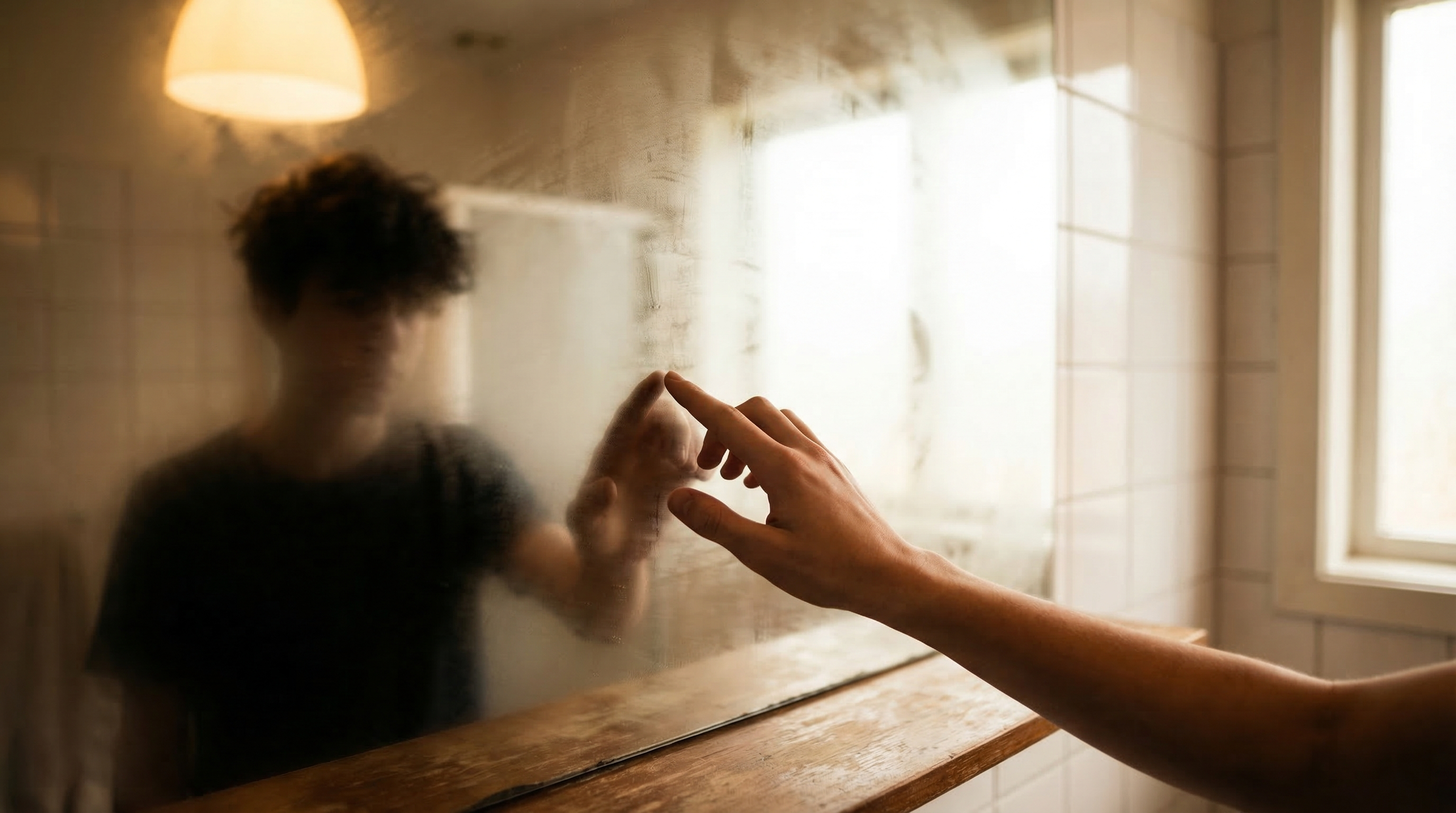
For many teens with acne, the first thing that changes is their relationship with their own reflection. What used to be a quick glance before heading out the door becomes an extended, agonizing inspection. Every new spot is cataloged. Every scar is memorized. Some teens develop what researchers call attentional bias — they become unable to look at their face without their gaze being pulled immediately to their acne, unable to see anything else.
Davern and O'Donnell (2018) found that the stigma associated with acne was a stronger predictor of psychological distress than the objective severity of the acne itself. In other words, it's not just about how bad the acne is — it's about how visible and shameful it feels. A teenager with moderate acne who feels deeply stigmatized may suffer more than a teenager with severe acne who has strong social support.
Social Withdrawal and Avoidance
One of the most common and concerning patterns is gradual social withdrawal. It often starts small:
- Choosing a seat in the back of the classroom
- Wearing a hood or letting hair fall over the face
- Declining invitations to go swimming or to sleepovers
- Avoiding well-lit spaces or situations where people might look closely at their face
- Spending more time alone in their room
Over time, these small avoidances can escalate. Kubota et al. (2010) found that adolescents with acne were significantly more likely to avoid social situations entirely. Some teens begin skipping school — not because they don't care about their education, but because the thought of sitting under fluorescent lights in a room full of peers feels unbearable.
Smithard et al. (2001) found that even among teens with relatively mild acne, psychological morbidity was common — meaning that the emotional toll doesn't require severe, cystic breakouts. A handful of visible pimples during a critical social event can feel catastrophic to a teenager whose brain is developmentally primed to interpret social threat.
For parents: If your teen has stopped wanting to participate in activities they used to enjoy, pay close attention. This is often not laziness or "a phase." It can be a sign that acne-related shame is shrinking their world.
The Comparison Trap and Social Media
Today's teenagers face a challenge no previous generation has encountered: they are growing up with a curated, filtered, airbrushed version of reality in their pocket at all times.
Social media platforms are saturated with images of flawless skin. Even "no filter" posts are often carefully lit and angled. Influencers promoting skin care products display complexions that are edited, treated, and professionally photographed. For a teenager with active acne, scrolling through Instagram or TikTok isn't just browsing — it's a relentless comparison exercise that almost always ends with the conclusion: Something is wrong with me.
Research by Magin et al. (2006) documented that acne sufferers frequently engage in upward social comparison — compulsively measuring themselves against people with clearer skin — which consistently worsens self-esteem and body dissatisfaction. Social media has taken this natural tendency and amplified it to an unprecedented scale.
The result is a teenager who not only feels bad about their skin, but who has an ever-present device confirming that they are, in fact, different from the impossibly smooth faces filling their feed.
Acne and Identity: "I Am My Skin"
Perhaps the most insidious effect of adolescent acne is how it can distort identity formation itself. When a teenager's skin is a source of daily distress, they can begin to organize their entire self-concept around it. They stop thinking I have acne and start thinking I am the kid with bad skin.
This identity fusion — where a temporary condition becomes a permanent self-definition — is particularly dangerous because it shapes decision-making long after the acne itself fades. Teens who internalize acne as part of their identity may avoid leadership roles, romantic relationships, or social risks well into adulthood, carrying a sense of defectiveness that outlasts every single breakout.
Signs Your Teen Is Struggling
Teenagers are notoriously private about emotional pain. They are even less likely to talk about it when the source of pain is something on their face that they feel powerless to control. Here are signs that acne may be taking a serious toll on your teenager's mental health:
- Spending excessive time in the bathroom examining, treating, or trying to cover their skin
- Refusing to leave the house on certain days, often tied to breakouts
- Avoiding eye contact or angling their face away during conversations
- Declining social invitations they would have previously accepted without hesitation
- Dropping activities — quitting sports, clubs, or hobbies that involve being seen
- Changes in eating or sleeping patterns that seem connected to skin concerns
- Increased irritability or anger, especially when skin is mentioned or when plans involve being photographed
- Skin picking — compulsive touching, squeezing, or scratching at acne, which can indicate anxiety and creates a worsening cycle of inflammation and scarring
- Statements about being ugly, disgusting, or unlovable — even if said in a "joking" tone
- Academic decline that doesn't have another clear explanation
- Expressing hopelessness — "Nothing works," "I'll always look like this," "What's the point"
Any one of these alone might be a typical teenage moment. Several of them together, persisting over weeks, should be taken seriously.
What Parents Should and Shouldn't Say
This section might be the most important one in this article. Because the truth is, many well-meaning parents inadvertently make their teenager's acne-related pain worse — not out of cruelty, but out of discomfort, or a genuine desire to reassure.
What Backfires
"It's just acne. Everyone gets it." This is the single most common response from parents, and it is almost universally experienced by teenagers as dismissive. Yes, acne is common. But "common" doesn't mean "painless." Broken bones are common too — you wouldn't tell your child to stop crying about one. When a teen hears "everyone gets it," what they actually hear is: Your pain doesn't matter. You're overreacting.
"You'll grow out of it." Even if this is statistically likely, it means nothing to a teenager who is suffering right now. Adolescence doesn't feel temporary when you're living it. Telling a 15-year-old that things will be better at 22 is like telling someone drowning that the ocean ends eventually. It may be true, but it doesn't help them breathe today.
"Stop picking at it — you're making it worse." This one is medically accurate and emotionally devastating. Skin picking is often a compulsive behavior driven by anxiety, not a rational choice. When a parent says this, the teen hears: This is your fault. You did this to yourself. It adds shame on top of an already overwhelming pile.
"Have you tried washing your face?" To a teenager who may already be spending 30 minutes a day on a skin care routine, trying every product they can find, and watching dozens of dermatology videos — this question feels like an accusation of laziness or poor hygiene. Acne is not a cleanliness issue, and implying that it is adds a layer of stigma that research shows directly worsens psychological outcomes.
"At least it's not [something worse]." Comparing your teen's suffering to other conditions — cancer, disability, poverty — doesn't make their pain smaller. It just teaches them that they don't have permission to feel it.
What Actually Helps
"I can see this is really hard for you, and I want you to know I take it seriously." Validation. That's it. That's the foundation. Before you offer solutions, before you suggest a dermatologist, before you do anything else — acknowledge that the pain is real. Research on adolescent coping consistently shows that perceived parental support is one of the strongest protective factors against depression and anxiety in teenagers dealing with appearance-related concerns.
"Your feelings about this make complete sense." Not "you shouldn't feel that way." Not "it's not that bad." Just: your feelings are legitimate. This single sentence can crack open a conversation that's been sealed shut for months.
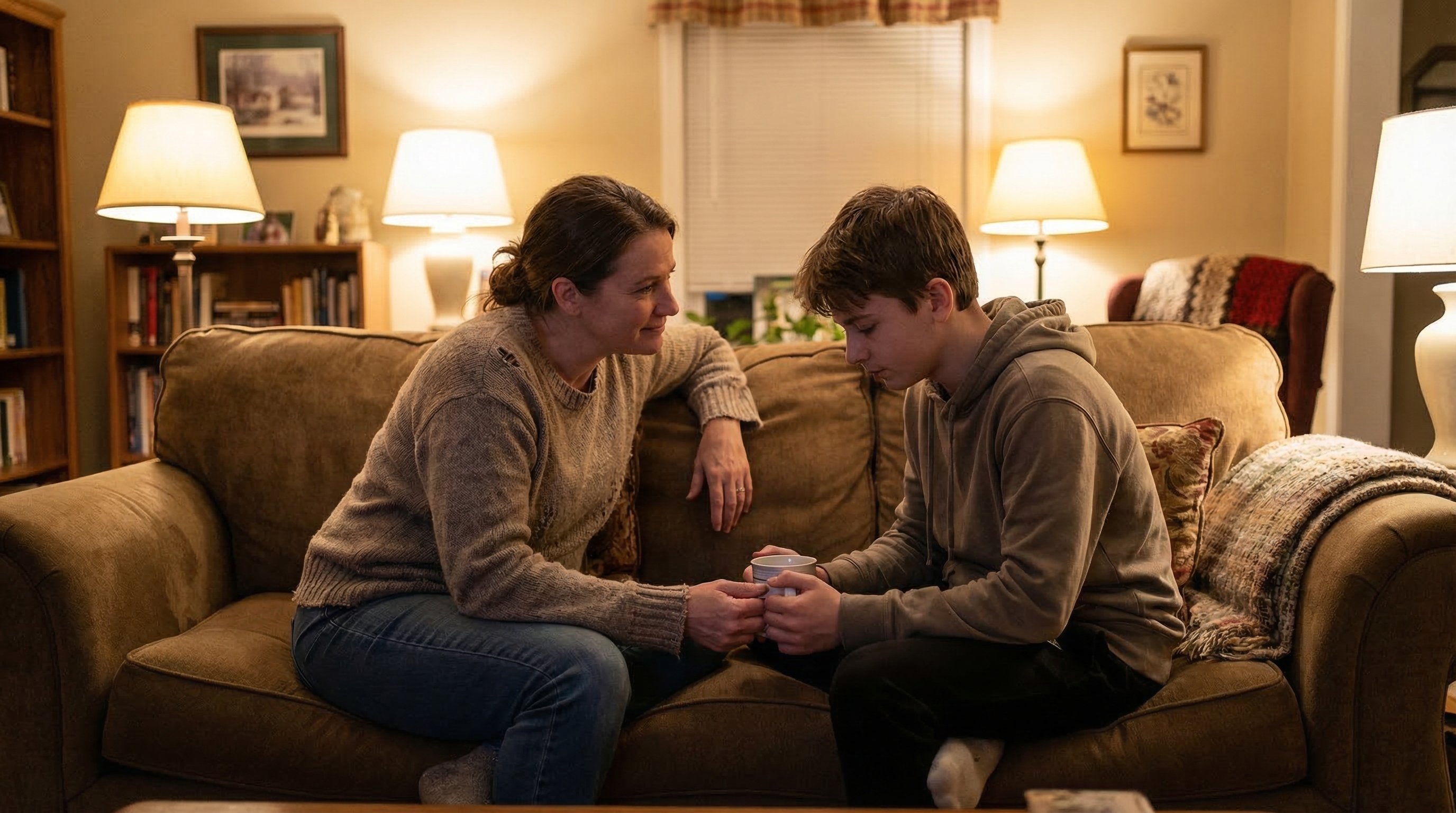
"I'd like to help if you want help. What would feel supportive to you?" This gives your teen agency. It says: I'm not going to fix this for you or over you. I'm going to let you lead. Some teens want a dermatologist appointment. Some want a therapist. Some just want you to stop bringing it up. Let them tell you.
"You are so much more than your skin." Say this — but only after you've validated their pain. If you lead with it, it sounds dismissive. After you've acknowledged how hard things are, this becomes one of the most powerful things a parent can say.

Evidence-Based Coping Strategies
Acknowledging the pain is step one. But teenagers (and their parents) also need practical, research-supported strategies for managing the psychological weight of acne.
Cognitive Behavioral Approaches
Cognitive behavioral therapy (CBT) has the strongest evidence base for treating the psychological effects of skin conditions. CBT works by helping teens identify and challenge the distorted thought patterns that acne often triggers:
- All-or-nothing thinking: "If my skin isn't perfect, I'm ugly."
- Mind reading: "Everyone is staring at my acne."
- Catastrophizing: "This breakout will ruin everything."
- Labeling: "I'm disgusting."
A CBT-trained therapist can help a teenager recognize that these thoughts are not facts — they're automatic, distorted interpretations generated by a brain under stress. Over time, teens learn to notice these patterns and replace them with more balanced perspectives. This doesn't mean pretending acne doesn't matter. It means learning to respond to a breakout with "This is frustrating and temporary" instead of "I can never show my face again."
Even without formal therapy, parents can support this process by gently questioning catastrophic statements:
- Teen: "My skin is disgusting. I can't go to school."
- Parent: "I hear you. It sounds like you're feeling really overwhelmed this morning. Can we talk about what specifically feels hardest right now?"
Acceptance-Based Strategies
Acceptance and Commitment Therapy (ACT) offers a complementary approach that many teens find more intuitive than traditional CBT. Instead of challenging negative thoughts, ACT teaches teens to acknowledge difficult feelings without being controlled by them.
The core idea: you can feel self-conscious about your skin and still go to the party. You can hate your breakout and still raise your hand in class. Feelings don't have to dictate actions.
This approach is particularly helpful for acne because it doesn't require a teenager to feel good about their skin — which would feel dishonest. Instead, it asks: Can you make room for this discomfort and still live the life you want?
Practical ACT-inspired exercises include:
- Naming the feeling: "I notice I'm having the thought that everyone is looking at my skin." Simply adding "I notice I'm having the thought that..." creates distance between the teen and the thought.
- Values clarification: Helping your teen identify what matters most to them — friendships, creativity, athletics, learning — and making choices based on those values rather than on acne-avoidance.
- Willingness practice: Gradually doing things that feel uncomfortable (attending a social event despite a breakout) and discovering that the anticipated disaster doesn't happen — or that they can survive it if it does.
Building Identity Beyond Skin
One of the most protective things you can do for a teenager with acne is help them develop a rich, multi-dimensional sense of identity that doesn't depend on appearance.
This means actively investing in the parts of your teen's life that have nothing to do with how they look:
- Encourage skill development in areas where they feel competent — music, coding, writing, athletics, cooking, anything that builds mastery
- Celebrate effort and character, not appearance — praise their kindness, their persistence, their humor, their creativity
- Expose them to role models who are valued for contributions beyond looks — scientists, writers, activists, entrepreneurs
- Limit appearance-focused commentary in your household — for everyone, not just your teen. If you regularly comment on your own or others' appearances, your teenager absorbs the message that looks are what matter most
Research consistently shows that teens who have multiple sources of self-worth — academics, relationships, hobbies, values — are more psychologically resilient when one domain (like appearance) is threatened. The teen whose entire self-esteem rests on their appearance has no buffer. The teen who also knows they're a great friend, a talented musician, and a dedicated student has resources to draw on.
Treating the Skin, Too
This article is about the emotional side of acne, but it would be incomplete without saying this: effective dermatological treatment matters for mental health, too.
When acne improves, self-esteem often follows. The American Academy of Dermatology explicitly states that treating acne can improve psychological well-being and quality of life. Seeking treatment is not vanity — it is a legitimate mental health intervention.
If your teen's acne is moderate to severe, seeing a dermatologist is not optional. It's part of taking the whole problem seriously.
That said, treatment takes time — often weeks to months. The coping strategies above aren't a replacement for treatment. They're what keeps your teenager afloat while treatment does its work.
When to Seek Professional Help
There is a line between normal distress and clinical mental illness, and acne can push a vulnerable teenager across it. Magin et al. (2006) documented significant associations between acne and clinical depression, clinical anxiety, and reduced social functioning — not just "feeling bad," but diagnosable conditions that require professional intervention.
Warning Signs That Require Professional Attention
Seek help from a mental health professional if your teenager:
- Expresses persistent hopelessness or statements like "things will never get better"
- Has lost interest in nearly all activities, not just ones related to appearance
- Shows signs of depression lasting more than two weeks — persistent sadness, fatigue, sleep changes, appetite changes, difficulty concentrating
- Engages in compulsive skin picking that causes visible damage, bleeding, or scarring
- Has mentioned self-harm or suicidal thoughts — even casually, even "as a joke"
- Is refusing to attend school regularly due to skin concerns
- Has developed significant social anxiety that extends beyond acne-related situations
- Is using alcohol, drugs, or other substances to cope with emotional pain
The Halvorsen et al. (2011) study found that suicidal ideation was significantly elevated in teenagers with acne, particularly girls. This is not something to monitor from a distance. If your teenager is expressing thoughts of self-harm or suicide, contact a mental health professional immediately. The 988 Suicide and Crisis Lifeline (call or text 988) is available 24/7.
What Kind of Professional Help
- A dermatologist for the acne itself — because visible improvement in skin genuinely helps emotional well-being
- A therapist experienced with adolescents, ideally one trained in CBT or ACT for appearance-related concerns or health-related quality of life
- A psychiatrist if symptoms suggest clinical depression or anxiety that may benefit from medication
- A school counselor as an additional support — they can help with academic accommodations if your teen is missing school
The most effective approach treats the skin and the mind simultaneously. Don't choose one or the other. Your teenager's skin needs a dermatologist. Your teenager's heart may need a therapist. Both are real, both are medical, and neither is something they should have to handle alone.
A Note for the Teenager Reading This
If you're the one with acne — if you're reading this in your room, maybe after another hard day, maybe after looking in the mirror and feeling that familiar sinking feeling — there are some things you should hear.
You are not shallow for caring about this. Your brain is at a stage of development where social evaluation carries enormous weight. That's not a flaw. That's being human and fifteen.
You are not alone. Roughly 85% of teens deal with acne. The vast majority of them never talk about how it makes them feel. There are people sitting next to you in class, walking past you in the hallway, who understand exactly what you're going through and are just as afraid to say it out loud.
Your skin does not define you. It feels like it does right now. It will not always feel this way. That is not a hollow promise — it is what the research shows, and it is what millions of adults who once had teenage acne will tell you.
Asking for help is not weakness. If you're struggling, tell someone — a parent, a school counselor, a doctor, a trusted adult. You deserve support. Not because acne is trivial and you just need to toughen up. But because it's a real problem that affects your real life, and real problems deserve real help.
Bottom Line
Acne is a medical condition. The psychological pain it causes in teenagers is also a medical reality — documented in decades of peer-reviewed research and experienced by millions of adolescents who are rarely asked how their skin makes them feel.
If you're a parent, your most powerful tool is not the right cleanser or the best dermatologist (though both matter). Your most powerful tool is taking your teenager's emotional experience seriously — saying "I see that this is hurting you, and I'm here" — and then backing that up with action: professional treatment for their skin, professional support for their mental health if needed, and a home environment where their worth is never, ever reduced to their complexion.
The research is unambiguous: parental support, professional treatment, and a strong sense of identity beyond appearance are the three pillars that carry teenagers through this. You don't need to fix everything. You just need to show up — with empathy, without judgment, and with the willingness to treat this as what it is.
Not "just acne." A real struggle, carried by a real person, who needs you to believe them when they say it hurts.
How we reviewed this article:
Our experts continually monitor the health and wellness space, and we update our articles when new information becomes available.
- Halvorsen JA, et al. (2011). Suicidal ideation, mental health problems, and social impairment are increased in adolescents with acne. Journal of Investigative Dermatology.https://pubmed.ncbi.nlm.nih.gov/20944653/
- Tan JK, Bhate K. (2015). A global perspective on the epidemiology of acne. British Journal of Dermatology.https://pubmed.ncbi.nlm.nih.gov/26031612/
- Davern J, O'Donnell AT. (2018). Stigma predicts health-related quality of life impairment, psychological distress, and somatic symptoms in acne sufferers. PLOS ONE.https://pubmed.ncbi.nlm.nih.gov/30403714/
- Dalgard FJ, et al. (2015). Self-esteem and body satisfaction among late adolescents with acne. Journal of the European Academy of Dermatology and Venereology.https://pubmed.ncbi.nlm.nih.gov/25059289/
- Magin P, et al. (2006). The psychological and social effects of acne. Dermatologic Clinics.https://pubmed.ncbi.nlm.nih.gov/16677965/
- Yentzer BA, et al. (2010). Acne vulgaris in the United States: a descriptive epidemiology. Cutis.https://pubmed.ncbi.nlm.nih.gov/20666185/
- Mallon E, et al. (1999). The quality of life in acne: a comparison with general medical conditions. British Journal of Dermatology.https://pubmed.ncbi.nlm.nih.gov/10354575/
- Kubota Y, et al. (2010). Community-based epidemiological study of psychosocial effects of acne in Japanese adolescents. Journal of Dermatology.https://pubmed.ncbi.nlm.nih.gov/20629551/
- American Academy of Dermatology. Acne can affect more than your skin.https://www.aad.org/public/diseases/acne/mental-health
- Smithard A, et al. (2001). Acne prevalence, knowledge about acne and psychological morbidity in mid-adolescence. British Journal of Dermatology.https://pubmed.ncbi.nlm.nih.gov/11167684/
Read This Next
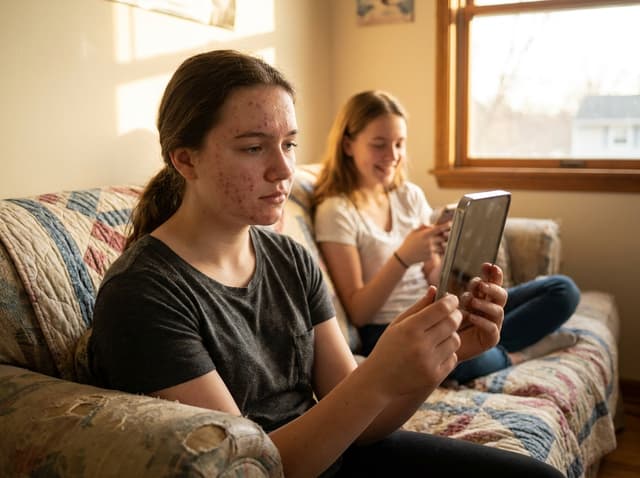
When Your Sibling Has Clear Skin and You Don't: Dealing with Acne Jealousy
Watching your sibling eat the same food, skip skincare, and have perfect skin while you break out constantly is one of the most frustrating parts of having acne.
Read More →
Does Sunlight Help or Hurt Acne? The Complicated Truth
Sun might temporarily mask acne, but it makes things worse long-term. Here's why the vacation skin effect isn't what you think and why UV isn't an acne treatment.
Read More →
Instagram Filters and Acne: How Social Media Distorts Skin Reality
Filters blur texture, erase pores, and create a version of skin that doesn't exist in real life. Here's how that messes with your head when you have acne.
Read More →
Honey for Acne: Does This Kitchen Ingredient Actually Work?
Manuka honey has real antibacterial research behind it. Regular honey, not so much. Here's what works, what doesn't, and whether it's worth the sticky mess.
Read More →
Green Tea and Acne: The Drink (and Ingredient) That Might Help
EGCG in green tea has anti-inflammatory and anti-androgenic properties that could help acne-prone skin. Here's what the research says about drinking it and putting it on your face.
Read More →