How to Stop Obsessing Over Your Skin: A Practical Guide for Teens
Medically reviewed by Dr. Rachel Torres, MD, Pediatric Dermatologist
Written by Teen Acne Solutions Editorial Team — Updated April 25, 2026
How to Stop Obsessing Over Your Skin: A Practical Guide for Teens
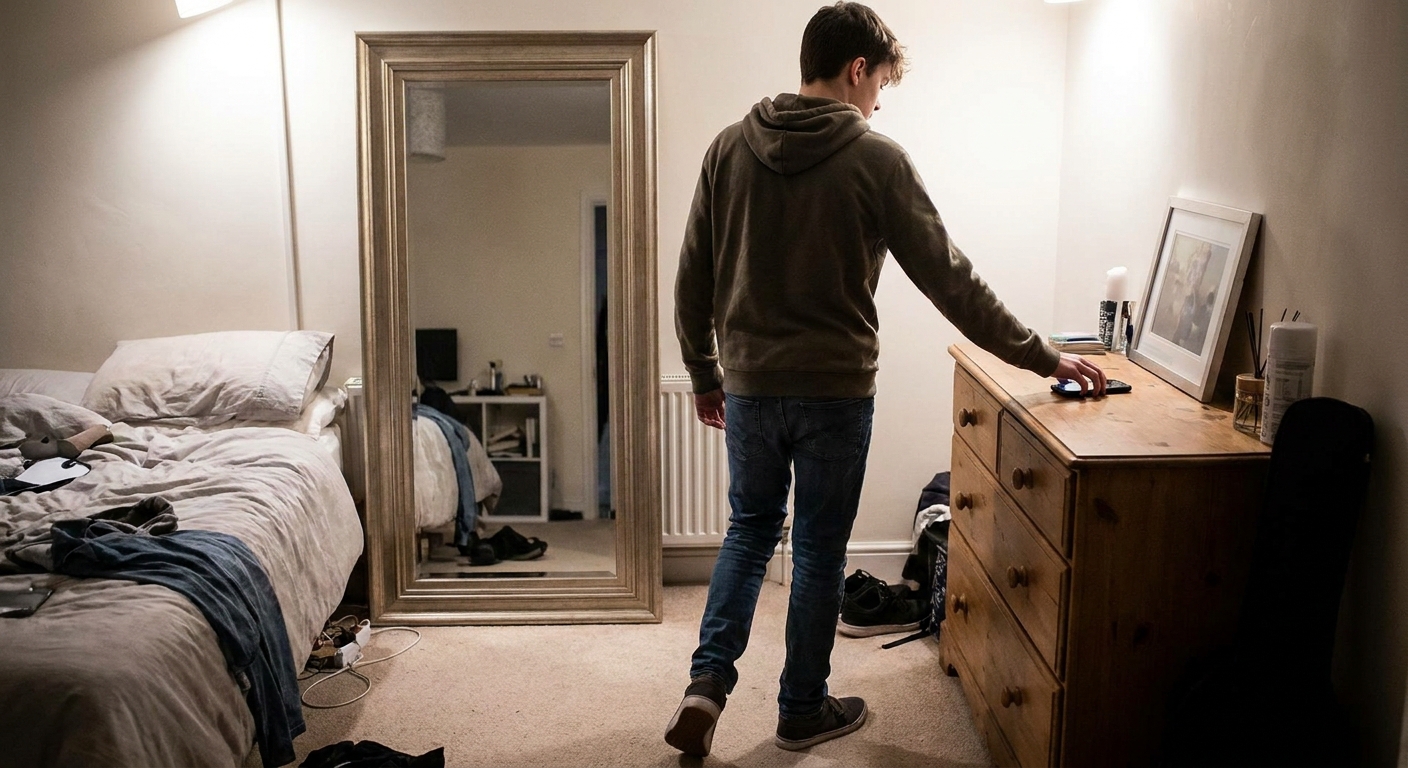
I'm going to be honest with you: I can't give you a magic trick that makes you stop caring about your acne. If someone with breakouts told me they felt zero distress about their skin, I'd actually be a little skeptical. Acne is frustrating. It's okay to be frustrated.
But there's a wide gap between "frustrated" and "consumed." And if you've landed on this article, my guess is you're closer to the consumed end. You're spending more time thinking about your skin than feels right. It's eating into your day, your mood, your ability to enjoy things. You want it to stop, or at least to loosen its grip.
That's a realistic goal. Not "never think about your skin again" — but "get to a place where it doesn't run your life." Here's how to start.
The Skin-Checking Cycle (and Why It Backfires)
Before getting into strategies, it helps to understand why obsessing over your skin actually makes your skin anxiety worse, not better.
Here's what happens: You notice a pimple, or you feel a bump forming under the surface. Anxiety spikes. So you go to the mirror to check — how bad is it? You examine closely, maybe in different lighting. For a brief moment after checking, the anxiety drops slightly. Your brain registers that as: "Checking helped. Do it again next time."
Except the relief doesn't last. Within minutes, the anxiety returns, often stronger. So you check again. And the cycle tightens.
This is a textbook anxiety maintenance loop. A study by Veale and Riley (2001) found that prolonged mirror-gazing increased anxiety, disgust, and distorted self-perception in people concerned about their appearance. Participants who looked in a mirror for an extended period actually rated their appearance as worse afterward than before they started looking. The mirror didn't provide clarity — it provided distortion.
Your phone camera does the same thing. That front-facing camera you keep flipping open to check your skin? It's a mirror that follows you everywhere. A 2019 study in Body Image found that frequent selfie-taking and selfie-viewing were associated with increased appearance-related anxiety and lower self-esteem, especially in adolescents (Lonergan et al., 2019).
Knowing this doesn't make the urge go away. But it can help you recognize the moment it's happening and remind yourself: checking won't give me what I'm looking for.
The 2-Minute Rule
This is the single most practical thing I can offer. It's simple and it works — not immediately, but over days and weeks.
You are allowed to look at your skin in a mirror twice a day, for no more than two minutes each time. Once in the morning when you do your skincare routine, and once at night. That's it.
The rules:
- Normal bathroom lighting. Not the magnifying mirror. Not direct sunlight. Not your phone flashlight held two inches from your face.
- Two minutes means two minutes. Set a timer if you need to.
- During those two minutes, do your routine. Cleanse, apply treatment, moisturize. You're there for a purpose, not for inspection.
- Outside those two windows, no mirror checking. No phone camera. No checking your reflection in windows, dark phone screens, or car mirrors.
This will be hard at first. The urge to check will feel almost physical. That's normal — you're breaking a compulsive habit, and the early days of breaking any habit are uncomfortable. Research on exposure and response prevention (ERP), a technique used in OCD treatment, shows that resisting compulsions leads to a temporary spike in anxiety followed by a natural decrease (Foa & Kozak, 1986). Your brain learns that it can tolerate the uncertainty of not checking, and the urge weakens over time.
If going from constant checking to twice daily feels too extreme, step down gradually. Check every two hours. Then every three. Then morning and evening only. What matters is the direction, not the speed.
Your Phone Is Making This Worse
I want to spend some time on social media because I think it's one of the biggest drivers of skin obsession in teens right now, and it doesn't get treated with enough seriousness.
Your Instagram Explore page and TikTok For You Page are full of skin content. Transformation videos. Close-up pore footage. "What I eat in a day for clear skin." Product hauls. Dermatologist reaction videos. Some of this content is genuinely useful. A lot of it is toxic.
Here's what the research says: A systematic review by Saiphoo and Vahedi (2019) found a consistent negative association between social media use and body image, particularly in adolescents. The mechanism is comparison. You see filtered, edited, professionally lit skin, and your brain treats it as the standard against which your own skin should be measured. Even "no filter" content is usually filmed in flattering conditions with good cameras.
What to actually do:
Unfollow skin-focused accounts for 30 days. Not forever — just 30 days. This includes acne journey accounts, skincare influencers, and dermatology content creators. I know some of these accounts feel helpful, but if you're in an obsessive phase, they're feeding the preoccupation even when the information is good.
Mute related keywords. Most platforms let you mute words and hashtags. Mute "acne," "skincare routine," "clear skin," "glow up," and whatever other terms trigger comparison spirals for you.
Notice the urge-to-scroll pattern. When do you reach for skin content? Usually when you're already anxious about your skin. You're looking for reassurance or solutions, but what you're actually getting is more fuel for the obsession. When you catch yourself searching "how to get rid of [specific skin concern] fast," put the phone down. You've already read everything the internet has to say. Reading it again won't change anything.

When Skincare Becomes Self-Harm
This is uncomfortable to talk about, but it matters. There's a point where "treating your acne" flips into something that's actually damaging your skin and your mental health.
Over-exfoliating. Using chemical exfoliants (AHAs, BHAs) daily or multiple times a day because you want faster results. Using physical scrubs aggressively. Your face burns, peels, and turns red, but you keep going because you feel like you're "doing something." A study by Draelos (2018) in the Journal of Clinical and Aesthetic Dermatology found that over-exfoliation damages the skin barrier, increases transepidermal water loss, and can actually trigger more breakouts — the exact thing you're trying to prevent.
Skin picking (excoriation). Spending extended periods squeezing, poking, or scratching at your skin. This often happens in a trance-like state, where you don't realize how long you've been at it until you see the damage. Excoriation disorder is recognized in the DSM-5, and it frequently co-occurs with acne and BDD (Grant et al., 2012). If you regularly pick at your skin until it bleeds or scars, that's not "just a bad habit." It deserves clinical attention.
Constant product switching. Trying a new product every few days, never giving anything time to work, layering incompatible actives, applying prescription-strength treatments without guidance. Your skin is raw and reactive, but stopping feels impossible because what if the next product is the one that finally works?
If any of these resonate, I want you to step back and ask: is what I'm doing to my skin right now actually helping, or is it just giving me a sense of control? There's an important difference.
Redirect Strategies That Actually Work
"Just stop thinking about it" is useless advice. Your brain doesn't work that way. What does work is giving your brain something else to do — something engaging enough that the skin thoughts can't compete.
Physical activity. This one has real data behind it. A meta-analysis by Stubbs et al. (2017) found that exercise significantly reduced anxiety symptoms across multiple populations. It doesn't have to be intense — a walk, shooting hoops, swimming, dancing in your room. The point is to get into your body and out of the mirror. Bonus: exercise improves blood flow to the skin, which actually supports healing.
Hands-busy activities. Drawing, playing guitar, cooking, building something, gaming — anything that requires your hands and attention. The skin-checking urge is strongest when your hands are free and your mind is idle. Occupying both simultaneously is effective.
Social contact. I know this feels counterintuitive when your skin is the reason you want to isolate. But spending time with people you're comfortable around — even if it's just one friend — pulls your attention outward. You start thinking about the conversation, the activity, the shared experience. Your skin moves to the background. It's still there, but it's not the entire frame.
Timed worry periods. This is a CBT technique. You designate a specific 15-minute window each day as your "skin worry time." Any time a skin worry pops up outside that window, you note it and postpone it: "I'll think about that at 4pm." When 4pm arrives, you can worry if you still want to. Often, by the time the window arrives, the worry has lost its charge. Research by Borkovec et al. (1983) found that structured worry periods reduced overall anxiety and worry frequency.
Building an Identity Beyond Your Skin
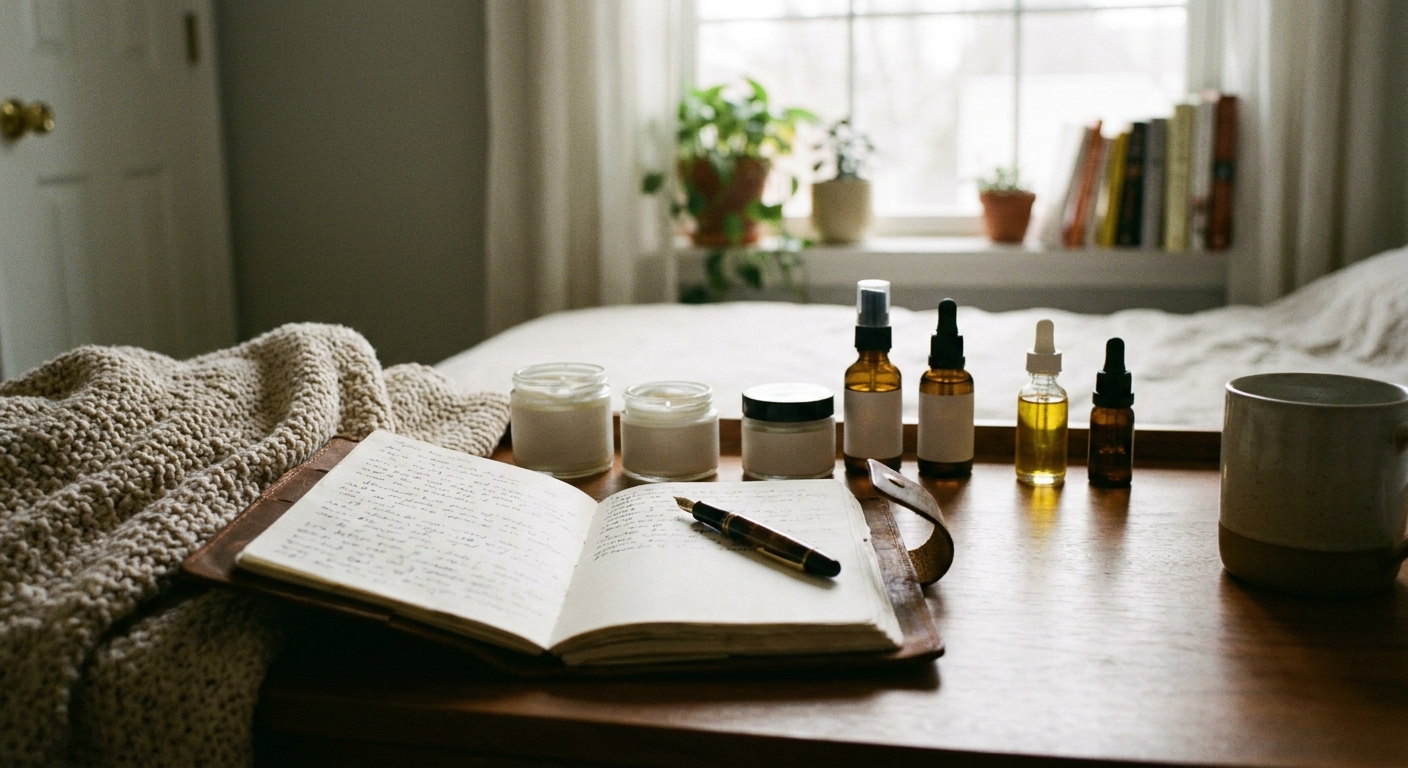
This is the longer-term work, and it's probably the most important part.
When acne dominates your teen years, it's easy for your identity to collapse around it. You become "the person with bad skin" — not to other people, necessarily, but to yourself. Everything gets filtered through the skin lens. You don't think "I had a good day" — you think "my skin looked okay today, so it was a good day." Your worth fluctuates with your breakouts.
Rebuilding means deliberately investing in parts of yourself that have nothing to do with your face.
What are you good at? Not "what do you wish you were good at" — what can you actually do right now? Maybe you're funny. Maybe you're a decent writer. Maybe you're the person people come to when they need advice. Maybe you're fast, or patient, or good with animals, or weirdly knowledgeable about a niche topic.
Those things are yours. Acne can't touch them.
I'm not saying this to minimize what acne takes from you. I'm saying it because the obsession narrows your field of vision until skin is all you can see, and deliberately widening that field is one of the few things that genuinely helps.
Try this: Write down five things you'd want people to remember about you if your appearance were completely invisible. Not your face, not your body — just who you are. Read that list when the skin spiral starts. It won't cure anything, but it can remind you that you're more than a breakout.
Practical Daily Exercises
Here's a simple framework you can start with today:
Morning:
- 2-minute skincare routine in normal lighting. Do your routine, then walk away.
- Before leaving the house, say one specific thing you're looking forward to today that has nothing to do with your skin. Out loud if you can. "I'm looking forward to lunch with Maya." It sounds silly. It redirects your brain.
During the day:
- When you catch yourself checking (mirror, phone camera, window reflection), note it without judgment and redirect. "There's the urge. I'm going to [specific alternative activity] instead."
- If a skin worry hits, write it on a note for your worry period. Don't engage with it in the moment.
Evening:
- 2-minute nighttime routine in normal lighting.
- Write down one thing that went well today. Not skin-related.
- 15-minute worry period if you want it. After 15 minutes, close it out.
Weekly:
- Track your mirror-checking frequency. Not to judge yourself, but to watch the trend. Progress isn't linear — a bad day doesn't erase a good week.
Key Takeaways
- The skin-checking cycle makes anxiety worse, not better. Every check trains your brain to check again. Breaking the cycle starts with limiting mirror time.
- The 2-minute rule works. Two minutes, twice a day, normal lighting. Everything else is compulsive checking dressed up as skincare.
- Social media is probably your biggest trigger right now. A 30-day unfollow experiment costs you nothing and might change how you feel significantly.
- If your skincare routine is damaging your skin through over-exfoliating, picking, or constant product switching, that's a sign the obsession has taken over the routine.
- Your identity is bigger than your skin. Deliberately investing in non-appearance parts of yourself is protective, not avoidant.
The Bottom Line
You're not going to wake up tomorrow and feel relaxed about your skin. That's fine. What you can do is start building small habits that weaken the obsession's grip, one day at a time. The 2-minute rule, the social media detox, the redirect strategies, the worry periods — none of them are dramatic. They're boring, practical, and incremental. But they work because they're targeting the actual mechanism that keeps you stuck: the compulsive loop of checking, comparing, and catastrophizing.
If you try these strategies for a few weeks and the obsession doesn't loosen at all — if it's still running your life despite real effort — that's information worth taking to a therapist. There's no shame in needing professional support. Some patterns are too entrenched to break alone, and a good therapist can give you tools that go beyond what any article can offer.
You deserve to think about something other than your skin today. Start small.
Sources:
- Veale, D., & Riley, S. (2001). Mirror, mirror on the wall, who is the ugliest of them all? The psychopathology of mirror gazing in body dysmorphic disorder. Behaviour Research and Therapy, 39(12), 1381-1393.
- Lonergan, A. R., Bussey, K., Mond, J., Brown, O., Griffiths, S., Murray, S. B., & Mitchison, D. (2019). Me, my selfie, and I: The relationship between editing and posting selfies and body dissatisfaction in men and women. Body Image, 28, 39-43.
- Foa, E. B., & Kozak, M. J. (1986). Emotional processing of fear: Exposure to corrective information. Psychological Bulletin, 99(1), 20-35.
- Saiphoo, A. N., & Vahedi, Z. (2019). A meta-analytic review of the relationship between social media use and body image disturbance. Computers in Human Behavior, 101, 259-275.
- Draelos, Z. D. (2018). The science behind skin care: Cleansers. Journal of Clinical and Aesthetic Dermatology, 11(5), 28-32.
- Grant, J. E., Odlaug, B. L., Chamberlain, S. R., Keuthen, N. J., Lochner, C., & Stein, D. J. (2012). Skin picking disorder. American Journal of Psychiatry, 169(11), 1143-1149.
- Stubbs, B., Vancampfort, D., Rosenbaum, S., Firth, J., Cosco, T., Veronese, N., ... & Schuch, F. B. (2017). An examination of the anxiolytic effects of exercise for people with anxiety and stress-related disorders: A meta-analysis. Psychiatry Research, 249, 102-108.
- Borkovec, T. D., Wilkinson, L., Folensbee, R., & Lerman, C. (1983). Stimulus control applications to the treatment of worry. Behaviour Research and Therapy, 21(3), 247-251.
How we reviewed this article:
Our experts continually monitor the health and wellness space, and we update our articles when new information becomes available.
Read This Next
When Your Sibling Has Clear Skin and You Don't: Dealing with Acne Jealousy
Watching your sibling eat the same food, skip skincare, and have perfect skin while you break out constantly is one of the most frustrating parts of having acne.
Read More →
Does Sunlight Help or Hurt Acne? The Complicated Truth
Sun might temporarily mask acne, but it makes things worse long-term. Here's why the vacation skin effect isn't what you think and why UV isn't an acne treatment.
Read More →
Instagram Filters and Acne: How Social Media Distorts Skin Reality
Filters blur texture, erase pores, and create a version of skin that doesn't exist in real life. Here's how that messes with your head when you have acne.
Read More →
Honey for Acne: Does This Kitchen Ingredient Actually Work?
Manuka honey has real antibacterial research behind it. Regular honey, not so much. Here's what works, what doesn't, and whether it's worth the sticky mess.
Read More →
Green Tea and Acne: The Drink (and Ingredient) That Might Help
EGCG in green tea has anti-inflammatory and anti-androgenic properties that could help acne-prone skin. Here's what the research says about drinking it and putting it on your face.
Read More →