Makeup and Acne: How to Cover Breakouts Without Making Them Worse
Medically reviewed by Dr. Sarah Mitchell, MD, Board-Certified Dermatologist
Written by Teen Acne Solutions Editorial Team — Updated March 15, 2026
Key takeaways
- Non-comedogenic makeup won't cure acne, but it won't make it worse when used correctly
- The order matters: skincare treatment first, then primer, then makeup — never skip treatment
- Dirty brushes and sponges are a major hidden cause of breakouts — clean them weekly
- Mineral-based foundations with zinc oxide may actually have mild anti-inflammatory benefits
- Always remove makeup completely before bed — sleeping in makeup significantly increases breakout risk
Let's get one thing straight: wanting to wear makeup when you have acne does not make you vain, shallow, or "part of the problem." Breakouts can seriously affect your confidence — especially during your teen years when it feels like everyone is looking at your skin. Covering up a pimple before school or a social event is completely valid, and with the right approach, you can do it without sabotaging your skin.
The real issue was never makeup itself. It was the wrong makeup, applied the wrong way, with tools that haven't been cleaned since you bought them. This guide breaks down exactly how to cover acne with makeup safely — from choosing non-comedogenic products to removing everything properly at the end of the day.
Whether you wear a full face daily or just dab on concealer for picture day, this article will help you make choices that work with your skin, not against it.
Can Makeup Cause Acne?
This is the question behind so many well-meaning but frustrating comments like "maybe if you stopped wearing makeup, your skin would clear up." The truth is more nuanced than that.
The Real Story Behind "Acne Cosmetica"
Back in 1972, dermatologists Kligman and Mills coined the term acne cosmetica to describe acne triggered specifically by cosmetic products. Their research found that certain cosmetic ingredients could clog pores and cause a particular pattern of small, persistent bumps — mostly on the cheeks, chin, and forehead.
Here's the important context: the cosmetic formulations available in the 1970s were dramatically different from what's on drugstore shelves today. Many products back then were heavily oil-based and contained ingredients we now know are highly comedogenic (pore-clogging). Modern makeup for acne prone skin has come a long way.
So, Does Makeup Cause Breakouts or Not?
The honest answer: it depends entirely on the product, how you apply it, and how you remove it.
Research published in Dermatology found that appropriately formulated cosmetics — specifically those labeled non-comedogenic — did not worsen acne in study participants and, in some cases, actually improved treatment adherence because patients felt better about their appearance while their acne medications did their work.
Think about it this way: if covering a breakout helps you feel confident enough to actually stick with your skincare routine (instead of hiding in your room feeling miserable), that's a net positive for your skin.
The bottom line: Non-comedogenic makeup, applied correctly and removed thoroughly, does not cause acne. But the wrong products absolutely can — which is why ingredient awareness matters.
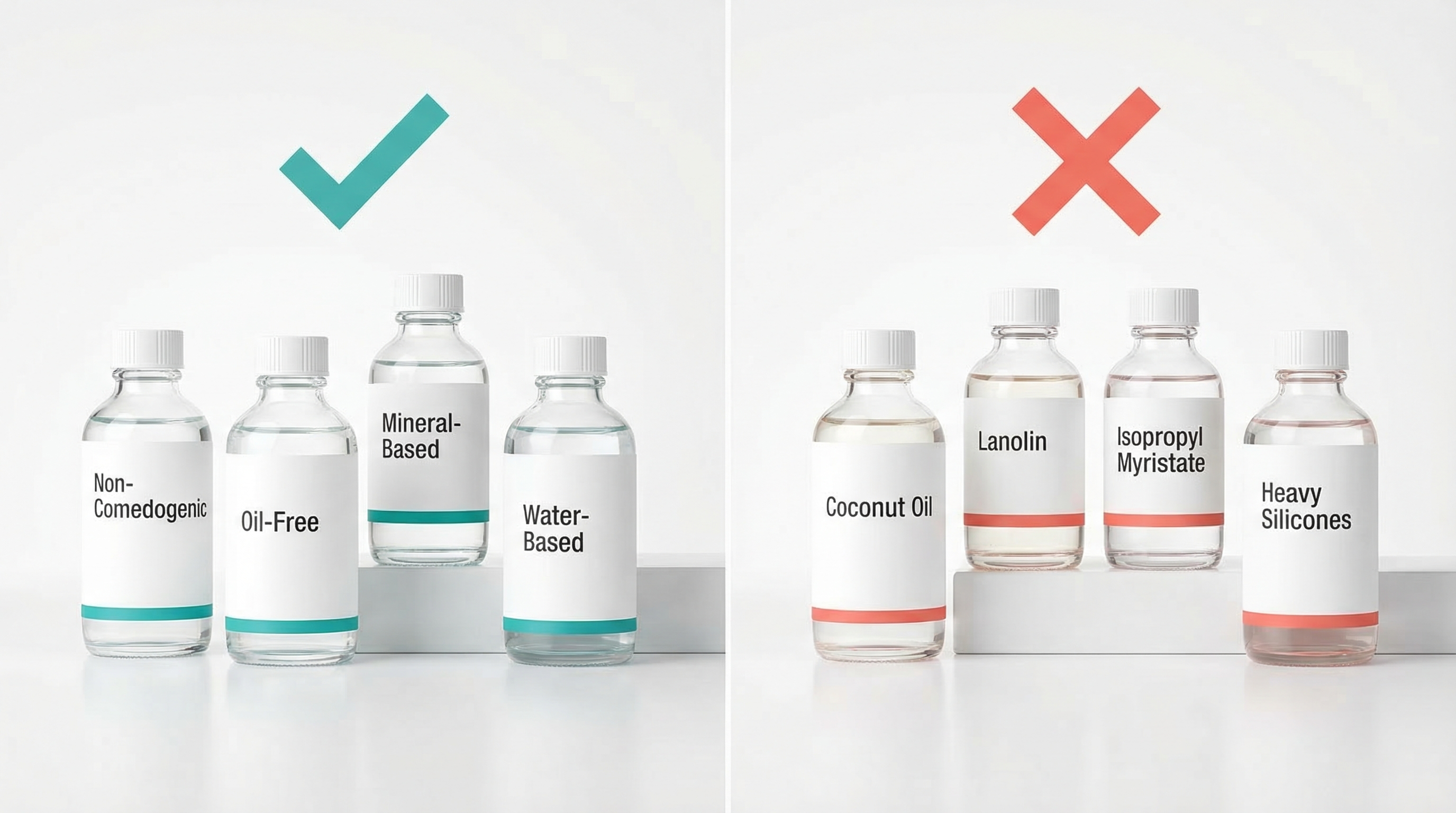
Ingredients to Avoid
When you're shopping for acne safe makeup, flipping over the product and scanning the ingredient list is the single most important habit you can build. Not every ingredient with a long, complicated name is bad — but some are proven pore-cloggers that have no business being on acne-prone skin.
High-Comedogenicity Ingredients
These ingredients have been rated high on the comedogenicity scale (typically 3-5 out of 5) in studies like the classic rabbit ear assay by Fulton et al. Avoid them when possible:
- Isopropyl myristate — An emollient found in many foundations. It's one of the most well-documented pore-clogging ingredients in dermatological research. If you see this on a label, put the product back.
- Coconut oil (Cocos nucifera oil) — Hugely popular in the "natural beauty" space, but it has a comedogenicity rating of 4 out of 5. It's great for your hair. It's terrible for acne-prone facial skin.
- Lanolin — Derived from sheep's wool, lanolin is a heavy moisturizing agent commonly found in lip products and cream foundations. Highly comedogenic for many people.
- D&C red dyes (especially Red 17, Red 21, Red 27, Red 36) — These synthetic colorants, common in blushes and tinted products, have been shown to be comedogenic. Look for mineral-based color alternatives instead.
- Algae extract / Carrageenan — Often marketed as "natural" and "nourishing," but both rate high on the comedogenicity scale.
- Wheat germ oil — Another "natural" ingredient that sounds gentle but clogs pores readily.
- Acetylated lanolin alcohol — A modified form of lanolin that's even more comedogenic than the original.
Other Ingredients to Watch
These aren't always pore-cloggers for everyone, but they're worth being cautious about if your skin is particularly reactive:
- Silicones ending in "-cone" or "-siloxane" (like dimethicone) — These are actually rated low on the comedogenicity scale, but very heavy silicone-based primers can sometimes trap sweat and oil underneath, especially during hot weather or exercise. If you notice breakouts concentrated where you apply primer, silicone buildup might be the culprit.
- Fragrance / Parfum — Won't necessarily clog pores, but can cause irritation and inflammation that worsens existing acne. Fragrance-free is always the safer bet for acne-prone skin.
- Alcohol denat. (denatured alcohol) — In high concentrations, this can strip your skin barrier, leading to increased oil production and — you guessed it — more breakouts.
Your "Red Flag" Quick-Check List
Before buying any new makeup product, scan for these terms. If you spot more than one, consider a different option:
- Isopropyl myristate
- Isopropyl palmitate
- Coconut oil / Cocos nucifera oil
- Lanolin / acetylated lanolin
- D&C Red dyes (17, 21, 27, 36)
- Algae extract
- Wheat germ oil
- Ethylhexyl palmitate
- Lauric acid (in high concentrations)
- Myristyl myristate
Ingredients That Actually Help
Here's the exciting part: some makeup ingredients don't just avoid causing breakouts — they actively support your skin. When you're looking for makeup for acne prone skin, these are the ingredients to seek out.
Zinc Oxide
Found in many mineral foundations and sunscreens, zinc oxide is a quiet superstar. Research published in the Journal of Dermatological Science demonstrated that zinc oxide has legitimate anti-inflammatory and antibacterial properties. When you wear a mineral foundation containing zinc oxide, you're getting light coverage and mild acne-fighting benefits. It also provides broad-spectrum sun protection, which is important if you're using acne treatments like retinoids or benzoyl peroxide that make your skin more sun-sensitive.
Niacinamide (Vitamin B3)
Increasingly common in tinted moisturizers and BB creams, niacinamide helps regulate oil production, strengthens the skin barrier, and reduces redness. If you spot this on a makeup ingredient list, that's a green flag.
Salicylic Acid
Some concealers and foundations now contain low concentrations of salicylic acid (typically 0.5-2%). This beta-hydroxy acid (BHA) penetrates into pores to dissolve the oil and dead skin cells that lead to clogs. A concealer with salicylic acid can treat a pimple while covering it — that's genuinely helpful.
Titanium Dioxide
Like zinc oxide, titanium dioxide is a mineral sun filter that's gentle and non-comedogenic. It's a common ingredient in mineral and powder foundations.
Hyaluronic Acid
If your acne treatments are drying out your skin (common with benzoyl peroxide and retinoids), a foundation or tinted moisturizer containing hyaluronic acid can help maintain hydration without adding oil.
Your "Green Flag" Ingredient List
Look for products that feature some of these:
- Zinc oxide
- Titanium dioxide
- Niacinamide
- Salicylic acid (0.5-2%)
- Hyaluronic acid
- Aloe vera extract
- Green tea extract (Camellia sinensis)
- Centella asiatica extract
- Allantoin
Step-by-Step Application Guide
The order you apply products matters just as much as the products themselves. Here's the complete routine for covering breakouts without making them worse.
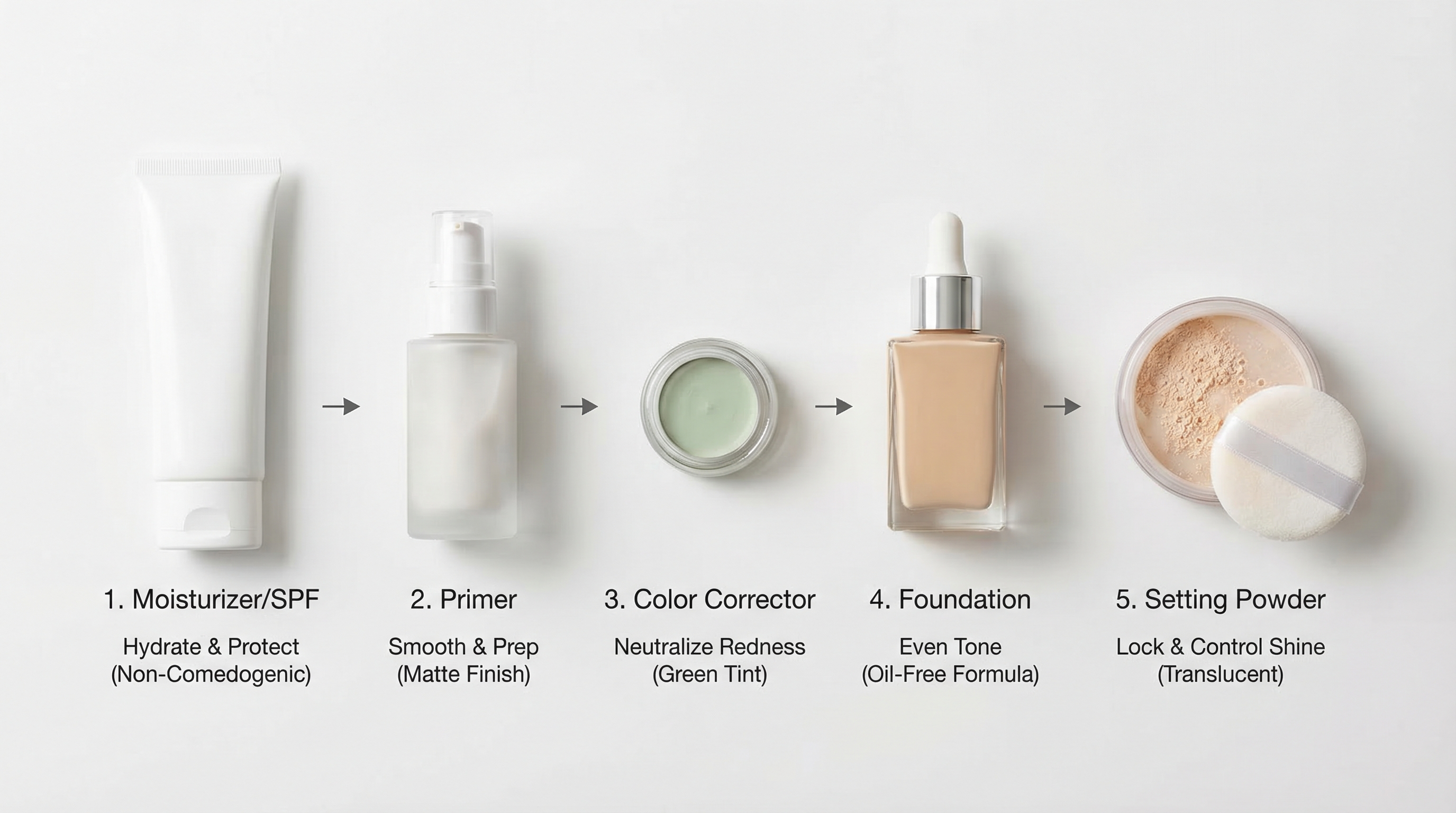
Step 1: Skincare Treatment First — Always
Your acne treatment is the priority. Makeup is the supporting player, not the star. Apply your full skincare routine — cleanser, acne treatment (benzoyl peroxide, salicylic acid, adapalene, or whatever your dermatologist has prescribed), and moisturizer — and let everything absorb for at least 5-10 minutes before reaching for any makeup.
Why this matters: If you layer makeup directly over wet or tacky treatment products, the makeup won't adhere properly, it'll slide around during the day, and you may dilute the effectiveness of your treatment. Patience here pays off.
Step 2: SPF (If Not in Your Moisturizer)
If your moisturizer doesn't contain SPF 30+, apply a separate sunscreen now. This is especially non-negotiable if you're using retinoids or chemical exfoliants. Look for lightweight, non-comedogenic sunscreens — mineral options with zinc oxide do double duty here.
Step 3: Primer
A good primer creates a smooth base, helps makeup last longer, and acts as a barrier between your treatment products and your makeup. Choose a non-comedogenic, silicone-free or lightweight silicone primer. Apply a thin, even layer — you don't need much.
Pro tip: If you have oily skin, a mattifying primer in your T-zone can help prevent that midday shine without requiring powder touch-ups (which can build up and clog pores over the course of the day).
Step 4: Color Corrector (Optional but Powerful)
This is the secret weapon most teens don't know about. Instead of piling on layers of heavy concealer to cancel out redness, a color corrector does the job with a fraction of the product. We'll cover specific techniques in the next section.
Step 5: Foundation (Less Is More)
Choose a lightweight, non-comedogenic, buildable-coverage foundation. The key word here is buildable — start with a thin layer everywhere, then add coverage only where you need it. This prevents the heavy, cakey look that screams "I'm covering something" and also reduces the total amount of product sitting on your skin.
Application method matters: Use a clean, damp beauty sponge (like a Beautyblender) or a clean foundation brush. Dab and press — don't rub or drag, especially over active breakouts. Rubbing can irritate inflamed skin and also spread bacteria from one area to another.
Step 6: Concealer
Apply concealer after foundation, directly on any spots that still need coverage. Use a small, precise brush or a clean fingertip. Pat gently — don't rub. Build up in thin layers rather than applying one thick glob.
Step 7: Setting
Set your makeup with a light dusting of translucent, non-comedogenic setting powder. Focus on your T-zone and any areas that tend to get oily. A setting spray can help lock everything in place without the heaviness of excess powder.
Avoid: Heavy powder all over your face. Over-powdering can settle into fine lines, look unnatural, and actually mix with your natural oils throughout the day to form a pore-clogging paste.
How to Cover Different Types of Breakouts
Not all pimples are created equal, and covering a red, inflamed cyst is a completely different challenge from concealing a flat dark spot. Here's how to handle each type.
Red, Inflamed Pimples
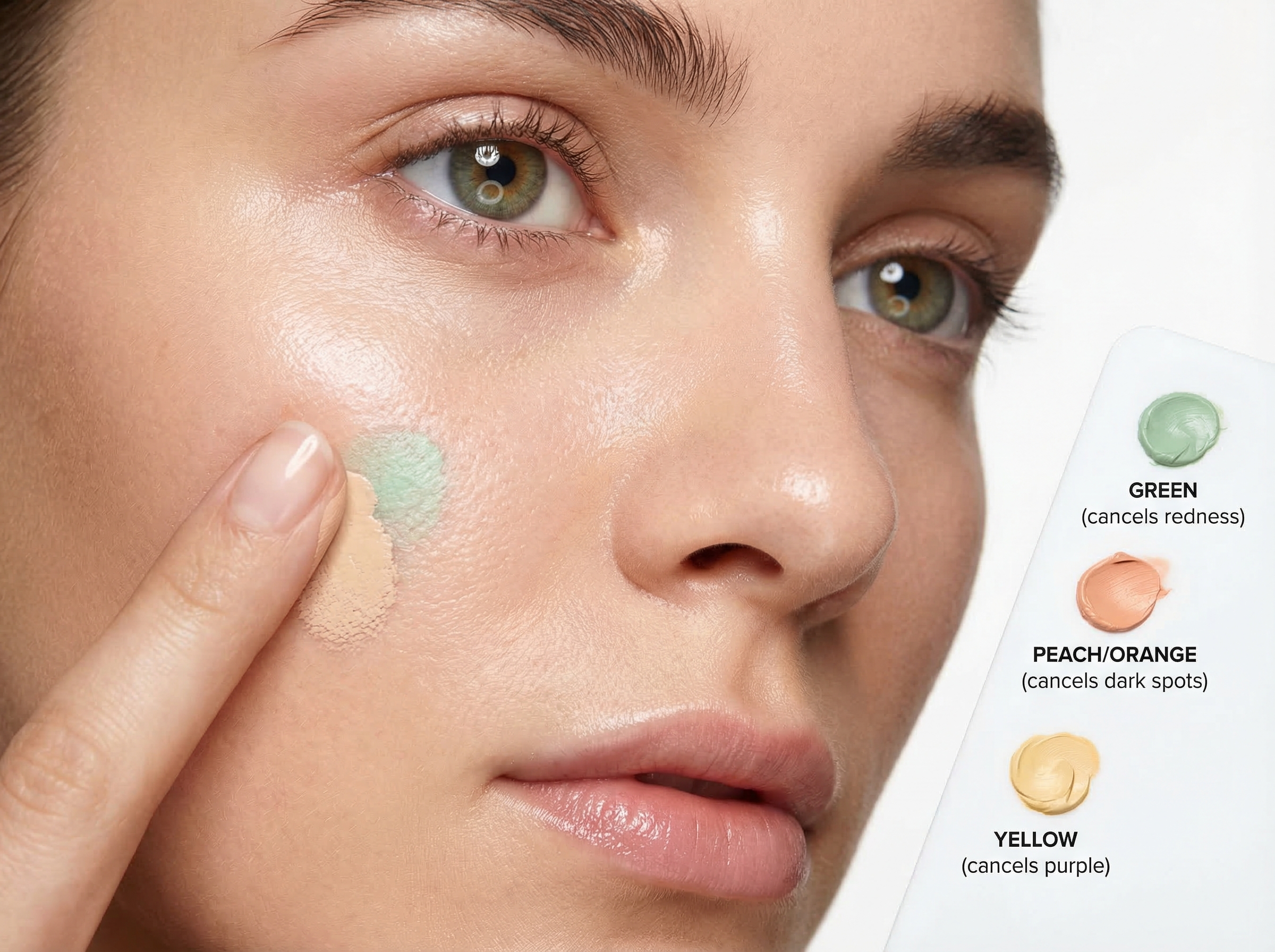
The color correction approach: Red and green are opposite on the color wheel. A small amount of green color corrector, dabbed directly onto the red area and blended at the edges, neutralizes the redness before you even touch your foundation.
- Dab a tiny amount of green corrector onto the pimple with a small brush or clean fingertip.
- Blend only the edges — leave the concentrated color on the pimple itself.
- Let it set for 30 seconds.
- Gently pat (don't rub) your foundation over the area.
- If needed, add a thin layer of concealer that matches your skin tone.
- Set with a light tap of translucent powder.
Result: Full coverage without five layers of heavy concealer.
Cystic Acne (Deep, Painful Bumps)
Cystic breakouts are particularly challenging because they're raised, and no amount of color can flatten a bump. Focus on color matching rather than trying to make the bump invisible.
- Don't try to flatten cystic pimples with pressure or excessive product — this will only draw more attention to the texture.
- Use green corrector if the area is red.
- Apply a thin layer of your regular foundation over the entire face, including the cystic area.
- Use a concealer that exactly matches your skin tone (not lighter). A lighter shade highlights the bump.
- Pat gently. Set with powder.
- Accept that texture will still be slightly visible, and that's okay. The goal is to minimize the color contrast, not to create a perfectly flat surface.
Honest note: Even professional makeup artists can't make a raised cystic pimple completely invisible. If anyone tells you otherwise, they're editing their photos. Focus on reducing redness and let the texture be.
Whiteheads
Do not pop a whitehead and then try to cover it with makeup. Open wounds and makeup are a recipe for infection and a worse breakout. If the whitehead is intact:
- Apply a thin layer of foundation over the area.
- Use a very small amount of concealer, patted (not rubbed) directly on the whitehead.
- Set with powder.
- Avoid touching the area throughout the day.
If a whitehead has opened on its own, treat it like a wound: apply a thin layer of an acne spot treatment or a hydrocolloid pimple patch instead of makeup. You can apply makeup around the patch if needed.
Post-Inflammatory Hyperpigmentation (PIH) and Dark Spots
These flat, discolored marks left behind after a pimple heals are actually easier to cover than active breakouts because there's no raised texture to deal with.
Color correction guide for dark spots:
- Purple/blue-toned dark spots (common on lighter skin tones): Use a peach or orange corrector.
- Brown/dark brown spots (common on medium to deeper skin tones): Use an orange or deep peach corrector.
- Red/pink marks (post-inflammatory erythema): Use a green corrector.
Apply the corrector, blend the edges, then layer foundation and concealer as needed. Because PIH is flat, coverage tends to look very natural.
Removing Makeup Properly
Here's where many people undo all their good work. Sleeping in your makeup — even once — significantly increases your risk of a breakout. Makeup, mixed with a full day's worth of oil, sweat, and environmental debris, creates the perfect pore-clogging cocktail when left on overnight.
The Double Cleanse Method
Double cleansing is the most effective way to remove makeup completely without stripping your skin. It's standard practice in dermatology-backed skincare, and it's easier than it sounds.
First cleanse — Oil-based or micellar cleanser: Use a gentle, non-comedogenic cleansing oil, cleansing balm, or micellar water. This step dissolves the makeup, sunscreen, and excess oil on the surface of your skin. Massage gently over dry skin for about 60 seconds, then rinse with lukewarm water (or wipe off with a soft cotton pad if using micellar water).
Wait — oil cleanser on acne-prone skin? Yes. Oil-based cleansers work on the principle that "like dissolves like." They break down the oil-based components of your makeup far more effectively than a foaming cleanser alone. The key is choosing one that's specifically formulated to be non-comedogenic and rinses clean. Look for cleansing oils based on jojoba oil or grapeseed oil, which are low on the comedogenicity scale.
Second cleanse — Water-based cleanser: Follow up with your regular gentle, acne-appropriate face wash. This cleanses your actual skin — removing any remaining residue, bacteria, and impurities that the first cleanse loosened up. Look for a cleanser with a pH between 4.5 and 6.5 to maintain your skin's acid mantle.
After cleansing: Apply your evening skincare treatments and moisturizer as usual.
Makeup Removal Mistakes to Avoid
- Using face wipes as your only cleansing step. Wipes don't actually cleanse — they smear product around. They're fine in a pinch (camping trip, sleepover, emergency) but should never be your everyday method.
- Scrubbing your face aggressively. This irritates active breakouts, spreads bacteria, and damages your skin barrier. Be gentle. Your cleanser is doing the work, not your hands.
- Using hot water. Lukewarm is ideal. Hot water strips natural oils and can cause rebound oil production.
- Skipping the double cleanse because you "only wore a little makeup." Even light coverage, combined with SPF and primer, needs proper removal. One cleanse often isn't enough.
Tool Hygiene
You could use the most perfectly formulated non-comedogenic makeup in the world, and it won't matter if you're applying it with a brush that's harboring three weeks' worth of bacteria, dead skin cells, and old product buildup. Tool hygiene is one of the most overlooked causes of persistent breakouts.
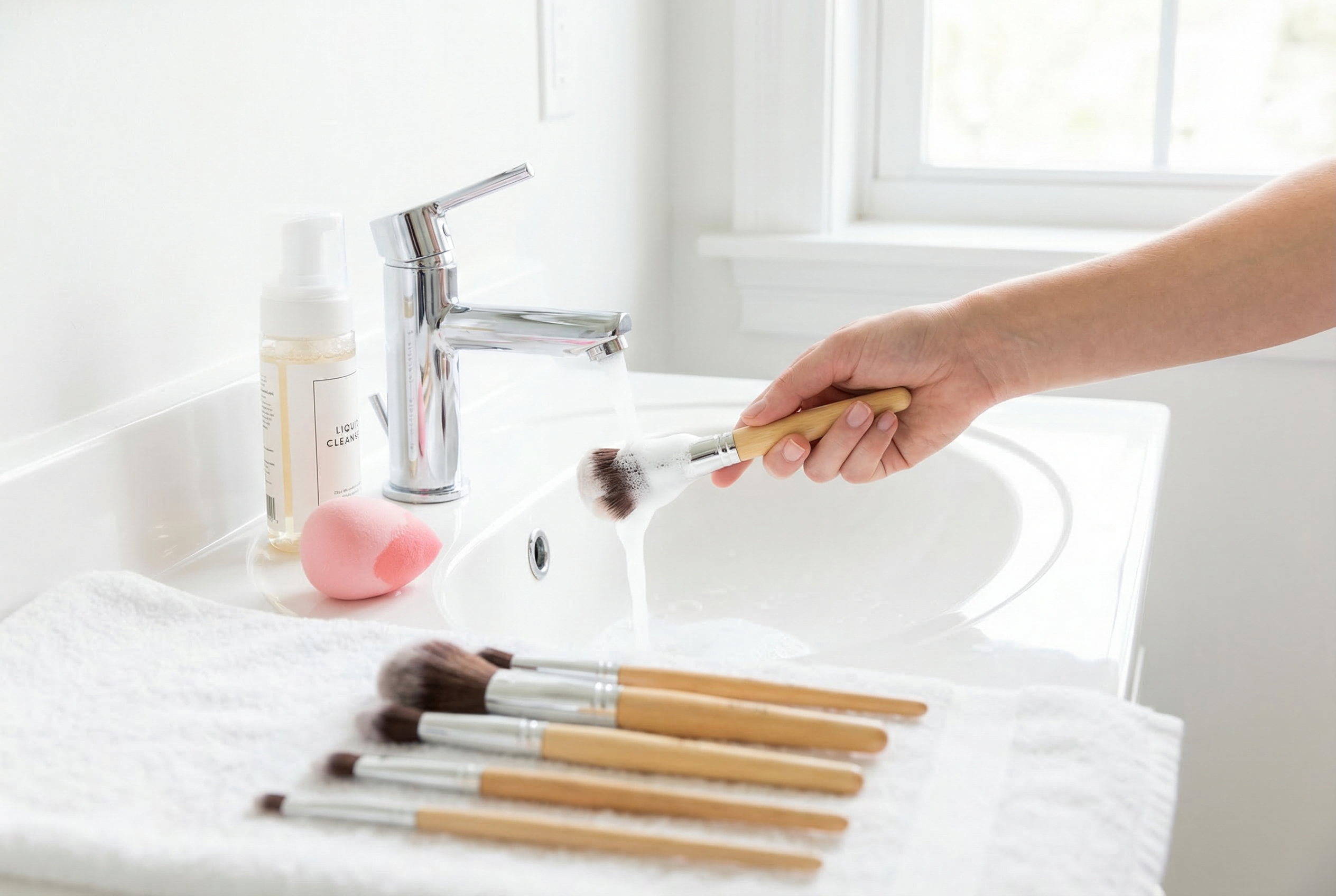
Brush Cleaning Schedule
Daily (quick clean): Spray your most-used brushes — foundation brush, concealer brush, and powder brush — with a brush cleaning spray or 70% isopropyl alcohol. Swirl on a clean paper towel until no product transfers. Let dry before the next use.
Weekly (deep clean): This is the non-negotiable one.
- Wet brush bristles with lukewarm water (avoid getting water above the ferrule — the metal part — as this loosens the glue over time).
- Apply a gentle, fragrance-free soap or dedicated brush cleanser to the bristles.
- Swirl the brush on a textured cleaning mat or in the palm of your hand.
- Rinse thoroughly until the water runs clear.
- Reshape the bristles and lay flat on a clean towel to dry. Never dry brushes standing upright — water will seep into the handle and breed bacteria.
Sponge Maintenance
Beauty sponges are incredibly useful for applying foundation over acne-prone skin because the bouncing/dabbing motion is gentler than brush strokes. However, sponges are also bacteria magnets.
- After every use: Rinse thoroughly with warm water and gentle soap. Squeeze out excess water and let air dry in a well-ventilated area (not inside a closed makeup bag).
- Weekly: Deep clean by soaking in warm, soapy water for a few minutes, then squeezing and rinsing until the water runs clear.
- Replace every 1-3 months. If your sponge is stained, has an odor, or starts tearing — it's done. Sponges are not a lifetime investment. A $7 sponge replaced regularly is better for your skin than a $20 sponge used for six months.
Other Hygiene Tips
- Don't share makeup. Especially concealer, foundation, and anything that touches your face. Sharing transfers bacteria between people.
- Sharpen lip and eye pencils before each use. This removes the top layer that's been exposed to bacteria.
- Check expiration dates. Liquid products (foundation, concealer) generally last 6-12 months after opening. Powder products last 12-24 months. Mascara should be replaced every 3 months.
- Clean your phone screen. If you press your phone against your cheek, you're transferring everything on that screen directly to your skin. Wipe it down daily with a screen-safe disinfecting wipe.
Building Your Acne-Safe Makeup Routine: A Drugstore-Friendly Checklist
You don't need expensive prestige brands to find acne safe makeup. Many drugstore products are formulated with acne-prone skin in mind. Here's what to look for on the label when you're standing in the aisle:
Must-Have Label Claims
- Non-comedogenic — Formulated not to clog pores
- Oil-free — No added oils (though not all oils are bad; this is a useful starting filter)
- Fragrance-free — Eliminates a common irritant
- Dermatologist-tested — Has undergone professional evaluation
- Hypoallergenic — Lower risk of causing allergic reactions
Bonus Features to Seek Out
- Contains salicylic acid (treats while it covers)
- Contains niacinamide (regulates oil, reduces redness)
- Contains zinc oxide or titanium dioxide (mineral-based, anti-inflammatory, sun protection)
- Contains hyaluronic acid (hydrating without adding oil)
- Buildable coverage (so you can use less product overall)
- Available in a wide shade range (a good shade match means less product needed)
A Note on "Clean" and "Natural" Beauty
Marketing terms like "clean," "natural," and "botanical" are not regulated and do not automatically mean a product is safe for acne-prone skin. As we discussed earlier, coconut oil is about as natural as it gets — and it's one of the most comedogenic ingredients available. Always check the actual ingredient list rather than relying on front-of-package marketing claims.
When to See a Dermatologist
If your acne is moderate to severe, no amount of makeup technique can substitute for proper medical treatment. Consider seeing a dermatologist if:
- Over-the-counter treatments haven't improved your acne after 8-12 weeks of consistent use
- Your breakouts are leaving scars or persistent dark marks
- You have deep, painful cystic acne that doesn't respond to surface-level treatments
- Acne is significantly impacting your mental health or daily activities
- You suspect your makeup or skincare products are causing reactions but can't identify the trigger
A dermatologist can prescribe treatments like topical retinoids, antibiotics, or hormonal therapies that work on a deeper level than anything available over the counter. And they can help you build a complete skincare-and-makeup routine that works together rather than at cross purposes.
The Bottom Line
Wearing makeup with acne is not a contradiction. You're not "hiding" or "making things worse" — you're taking control of how you present yourself to the world, and that matters. The key is doing it thoughtfully.
Choose non-comedogenic, ingredient-conscious products. Apply them in the right order, over your skincare treatments, with clean tools. Remove everything thoroughly at the end of the day. And remember that your acne treatment routine is the foundation (pun intended) — makeup is just the finishing touch.
Your skin is doing its best. You're doing your best. And with the right approach, how to cover acne with makeup becomes just another part of your daily routine — no guilt required.
How we reviewed this article:
Our experts continually monitor the health and wellness space, and we update our articles when new information becomes available.
- Draelos ZD. (2006). The effect of a daily facial cleanser for normal to oily skin on the skin barrier of subjects with acne. Cutis.https://pubmed.ncbi.nlm.nih.gov/16536897/
- Fulton JE, et al. (1984). Comedogenicity of current therapeutic products, cosmetics, and ingredients in the rabbit ear. Journal of the American Academy of Dermatology.https://pubmed.ncbi.nlm.nih.gov/6229554/
- Zhu M, et al. (2017). Anti-inflammatory effects of zinc oxide in acne vulgaris. Journal of Dermatological Science.https://pubmed.ncbi.nlm.nih.gov/28688725/
- Dréno B, et al. (2007). The role of cosmetics in acne management. Dermatology.https://pubmed.ncbi.nlm.nih.gov/17911985/
- Hayashi N, et al. (2005). Comedogenicity of cosmetic products in Japanese subjects. Contact Dermatitis.https://pubmed.ncbi.nlm.nih.gov/15932581/
- American Academy of Dermatology. Acne: Tips for Managing.https://www.aad.org/public/diseases/acne/skin-care/tips
- Draelos ZD. (2015). Cosmeceuticals and cosmetic practice. John Wiley & Sons.https://doi.org/10.1002/9781118384831
- Kligman AM, Mills OH. (1972). Acne cosmetica. Archives of Dermatology.https://pubmed.ncbi.nlm.nih.gov/4260198/
- Bowe WP, Shalita AR. (2008). Effective over-the-counter acne treatments. Seminars in Cutaneous Medicine and Surgery.https://pubmed.ncbi.nlm.nih.gov/18786497/
Read This Next

When Your Sibling Has Clear Skin and You Don't: Dealing with Acne Jealousy
Watching your sibling eat the same food, skip skincare, and have perfect skin while you break out constantly is one of the most frustrating parts of having acne.
Read More →
Does Sunlight Help or Hurt Acne? The Complicated Truth
Sun might temporarily mask acne, but it makes things worse long-term. Here's why the vacation skin effect isn't what you think and why UV isn't an acne treatment.
Read More →
Instagram Filters and Acne: How Social Media Distorts Skin Reality
Filters blur texture, erase pores, and create a version of skin that doesn't exist in real life. Here's how that messes with your head when you have acne.
Read More →
Honey for Acne: Does This Kitchen Ingredient Actually Work?
Manuka honey has real antibacterial research behind it. Regular honey, not so much. Here's what works, what doesn't, and whether it's worth the sticky mess.
Read More →
Green Tea and Acne: The Drink (and Ingredient) That Might Help
EGCG in green tea has anti-inflammatory and anti-androgenic properties that could help acne-prone skin. Here's what the research says about drinking it and putting it on your face.
Read More →