Acne and Social Media: How to Deal with Unrealistic Skin Standards
Medically reviewed by Dr. Rachel Torres, MD, Pediatric Dermatologist
Written by Teen Acne Solutions Editorial Team — Updated March 14, 2026
Key takeaways
- 95% of photos on social media use some form of skin smoothing, filtering, or editing
- Teens who spend 3+ hours daily on social media are significantly more likely to report body image issues
- The 'comparison trap' is particularly harmful because acne is one of the most visible and hardest-to-hide conditions
- Following acne-positive accounts and real skin content can significantly improve self-perception
- Taking social media breaks during flare-ups is a valid and evidence-supported coping strategy
You open Instagram. Within three swipes, you've seen a skincare influencer with literally zero pores, a "Get Ready With Me" video where someone's bare face looks airbrushed before they even apply foundation, and a TikTok telling you that a $90 serum will give you "glass skin" in two weeks. Then you look in the mirror at the cluster of breakouts on your forehead, and something inside you just... sinks.
If that cycle sounds familiar, you're not alone — and you're not being dramatic. Social media is fundamentally warping the way teens see their own skin, and if you have acne, the distortion hits harder than almost anything else. Research backs this up: the platforms you scroll through every day are engineered to show you a version of reality that doesn't actually exist, and your brain is wired to believe it anyway.
This isn't a lecture about how you should delete your apps. You're not going to do that, and honestly, that's fine. But understanding what's actually happening when you scroll — and learning a few strategies to fight back — can make a real difference in how you feel about your skin and yourself.
The Filter Problem
Here's a number that might shock you, or might not: an estimated 95% of photos shared on social media use some form of skin smoothing, filtering, or editing. That includes the "no filter" posts. Especially the "no filter" posts.
Let's talk about what filters and editing actually do to skin in photos, because it goes way beyond the obvious dog-ears-and-flower-crown Snapchat filters:
What's Really Happening Behind the Screen
- Automatic skin smoothing. Most phone cameras now apply skin smoothing by default, before you even open a social media app. Samsung, Apple, and other manufacturers build "beauty mode" processing into their camera software. Your selfie is being edited before you see it.
- Real-time face filters. TikTok and Instagram filters don't just add sparkles — they subtly narrow your jaw, enlarge your eyes, smooth your skin texture, and even out your skin tone in real time. Many of the most popular "natural" filters are specifically designed so you can't tell they're doing anything.
- Portrait mode blur. That soft, blurry background in portrait mode? It also softens skin texture, reduces the visibility of acne, and makes pores disappear. It's not just about the background.
- Professional editing. Influencers with larger followings routinely use apps like Facetune, Photoshop, or Lightroom to remove individual blemishes, smooth skin texture, and adjust lighting. A skilled editor can make active cystic acne completely invisible in under 60 seconds.
- Ring lights and professional lighting. Even without digital editing, the right lighting setup can make textured, bumpy skin look perfectly smooth. Ring lights specifically create an even wash of light that minimizes shadows — the same shadows that make acne visible in normal lighting.
The result? The "normal" skin you see on social media is a manufactured product. It doesn't exist in real life. Not on influencers, not on celebrities, not on that person from your school who seems to have flawless skin in every post. Everyone has texture. Everyone has pores. Most people get breakouts.
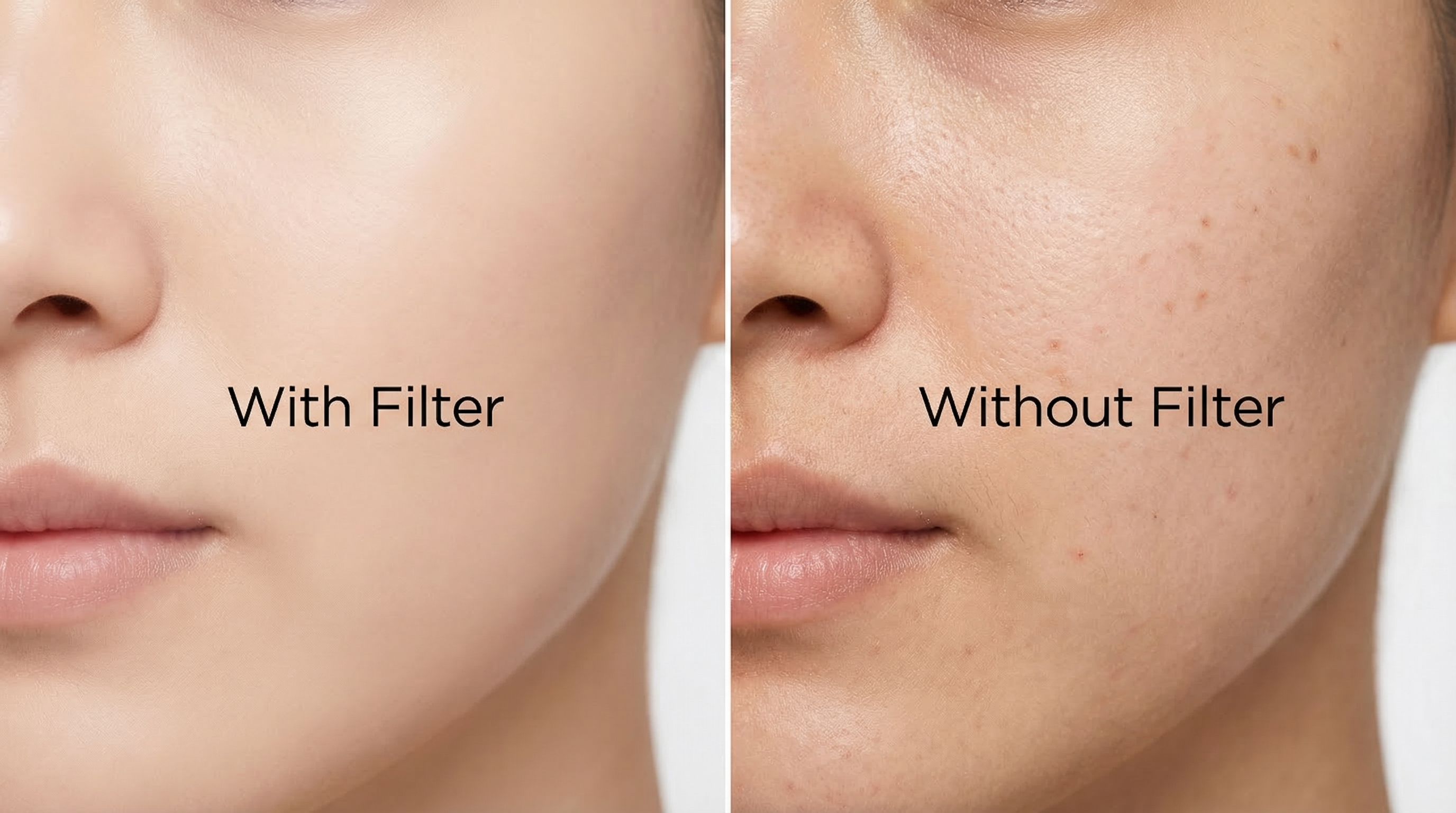
But knowing that intellectually and feeling it when you're deep in a scroll session at midnight? Those are two very different things.
How Social Media Affects Teens with Acne
The research on social media and teen mental health has gotten increasingly alarming over the past decade, and the data for teens with visible skin conditions is even worse.
A landmark 2017 report by the Royal Society for Public Health found that Instagram was the single most harmful social media platform for young people's mental health, particularly around body image and self-esteem. Teens who spent more than three hours a day on social media were significantly more likely to report mental health difficulties, including anxiety, depression, and poor body image.
For teens with acne specifically, the stakes are higher. A 2011 study published in the Journal of Investigative Dermatology found that adolescents with acne had significantly higher rates of mental health problems, social impairment, and even suicidal ideation compared to their clear-skinned peers. Social media didn't create these feelings — but it pours gasoline on them.
The Psychology: Why Your Brain Falls for It
In the 1950s, psychologist Leon Festinger developed social comparison theory — the idea that humans instinctively evaluate themselves by comparing to others. It's hardwired. You can't stop doing it any more than you can stop breathing.
Here's the problem: Festinger's research was about comparing yourself to real people in real life. Social media breaks that system completely. Instead of comparing yourself to the 30 or 40 people you'd naturally encounter in a day, you're now comparing yourself to hundreds or thousands of carefully curated, filtered, edited, and optimized images — many of which don't represent real human skin at all.
Research by Vogel and colleagues confirmed that exposure to idealized social media profiles consistently leads to lower self-evaluations, and the effect is strongest when people are looking at attributes they're already insecure about. If you have acne, and you're insecure about your skin, and every other image on your feed shows someone with impossibly smooth skin — the math isn't complicated.
Your brain doesn't add a footnote that says "this image has been filtered." It just files it under "what skin is supposed to look like" and quietly updates its expectations for your own face.
The Comparison Trap
Here's what makes acne particularly brutal in the social media age: you can't hide it.
Think about it. If you're insecure about your grades, nobody sees that on your face. If you're struggling with a family issue, you can keep it private. If you're self-conscious about your body, clothing choices give you some control.
But acne sits right there, on the most visible, most photographed, most scrutinized part of your body — your face. Every selfie, every video call, every time someone looks at you, it's there. And social media has turned daily life into a constant stream of face-focused content.
The Emotional Cycle
This is where it gets really insidious. Social media doesn't just make you feel bad about your acne — it can actually make your acne worse. Here's the cycle that dermatologists and psychologists see over and over:
- You scroll through social media and see flawless skin after flawless skin.
- You compare — sometimes consciously, sometimes without even realizing it.
- You feel bad — frustrated, sad, anxious, ashamed, angry at your own reflection.
- The stress response kicks in — cortisol rises, inflammation increases.
- You pick at your skin — sometimes as a stress response, sometimes trying to "fix" a blemish you noticed while comparing.
- Your acne gets worse — from the stress hormones, the picking, or both.
- You avoid posting or socializing — which leads to isolation, which leads to more scrolling.
- The cycle repeats.
This isn't weakness. It's a predictable psychological and physiological response to an environment your brain wasn't built for. Research published in PLOS ONE has shown that acne-related stigma directly predicts reduced quality of life, and social media is a stigma amplifier operating at unprecedented scale.

Skincare Misinformation Online
As if the comparison problem weren't enough, social media is also flooding teens with terrible skincare advice dressed up as expertise. TikTok in particular has become a hotbed of skincare misinformation, and it's genuinely causing harm.
The Worst Offenders
Dangerous DIY "remedies" that go viral:
- Lemon juice as a toner (can cause chemical burns and permanent hyperpigmentation)
- Baking soda scrubs (destroys your skin's acid mantle)
- Toothpaste on pimples (contains irritants like sodium lauryl sulfate that inflame skin)
- "Slugging" with Vaseline over active acne (can trap bacteria and worsen breakouts)
- Crushed aspirin masks (uncontrolled salicylic acid concentration that can cause irritation)
The product overload problem: TikTok's skincare culture has convinced teens that a 10-step routine with multiple actives is normal. It's not. Dermatologists consistently recommend that teenagers keep their routines simple — a gentle cleanser, a treatment product (like benzoyl peroxide or a retinoid prescribed by a doctor), and a moisturizer with sunscreen. That's it.
When a 16-year-old layers vitamin C serum, niacinamide, AHA/BHA exfoliant, retinol, and hyaluronic acid because TikTok told them to, the most likely outcome isn't "glass skin" — it's a destroyed moisture barrier and worse acne than they started with.
The "I cured my acne" narrative: Influencers love a transformation story. And some of them are genuine. But what they rarely mention is the dermatologist visits, the prescription medications, the professional treatments, the months of trial and error, and the fact that what worked for their skin may have zero relevance to yours. When someone says "this $45 serum cleared my skin," they're usually not telling you about the Spironolactone prescription they've been on for six months.
How to Spot Bad Skincare Advice
- If it promises fast, dramatic results — be skeptical. Real skin improvement takes weeks to months.
- If it comes from someone selling the product — that's an ad, not advice.
- If it involves putting food on your face — probably don't.
- If it contradicts what a dermatologist would say — trust the dermatologist.
- If the comments are full of people saying it burned or irritated their skin — believe them.
"Glass Skin" and Impossible Standards
Let's talk about "glass skin" for a second, because this trend captures everything wrong with social media skin culture in two words.
"Glass skin" refers to skin that's so smooth, clear, hydrated, and luminous that it looks like glass. It originated in Korean beauty culture and exploded on social media, becoming one of the most aspirational — and unattainable — beauty standards for teens worldwide.
Here's what the glass skin trend doesn't tell you:
- The photos use filters. Always. Even the "tutorial" videos showing you how to achieve it.
- Professional lighting is doing 80% of the work in most glass skin content.
- Many of the influencers promoting it have had professional treatments — microneedling, chemical peels, laser treatments, prescription retinoids — that they don't mention.
- Skin doesn't actually look like glass. Healthy, well-cared-for skin has texture. It has visible pores. It reflects light unevenly. It might have the occasional blemish. That's what real human skin looks like up close, and it's completely normal.
The "skin goals" culture creates a moving target that nobody can actually hit. You clear one breakout, and suddenly the standard is "poreless." You manage poreless in one photo, and now you need "dewy." The goalposts never stop moving because the standard is fictional.

Curating a Healthier Feed
Alright, here's where we get practical. You're not going to quit social media — and nobody's asking you to. But you can change what social media shows you, and that change has a measurable impact on how you feel.
Unfollow and Mute Strategically
You don't have to make a dramatic announcement about it. Just start quietly unfollowing or muting accounts that consistently make you feel worse about your skin:
- "Perfect skin" influencers who never show texture, pores, or breakouts
- Before-and-after accounts that make you feel like you need a transformation
- Skincare accounts that push expensive, complicated routines
- Anyone who makes you feel bad when their content shows up in your feed — you don't need a "good reason" to unfollow someone
Follow Acne-Positive and Real Skin Accounts
This one actually works. Research on social media and body image has found that exposure to realistic, diverse content can counteract the negative effects of idealized imagery. Seek out accounts that:
- Show unfiltered, unedited skin — including breakouts, texture, redness, and scarring
- Talk honestly about their acne journey, including setbacks
- Feature diverse skin types, tones, and conditions
- Post skincare content grounded in dermatological evidence rather than trends
- Show that people with acne live full, confident, social lives
When your feed normalizes real skin, your brain starts to recalibrate. It won't happen overnight, but over weeks and months, what you see shapes what you consider "normal" — and you can use that to your advantage.
Train the Algorithm
Social media algorithms learn from your behavior. Every time you pause on an image, like it, comment on it, or share it, the algorithm shows you more content like that. Use this intentionally:
- Linger on real skin content, acne-positive posts, and body-neutral messaging
- Scroll past quickly the heavily filtered, idealized content
- Use the "Not Interested" feature on TikTok and Instagram Reels for content that triggers comparison
- Search for and engage with hashtags like #realskin, #acnepositivity, #skinpositivity, and #normalizerealskin
Within a week or two, your algorithm will shift noticeably.
Social Media Breaks
Here's a strategy that research actually supports: take intentional breaks from social media, especially during flare-ups.
A study from the University of Pennsylvania found that limiting social media use to 30 minutes per day for three weeks led to significant reductions in loneliness and depression. Participants also reported reduced anxiety and FOMO (fear of missing out) — which, notably, got better after the initial adjustment period, not worse.
Why Breaks During Flare-Ups Matter
When your acne is flaring, your skin sensitivity and your emotional sensitivity spike at the same time. You're more aware of your skin, more self-conscious, and more vulnerable to comparison. That's exactly when social media does the most damage.
Taking a break during a flare-up isn't giving up or hiding. It's strategic self-care — the same way you'd rest a sprained ankle instead of running on it.
How to Actually Do It
- Delete apps from your home screen (not your phone — just your home screen). The extra friction of finding and re-opening them is often enough to break the autopilot scroll.
- Set screen time limits using your phone's built-in tools. Even a limit of one hour can help.
- Replace the habit, don't just remove it. If you normally scroll before bed, put a book or a podcast in that slot instead.
- Tell a friend. "Hey, I'm taking a break from Instagram for a few days" makes it feel real and gives you accountability.
- Start small. Try 24 hours. Then 48. You'll probably notice you feel better by day two.
Nobody is saying you need to go full digital detox and live off the grid. But giving yourself permission to step back when things feel heavy? That's not weakness. That's intelligence.
The Acne Positivity Movement
Something genuinely good has come out of the relationship between acne and social media: the acne positivity movement.
Over the past few years, a growing community of people — many of them teens and young adults — has started pushing back against filter culture by posting raw, unedited photos of their skin. Breakouts, scars, redness, texture — all of it, visible and unapologetic.
This movement matters because representation changes perception. When you see hundreds of people living their lives, going to events, creating content, and being visibly confident with acne, it chips away at the lie that clear skin is a prerequisite for living fully.
Some important things this movement gets right:
- Acne doesn't need to be "fixed" before you deserve to be seen. You're allowed to exist in public, take photos, and post them while you have breakouts.
- Seeking treatment and accepting your skin aren't mutually exclusive. You can work with a dermatologist on your acne AND refuse to feel ashamed of it in the meantime.
- Vulnerability is powerful. The accounts that get the biggest response are usually the ones that are honest about how acne makes them feel — not just the triumphant "I love my skin" posts, but the real, complicated, sometimes-painful truth.
Real Skin Content Worth Following
While we won't name specific accounts here (they change and evolve over time), look for creators who:
- Regularly show their skin without filters, even on bad skin days
- Talk about the emotional side of acne, not just the products
- Don't try to sell you a miracle cure
- Engage authentically with their community
- Show that acne is a normal part of life, not a crisis to be solved before you can start living
When It's More Than Just Feeling Bad
There's a line between "social media makes me feel crappy about my skin sometimes" and something more serious — and it's important to know where that line is.
Talk to a parent, school counselor, or therapist if:
- You're avoiding school, social events, or leaving your house because of how your skin looks
- You spend hours comparing your skin to others online and can't stop
- You're picking at your skin compulsively, causing wounds or scars
- You feel persistent sadness, hopelessness, or worthlessness connected to your appearance
- You've had thoughts about self-harm related to your skin or appearance
- You've started skipping activities you used to enjoy because you're ashamed of your acne
- You're spending money you don't have on products because social media convinced you they'd work
These aren't signs of being vain or oversensitive. Acne has a well-documented connection to anxiety, depression, and social withdrawal, and social media can intensify all of those. Asking for help is the smart move, not the weak one.
Tip for parents: If your teen is spending increasing time alone, avoiding social situations they used to enjoy, or seems preoccupied with their skin, don't brush it off as vanity. The psychological impact of acne in the social media age is real, measurable, and sometimes severe. Ask open-ended questions ("How are you feeling about things lately?") rather than appearance-focused ones ("Is your skin bothering you?"). And if your teen asks to see a dermatologist, take the request seriously — it might be about much more than just pimples.
Practical Reality Checks
When you're deep in a scroll and starting to spiral, try running through these reminders. They won't fix everything, but they can interrupt the comparison loop long enough for your rational brain to catch up:
- "This image has been edited." Assume it always has been. Because it almost certainly has.
- "I'm comparing my worst angle to their best angle." You see your skin in harsh bathroom lighting at 7 a.m. They posted a photo taken with a ring light and three filters at golden hour.
- "This person also gets breakouts." They do. Everyone does. You just don't see it because they don't post those days — or they edit them out.
- "Social media is a highlight reel, not a documentary." People post their best moments and best angles. The everyday reality looks nothing like the feed.
- "My worth isn't my skin." This one sounds cheesy. It is cheesy. It's also true. The people who matter to you don't care about your breakouts nearly as much as you think they do.
Bottom Line
Social media isn't going anywhere, and neither is acne (at least not overnight). The collision of filter culture, comparison algorithms, and a skin condition that sits right on your face creates a genuinely difficult reality for teens — and pretending it doesn't is unhelpful.
But you have more control than you think. You can reshape your feed. You can take breaks. You can follow people who show real skin. You can learn to spot the editing and the misinformation. You can talk to someone when it gets heavy. None of these things require you to quit social media or pretend you don't care about your skin. They just require you to be honest about what's actually happening on your screen — and intentional about how you respond to it.
Your skin is going through something. That's normal. It doesn't define you, it doesn't determine your future, and it definitely doesn't look as bad as you think it does after an hour of scrolling through filtered faces.
Put the phone down for tonight. Your skin — and your brain — will thank you in the morning.
How we reviewed this article:
Our experts continually monitor the health and wellness space, and we update our articles when new information becomes available.
- Fardouly J, Vartanian LR. (2016). Social media and body image concerns. Current Opinion in Psychology.https://pubmed.ncbi.nlm.nih.gov/26890975/
- Tiggemann M, Slater A. (2013). NetGirls: The Internet, Facebook, and body image concern in adolescent girls. International Journal of Eating Disorders.https://pubmed.ncbi.nlm.nih.gov/23847134/
- Halvorsen JA, et al. (2011). Suicidal ideation, mental health problems, and social impairment in adolescents with acne. Journal of Investigative Dermatology.https://pubmed.ncbi.nlm.nih.gov/20944653/
- Royal Society for Public Health. (2017). #StatusOfMind: Social media and young people's mental health.https://www.rsph.org.uk/our-work/campaigns/status-of-mind.html
- Twenge JM, Martin GN, Campbell WK. (2018). Decreases in psychological well-being among American adolescents. Emotion.https://pubmed.ncbi.nlm.nih.gov/29355336/
- Vogel EA, et al. (2014). Social comparison, social media, and self-esteem. Psychology of Popular Media Culture.https://doi.org/10.1037/ppm0000047
- American Psychological Association. (2023). Health advisory on social media use in adolescence.https://www.apa.org/topics/social-media-internet/health-advisory-adolescent-social-media-use
- Magin P, et al. (2006). The psychological and social effects of acne. Dermatologic Clinics.https://pubmed.ncbi.nlm.nih.gov/16677965/
- Davern J, O'Donnell AT. (2018). Stigma predicts health-related quality of life impairment in acne sufferers. PLOS ONE.https://pubmed.ncbi.nlm.nih.gov/30403714/
- Hunt MG, et al. (2018). No more FOMO: Limiting social media decreases loneliness and depression. Journal of Social and Clinical Psychology.https://doi.org/10.1521/jscp.2018.37.10.751
Read This Next
When Your Sibling Has Clear Skin and You Don't: Dealing with Acne Jealousy
Watching your sibling eat the same food, skip skincare, and have perfect skin while you break out constantly is one of the most frustrating parts of having acne.
Read More →
Does Sunlight Help or Hurt Acne? The Complicated Truth
Sun might temporarily mask acne, but it makes things worse long-term. Here's why the vacation skin effect isn't what you think and why UV isn't an acne treatment.
Read More →
Instagram Filters and Acne: How Social Media Distorts Skin Reality
Filters blur texture, erase pores, and create a version of skin that doesn't exist in real life. Here's how that messes with your head when you have acne.
Read More →
Honey for Acne: Does This Kitchen Ingredient Actually Work?
Manuka honey has real antibacterial research behind it. Regular honey, not so much. Here's what works, what doesn't, and whether it's worth the sticky mess.
Read More →
Green Tea and Acne: The Drink (and Ingredient) That Might Help
EGCG in green tea has anti-inflammatory and anti-androgenic properties that could help acne-prone skin. Here's what the research says about drinking it and putting it on your face.
Read More →